August 23 / 24, 2010
http://counterpunch.org/mcclintock08232010.html
A CounterPunch Special Report
By ANNE McCLINTOCK
Three vanishing acts are being played out in the Gulf: the disappearing of the oil from the ocean surface by Corexit, the disappearing of the story by the media blockade, and the disappearing from view of the shadowy private contractors who are making a mint helping BP and the Coast Guard keep a cover on the clean-up. This triple vanishing trick, collectively choreographed by BP and sundry federal agencies, culminated on August 4th in a report released by NOAA that claimed 75% of the oil spill had been captured, burned, evaporated or broken down. The White House hailed the report as something to celebrate. Energy advisor Carol Browne announced: “the vast majority of the oil is gone.”
A clamor of outrage immediately rose from the Gulf, as residents refused to dance the crisis-is-over, happy-feet dance. Hundreds of locals furiously insisted that they were still seeing masses of oil on ocean, beaches and marshes, and dead fish, dolphins, sharks, birds and other marine life washing ashore. Then on August 18th scientists from the Universities of Georgia and South Florida produced an open challenge to the White House report, asserting that 70% to 79% of the oil in the Gulf still remained in the water. Charles Hopkinson, a professor of marine science at the University of Georgia declared: “The idea that 75% of the oil is gone and of no concern to the environment is just absolutely incorrect.”
Spike Lee, filming in the Gulf, scoffed at what he called the BP/White House “abracabra kawabanga” trick and called on journalists to stay with the story. A few weeks earlier, the triple vanishing act had come together personally for me in a story that Steve, a private contractor, told in the shadows of a southern Louisiana bar. I call the contractor Steve, though that is not his real name. I cannot tell you his real name because he has assured me that he will kill me if I do. I had been in the Gulf for three days with Karin Hayes, a film-maker, documenting the oil-spill when Steve approached us in the bar, urgently wanting to tell us something.
“It’s as if a nuclear apocalypse has gone off in the Gulf,” he said. “The media is not telling the truth. No one is telling the truth. Let me tell you something. Yesterday on the beach where we work, my crew cleaned up seven hundred bags of oil. Today we went back and the beach was completely covered in oil, as if we had never been there. Today we carried away another seven hundred and fifty bags. Every day we clean up, then the tide brings it in again. The oil is everywhere, deep under the sand. Today I wanted to measure the oil, so I stuck my shovel into the sand and the oil was down there eight inches deep.”
Steve leaned in close, “Do you want to know how long my contract is to work down here?” he asked. “Three years.” His jaw muscles tightened as if he wanted to suck his words back into his mouth, but could not. “They are telling everyone it is not so bad, but clean-up will take many years. I am going to be here a long time.” Steve wiped a hand heavily over his eyes as if they were burning. “Let me tell you something. Today we saw three sharks washed up dead on the beach. The insides of their noses were black with oil. The membranes of their mouths were black with oil. Their eyes were black with oil.”
Steve is a war veteran who has seen a great deal of horror, but he seems to find this memory inordinately upsetting. “I am telling you this for the sake of our grandchildren,” he said. “We have an apocalypse going on and no one is paying enough attention.”
The CTEH Cover Up
A few days later, Steve and I were talking in the chemical-laced dusk of a car park. The Louisiana night was a strange brew of oily vapors and ginger blossom. Steve was slumped against his car, exhausted by his fifteen-hour day. The red tip of his cigarette burned on-off in the dark like a warning signal. As we talked, the nightly, muffled thrup-thrup of distant helicopters began. A number of people had told me about these strange, night flights, as helicopters and planes headed out on mysterious missions. I asked Steve where they were going.
“They are looking for oil,” he said. “The helicopters go out first at dusk. When they spot oil, they radio the gps locations back to the Coast Guard. Then between one and three in the morning, the planes go out and spray the oil with dispersants.”
“Why do they go out at night?” I ask. “They are hiding the oil with dispersants, Steve said. “They don’t want people to know how much oil there is out there. And they don’t want people to know how much dispersants they are spraying. It’s one of the big secrets down here.”
As it happens, Steve knows a good deal about dispersants. Before coming to work on the oil spill, he worked as a contractor for Halliburton; he now works in the Gulf for a company dealing with environmental toxicity and health hazards. It took a couple of hours talking and half a bottle of Southern Comfort before Steve revealed the name of his company. “I work for CTEH,” he said. Then he dragged his hand hard over his eyes. “I can’t believe I just told you that,” he said, but it was clear he wanted to.
Founded in 1997 in Arkansas, CTEH (Center for Toxicology and Environmental Health) specializes in toxicology and risk assessment. According to its website, CTEH “specializes in the specific expertise of toxicology, risk assessment, industrial hygiene, occupational health, and response to emergencies or other events involving release or threat of release of chemicals.” As it happens, CTEH is the company down in the Gulf that is quietly monitoring the levels of chemical toxicity of the oil-spill and its possible impact on the health of offshore workers involved in the clean-up.
CTEH is part of the Joint Unified Command based in Houma, Louisiana, where BP shares its office with the Coast Guard. The CTEH website is frank: CTEH is “proud” of its role in the Unified Command response. The website is less frank, however, about one stunningly important omission. CTEH is being paid by BP.
CTEH, in other word, is monitoring the possible toxic effects on workers of the chemicals BP has unleashed, and it is doing this at BP’s expense. In short, CTEH is being paid by BP to check up on BP. This is a conflict of interest so flagrant it is like a murder suspect hiring the forensic experts who will examine the murder scene.
CTEH has, to boot, an impressively consistent record of unsavory conflict of interest cases, where they have ruled favorably every time on behalf of their corporate clients. CTEH was hired by a coal company after it unleashed a massive coal-ash spill in the Tennessee Valley. CTEH declared everything hunky-dory. CTEH was hired by a paper mill sued by an employee for asbestos exposure. CTEH blamed the employee’s health problems on his lifestyle. Murphy Oil Refinery hired CTEH after spilling one million gallons into a community in St Bernard’s parish, LA. CTEH found nothing there for anyone to worry about.
Now, down in the Gulf, BP is paying CTEH to monitor the toxic levels of the air and water. As Nicholas Cheremisinoff, a former Exxon chemical engineer and expert on pollution prevention says, this means there is “a huge incentive for them to under-report.”
This also means that if anyone sues BP for health problems caused by toxic exposure to oil or chemicals, CTEH will be the expert witness called in on BP’s behalf. Indeed, two Gulf Coast residents, Glynis Wright and Janille Turner, are now filing a class action suit against BP in Alabama, for alleged health problems caused by clean-up chemicals, claiming that Corexit is four times more toxic than the crude oil. Cheremisinoff has said he is “100 per cent certain” CTEH will be called in as expert witness for BP.
Not surprisingly, down in the Gulf CTEH is flying very low under the radar. According to a report filed by the Louisian Bucket Brigade, at a community meeting in New Orleans, CTEH was present, but without any insignia or identifying credentials, repeatedly reassuring residents that the area was safe and that heat was the main hazard facing workers. When the LBB reporter asked the EPA rep why they were working for CTEH, the rep responded: “CTEH?…don’t know them.” When the reporter pulled out a copy of the CTEH website, the EPA rep backtracked: “Oh, yeah, we look at their data.” Asked if that didn’t amount to a conflict of interest, the rep admitted, “Yeah, that is a danger.” Shortly afterwards, he backtracked again: “No, we don’t really do anything with them. Who are they again?”
This crazy, conflict-of-interest carousel–where BP pays CTEH, and the EPA relies on CTEH data to monitor BP–is so flagrant that Rep. Lois Capps (D-CA) has formally requested that President Obama relieve BP of responsibility for protecting the health of workers and local residents.
CTEH and the EPA underplay the hazards, but down in the Gulf people are getting sick. Some men working on the oil spill have become ill and some hospitalized, though we don’t know the full extent because sick workers are contracted by BP not to talk to the media. BP could well stand, not for Beyond Petroleum, but for Beyond Principle. In a particularly nefarious act of cost-cutting and labor control, BP has hired prison inmates to do the clean-up, refusing to let them wear respirators, as this makes it visible that conditions are hazardous. Nor can they carry cell-phones lest they document the damage. Forced labor: slavery déjà vu. And there’s an extra perk for BP. Private companies like BP who use people on work-release get tax rebates of $2,400 for every worker they employ.
I heard many stories of people getting sick. I talked to the wife of a Vietnamese fisherman: “My husband has had chest problems ever since he went to work for BP,” she told me. “A lot of people are getting sick. And when the south wind blows, my asthma gets bad,” she said. In an internet café, I overheard a young man talking loudly into his cell about a blistering rash on his chest. “The doctor thinks it’s over-exposure to the chemicals,” he said.
The Corexit Cover-up
You have to hand it to them: BP’s image makers do a heck of a job looking on the bright side of life. Consider the multi-million dollar ads they regularly place in the New York Times (any one of which would go a long way towards putting an out-of-work fisherman on his feet). Not a drop of oil to be seen from sea to shining sea. Even the skimmers seem to be skimming up stardust. The beach are pristine. Not a dollop of oil to be seen. As Marci, a private contractor with an energy company, sardonically said to me one evening: “Clean. Clean as a baby’s butt clean. You know why? Dispersants.” Marci asked me: “Why do you think the oil stopped fifteen miles from the Florida coast? All along the Gulf, there is a fifteen-mile wide line where the oil stopped. How did it stop at that magical line?” She told me the same story others had told: “At night they go out with planes and spray it with dispersants. So the beaches look clean. But the oil is still there. Wait until the fall,” she said, “Wait until the weather cools, and the Mississippi drops. Then the oil will rise to the surface. Then the oil will come back.”
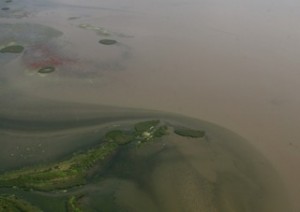
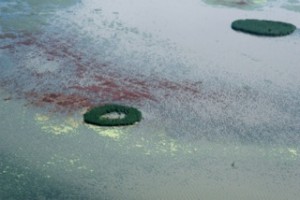
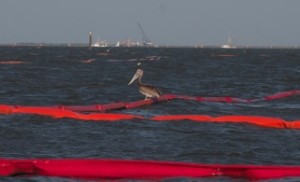
Marci was bristling with suppressed anger. ““You have to understand the tides,” she said. “Why do you think the oil is inside the booms, not outside them? It’s because of the dispersants. The dispersants sink the oil under the water. It looks like the oil is gone. But then the tides go in, taking the oil with them, and the oil goes in under the booms. Then the water cools, the oil rises, the tide goes out, and the oil is caught on the inside of the boom. Close to the marshes, close to the birds.” Travelling round Barataria Bay by boat and air, I have seen this for myself and have photos to show for it: islands surrounded by boom, with the oil trapped on the inside.
From the beginning, the use of dispersants has been clouded with controversy and cover-ups. The cutely named Corexit is made by the American company Nalco, and is famously banned in the UK and Europe on the grounds of its lethal toxicity. In April, shortly after the Deep Horizon blowout, Lisa Jackson of the EPA ruled that Corexit should only be used in “extremely rare” cases. Down in Louisiana, for decades there’s been a tightly-knit culture of mutual cronyism where local politicians and oilmen have their hands deep in each others pockets. On August 1st, the US House of Representatives Committee confirmed that for over three months, in violation of EPA’s official guidelines, the US Coast Guard had fast-tracked 74 permits giving BP the green light to “carpet-bomb” the Gulf. All told, at least 2 million gallons have been dumped into the Gulf, sprayed over the seas, islands and marshes.
The main ingredient in Corexit is 2-Butoxyethenol, which is toxic to blood, kidneys, liver and the central nervous system, also causing cancer, birth defects. Corexit is mutagenic for bacteria, huge amounts of which live in the Gulf of Mexico. Corexit ruptures red blood cells and accumulates as it moves up the food chain. The EPA, reluctant at first to release data, eventually conceded that Corexit is lethal for 50% of any group of test animals that comes in contact with it. Even the Department of Transportation classifies Corexit as Class 6.1: Poisonous Material” for transportation purposes.
The risks of Corexit to humans, the fragile marsh ecosystems and marine life are potentially staggering. Riki Ott, a marine toxicologist and tireless community activist, has testified meeting people all over the Gulf who are showing symptoms: “headaches, dizziness, sorethroats, burning eyes, rashes and blisters that go so deep, they are leaving scars.”
Dispersants have never been used in such quantities before, or at such depths in the ocean, or on open marshland. Dispersants are so dangerous because they accumulate up the food chain. Fiddler crabs absorb the toxins in their muscles and are then eaten by birds. Coyotes and feral pigs eat the bird corpses. Pelicans absorb the toxins from fish and even lightly oiled pelicans ingest the oil through their constant preening. Larger marine life like tuna, dolphins and whales carry the greatest lethal loads. Stories have been told by fishermen finding vast, floating graveyards of birds, dolphins and whale corpses near the Macondo well site, which, they say, are secretly disposed of at night.
Oil on the surface is easier to see, easier to retrieve, easier to burn. One study shows that oil mixed with Corexit is 11 times as lethal as the oil alone.
So why use such lethal toxins in the first place?
Dispersants are called dispersants because that’s what they do. They disperse the oil; they don’t destroy it. Dispersants sink the oil below the surface, make it harder to see, and therefore harder to sue BP for liability. On August 20th scientists produced new evidence of vast undersea plumes of oil drifting for miles. This week, another team of scientists in the journal Science confirmed the discovery of a massive 22 mile subsea oil plume the size of Manhattan and, most dismayingly, very little evidence that the oil was being broken down by microbes.
Chris Pinetich, a marine biologist and campaigner with the Sea Turtle Restoration Project, confirmed what Steve and others had told me: that Coast Guard planes were flying out at night spraying Corexit on the water and land. “People need to realize that their water, their air, the sand they are walking on, they things they are touching when they wake in the morning are coated with this stuff,” he said. “We are producing an experiment in the Gulf the likes of which no one has ever seen. Top scientists admit that. We are all part of the experiment.”
Death by dispersants is slow and invisible. Death by dispersants wreaks its havoc over generations. Dispersants are what Rob Nixon has called “slow violence.” We often think of violence as immediate and spectacular, bounded by space and time. Nixon recalls us to violence of a different kind: the “attritional devastation” that takes place gradually over time and space. Slow violence may be less visible, less media-sensational but enacts a toll no less lethal and lasting for being slow and out of sight.
Corexit is a form of slow violence: a conjurer’s trick, an alchemy of deceit, a sorcerer’s bargain with life and death.
And down in Barataria Bay, people cough the BP cough. Workers have rashes and burning eyes. Their ears get infected; their hands get blisters. When the southwind blows, lungs tighten and close. Some fishermen vomit, some struggle to breathe. Some get dizzy, some get diarhorrea. Some have ashthma, some fast-beating hearts. Their chests burn fire; their throats are sore. And their children cough the BP cough.
Slow Violence in the Gulf
Dispersants are not the only form of slow violence wreaked on the Gulf. The Deepwater Horizon blowout was by any standard spectacular violence: a volcanic crimson and grey apocalypse, an ocean in flames, a doomed, industrial colossus slowly pitching and sinking, taking with it nine men dead. But everyone I spoke to in the Gulf, echoed the same refrain: the Deepwater blowout was only the most recent, fast-forward, telegenic calamity on top of the permanent slow-motion catastrophe in the Gulf.
The slow violence of the oil spill comes on top of decades of slo-mo slaughter of the Gulf’s marshes and ocean waters by three forces: industrial dumping, chemical contamination and agricultural run-off; the forced engineering of the marshes by dredging and levees; and the tearing up of the vulnerable marshes by storms and hurricanes.
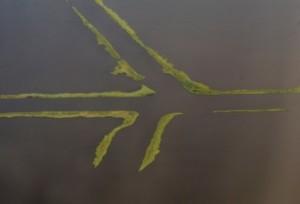
On July 18th, Karin and I flew in a Coast Guard plane to the Mocondo site. Two days before, BP partially capped the well. But flying over the five great passes where the Mississippi empties into the sea, I could still see great streaks of rust-red oil along the islands, and long white ribbons of dispersants in the foam-line of the currents. I already knew that beneath the Mocondo “ground zero” site lay a vast zone that had been dead for years, dead long before the Deepwater explosion: the Gulf “dead zone,” a stretch of water utterly inhospitable to life as vast as Lake Ontario.
The Gulf is one of the richest and most diverse eco-systems in the hemisphere, our largest wetlands and 40% of our fishing grounds. But since the 1950s, decades of greed and deregulation have turned the Gulf into the United States’ largest industrial wasteland. The Gulf is an immense, watery mausoleum to the hedonistic high-times of the military-industrial petro-era. If a gigantic hand emptied the Gulf like a basin of water, we would see a drowned version of industrial New Jersey: seeping oil-rigs, dumped military ordinance, unexploded bombs, thousands of miles of pipelines, a giant watery wrecking-yard, cluttered with the debris of a century of industrial waste. Miles from anywhere, the spires of an oil rig rise from the marshes, like a church to a demonic god.
Ninety per cent of all drilling for oil and gas in the United States takes place in the Gulf. This statistic hit home for me only when I opened a Hook ‘n Line fishing map. On the map, the Gulf’s waters are marked with thousands of small, red blocks so thickly clustered the map looks like a map with the measles, a map of malady. Each red square marks one of the 4,000 platforms littering the Gulf, many of them abandoned and many leaking.
The Gulf also bears the brunt of agricultural pollution from the heartland: runoff and waste from Midwest cornfields, sewage plants, golf courses, factories, nitrogen from fertilizer drain down the Mississippi into the Gulf every year. And through these damaged and vanishing marshes, massive watery superhighways have been cut, canals and passageways for the barges and huge ships on their way to the Gulf. Every straight line in the marshes is man made and a road to destruction. Every straight line has been forcibly dredged for flood control and shipping, the river and marshes forcibly reengineered by levees and canals to stop flooding, thereby fatally closing off the silt and fresh water that the marshes needs to sustain themselves, and rendering them vulnerable to the yearly slow violence of the hurricanes.
For many people I spoke to, the violence of Katrina was as great as the violence of the oil spill. Southern Louisiana is a half-drowned, shape-shifting, upside-down world, where boats float out of the treetops, and houses tilt out of the water. Everywhere we went, people still lived among the debris of Katrina. Boats flung by Katrina left to rot on the grassy verge of roads, half-wrecked houses, trees stripped bare and leaning arthritic against the evening sky.
Every day, Karin and I would drive past the huge coal and oil refineries, the Port Sulphur toxic dump, rotting boats, sunken cars, abandoned roads lined with methane barrels. Down near Venice, we found a toxic lake so rank with chemicals we can barely breathe. Not for nothing is the Deep Delta where we travelled every day, called “cancer alley,” with highest rates of cancer in the US.
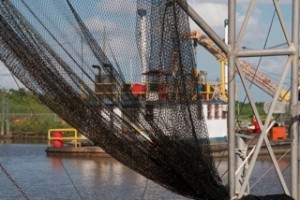
One evening, Karin and I pulled into an unprepossessing marina near a town called Empire, driving carefully past the sleeping BP security guard. A few oyster-boats were festooned with yellow boom, but the rest of the marina wore a forlorn and dilapidated air. From every boat, the useless fishing nets hung like shrouds, dark relics of better times. One man moved slowly about his small houseboat. We got talking and Lloyd Boudreau invited me into his houseboat and unrolled a huge photo of the disaster Katrina had wrought: the picture of his life turned upside down by Katrina. Stubbing fingers blackened by a life on the oil rigs, he pointed to his houseboat, upturned like a toy. Katrina is the ghost he lives with, as if he has no room in his heart to begin to think about the oil spill.
Battered by the accumulated slow violence of decades of corporate greed and mismanagement, dredging, levees, and hurricanes, the Louisiana delta is vanishing before our eyes, slipping into the sea at the rate of one football field every half hour. Since the 1930s, land the size of Delaware has vanished under water.
From Blowout to Blowback
Then BP partially capped the well and the media began to cap the story. NOAA issued its report on August 5th with some implausibly neat arithmetic, declaring 75% of the oil gone. I speak to Steve on the phone. “All the media has left,” he says. “But the oil hasn’t.”
Then blowback starts. Saying 75% of the oil is “gone” sounds cheering (less cheering, of course, if one remembers that 25% of the Deepwater spill is still four times as much as the total Exxon Valdez spill), but down in the Gulf, no one is buying even the 75%-gone story.
“The oil has not gone,” Tony, an out-of-work shrimp fisherman told me, “It’s just below the surface.” “They’re just covering their butts,” says woman at a gas-station. “They want everyone to think it’s over,” Charlotte Randolph, Lafourche Parish president said of the NOAA report: “This week in Lafourche parish we had hundreds of barrels a day washing in.
I call PJ Hahn, Director of Coast Zone Management in Plaquemines Parish. “I know there is plenty of oil out there,” Hahn insisted. “They say they have captured 75%, but they don’t even know how much there was to begin with. Figures lie, and liars figure,” he says.
“From the very beginning,” PJ told me, “the Coast Guard went to bed with BP. There was no oversight. They tried to cover for themselves. Now they’re trying to declare a quick ending. If they can get the President to convince everyone that it is over, then that reduces BP’s liability. There are two things working right now: there’s an election coming up and we have a President dying in the polls. They want to tell everyone it’s all ok. Now,” PJ says, “the media has left. They want to kill the story.”
“Last weekend, he continued, “we got stuck on a sandbar. When we gunned the engines, there was nothing but oil behind the boat. Then we dove with the Cousteau group again and there was plenty of oil on the bottom of the ground. The sand just covers it up. On Sunday night, we stopped at a barrier island, and as we were walking back to the boat, black oil spurted out of the hermit-crab holes. We pushed a stick down into the ground, and when we pulled the stick out, the oil began bubbling up. Fresh oil, not weathered oil. Wait till the shrimp boats start going out again. When those trawlers hit bottom, that’s when we will see a lot of things.”
A New Orleans radio poll showed 80% of respondents did not believe the NOAA report. Others offered similar testimony. Steve told me he saw a huge slick about five miles long and one mile wide on his way to work. Bob Marshall, writing for the New Orleans Times-Picayune reported seeing a great deal of oil at South Pass. Fishermen reported oil both inside Barataria Bay and out near the great Mississippi Passes and barrier islands. Riki Ott, flew out over Barataria Bay and afterwards wrote: “Bay Jimmy on the northeast side of Barataria Bay was full of oil. So was Bay Baptiste, Lake Grande Ecaille, and Billet Bay….We followed thick streamers of black oil and ribbons of rainbow sheen….The ocean’s smooth surface glinted like molten lead in the late afternoon sun. Oil. As far as we could see: oil.”
On my last evening down in the delta, fishing guide Dave Iverson took me by boat through Barataria Bay to the pelican rookeries at Queen Bess and Cat Islands near Grand Isle. As we passed through the he hauntingly lovely, lacey-green filigree marshland, flocks of snowy egrets and ibis lifted gracefully into the air ahead of us, an explosion of white confetti, an exuberant celebration of life. But returning through the marshes in the twilight through the oil-damaged parts, I saw miles of tangled boom filthy with oil, and inside the boom the black marshes, blackened as if a fire from hell had roared through. And everywhere a great stillness. Not a bird to be seen. I thought of John Keats’s great line: “The sedge is wither’d from the lake and no birds sing.” I thought of Rachel Carson’s book Silent Spring that launched the modern environmental movement. Will this silence do the same?
On what abacus can we count the slowly dying, the invisibly hurt, the already poisoned but not yet dead? In this, our summer of magical counting. All summer we’ve been counting: numbers of gallons spilled, numbers of toxins released, numbers of birds dying, numbers of fishermen out of work. We are like children counting on our fingers in the dark, trying to ward off the shapeless face of something dreadful that has been unleashed and that we cannot fully understand.
And down in Barataria Bay, the crabs climb out of the burning water and hold their claws to the sky. The creels stand empty; the boats lie still. Nets hang like shrouds. And children cough the BP cough.
All photos by Anne McClintock, copyright 2010.
Anne McClintock is the Simone de Beauvoir Professor of English and Women’s and Gender Studies at UW-Madison. She is the author of Imperial Leather: Race, Gender and Sexuality in the Colonial Contest, which was republished online by the ACLS E-Humanities Book Project. McClintock has written short biographies of Olive Schreiner and Simone de Beauvoir and a monograph on madness, sexuality and colonialism called Double Crossings. She has co-edited Dangerous Liaisons with Ella Shohat and Aamir Mufti. She can be reached at: amcclintock@wisc.edu
Special thanks to Richard Charter
