Christian Science Monitor: Obama’s new offshore oil drilling rules: too many loopholes?

http://www.csmonitor.com/Environment/2010/0817/Obama-s-new-offshore-oil-drilling-rules-too-many-loopholes

Richard is right; requiring an EA instead of an EIS is a major concession to quick permitting for more offshore oil, potentially without much needed environmental controls in place. DV

The White House’s new guidelines for offshore oil drilling in deep water were intended to make it tougher for oil companies to avoid detailed environmental reviews.

By Mark Clayton, Staff Writer / August 17, 2010

The Obama administration’s new guidelines for offshore oil drilling, which are intended to require much more detailed environmental reviews for deep-water drilling, have upset not only the oil industry, but environmentalists, too.

The recommendations unveiled by the White House Council on Environmental Quality (CEQ) and the US Department of the Interior on Monday were touted as ratcheting back widespread uses of “categorical exclusions.”

That designation by the Interior’s Minerals Management Service (MMS) had exempted many deep-water drilling operations from detailed environmental review under the National Environmental Policy Act (NEPA).

In the wake of the BP oil spill in the Gulf of Mexico, environmental and other groups found that BP’s Macondo well that was gushing oil – as well as most other deep-water wells in the region – had been graced with a categorical exclusion.

“In light of the increasing levels of complexity and risk – and the consequent potential environmental impacts – associated with deep-water drilling, we are taking a fresh look at the NEPA process and the types of environmental reviews that should be required for offshore activity,” said Interior Secretary Ken Salazar in a statement.

While Congress wrangles over just how to tighten environmental requirements for offshore drilling, the Obama Administration says categorical exclusions will now be used far more sparingly. Steps the CEQ called for in its review include:

* Reviewing the use of categorical exclusions for outer continental shelf, or OCS, oil and gas exploration and development “in light of the increasing levels of complexity and risk – and the consequent potential environmental impacts – associated with deep-water drilling.”

* Comprehensive NEPA review of individual deep-water exploration activities, including site-specific information “where appropriate,” a loophole that angers some environmentalists.

* Amending the OCS Lands Act to eliminate the current 30-day timeframe for approving exploration plan – and modify NEPA practices to reflect new environmental findings since the BP oil spill.

“The recommendations in this report are targeted to ensure robust environmental reviews for future oil and gas exploration and development,” Nancy Sutley, CEQ chair, said in a statement.

But limiting use of categorical exclusions could create costly delays and curb job growth, the American Petroleum Institute (API), an industry lobby group says.

“We’re concerned the change could add significantly to the department’s workload, stretching the timeline for approval of important energy development projects with no clear return in environmental protection,” Erik Milito, upstream director for API, said in a statement. “Environmental review of offshore operations under existing rules is extensive, and decisions on categorical exclusions, which are intended to avoid repetitive analysis, require review.”

Many environmentalists, however, were only marginally less irked about the recommendations than the oil industry – arguing that there were too many loopholes that would still allow categorical exclusions.

Under a directive signed Monday by Michael Bromwich, the new director of the MMS’s successor agency, the Bureau of Ocean Energy Management, Enforcement and Regulation (BOEM) “shall narrow its use of categorical exclusions.”

In the very next paragraph, the requirement “not to use” such exclusions is spelled out for equipment typically used in deep-water drilling – including floating drill rigs. But the last sentence in the paragraph also appears to leave open the possibility of a return to relatively light – some argue superficial – environmental review after the current six-month moratorium on deepwater drilling expires.

“If and when the July 12 suspension is no longer in force, all plans submitted for approval that propose an activity that involves [deep-water drilling equipment] shall be subject to an environmental assessment.”

What that means, says Richard Charter, an offshore drilling specialist for the Defenders of Wildlife, is that a few months from now when the moratorium on deep-water drilling in the Gulf is over, the standard for deep-water environmental review could be just an “Environmental Assessment,” or EA.

Under NEPA, the EA is a cursory document of a few pages that could easily devolve into a rubber-stamping exercise, he says. What’s needed, he argues, is an “Environmental Impact Statement” – a very detailed review – for each deep-water well proposal.

On the plus side, he notes, BOEM is planning to conduct a supplemental environmental impact statement for the Gulf – a major evaluation that could do a lot of good, Charter says. Until then, however, the Bromwich memo paves the way for new activities in the Gulf to continue using categorical exclusions “if they are in shallow enough water and without certain risk factors,” he says.

“The Bromwich memo cuts both ways,” Mr. Charter says. “It does curb some excesses in the use of categorical exclusions.

“But this is also an interim step that will pave the way for Interior to declare that drilling can now proceed safely. We will just have to wait and see if that word ‘safely’ means anything or not,” he says.

The BOEM will soon begin a formal comprehensive review and evaluation of its use of categorical exclusions, the Interior Department reported. While that review is going on, those exclusions will be used much more sparingly, Bromwich said. After the review is complete, BOEM says it will unveil a new approach that incorporates CEQ recommendations.

Special thanks to Richard Charter

Yahoo news: Gulf oil spill: Giant underwater plume challenges optimism plus Live Science: Gulf Plume Resists Oil-Eating Microbes

http://wildsingaporenews.blogspot.com/2010/08/gulf-oil-spill-giant-underwater-plume.html

19 Aug 10;

WASHINGTON (AFP) – Experts said Thursday they have mapped a 35-kilometer (22 mile) long underwater plume of oil that spewed from BP’s ruptured Gulf of Mexico well, seeming to challenge US government assertions that most of the oil has disappeared.

The oily underwater cloud measured two kilometers wide and 200 meters (650 feet) thick and was drifting through the Gulf at a depth of at least 900 meters, according to the paper by Woods Hole Oceanographic Institution (WHOI) marine biologists, published in the journal Science.

The plume was seen as not dissipating as rapidly as experts had expected, despite widespread use of dispersants which the government has insisted have been vital to the breakdown of vast amounts of oil.

The observations were made in late June, several weeks before the ruptured wellhead was capped, and about two months after an explosion sank the BP-leased Deepwater Horizon rig, triggering the largest ever maritime oil spill.

Challenging US government estimates based on natural processes rapidly dissipating the toxic crude, the authors said deep-sea microbes were degrading the plume only slowly and predicted the oil would endure for some time.

“We’ve shown conclusively not only that a plume exists, but also defined its origin and near-field structure,” said lead author Richard Camilli.

The oil already “is persisting for longer periods than we would have expected,” he added.

“Many people speculated that the sub-surface oil droplets were being easily downgraded. Well, we didn’t find that. We found that it was still there.”

US and BP officials earlier this month proclaimed that about three-quarters of the oil which gushed into the Gulf had been cleaned up or dispersed through natural processes.

Around 4.9 million barrels of oil are believed to have spewed from the fractured wellhead before it was capped last month. US officials say that of that amount, 800,000 barrels were contained and funneled up to ships on the surface.

The leak not only threatened livelihoods of fishermen and tourism businesses along the US Gulf coast, but also stoked fears of long-term ecological damage.

On August 4, the US National Oceanic and Atmospheric Administration (NOAA) said the “vast majority” of oil had been evaporated, removed by cleanup teams or was dispersing naturally.

The remaining 26 percent — or about 1.3 million barrels of oil — was classified as “residual oil” and “is either on or just below the surface as residue and weathered tar balls, has washed ashore or been collected from the shore, or is buried in sand and sediments,” the report said.

The Woods Hole team used a robotic submarine equipped with an underwater mass spectrometer to detect and analyze the plume, making repeated horizontal sweeps to ascertain its size and chemical composition.

They followed the “neutrally buoyant” cloud as it migrated slowly, at 0.27 kilometers per hour, southwest of the leaking well.

The plume was then tracked for a distance of about 35 kilometers before the approach of Hurricane Alex forced the scientists to turn back.

The spectrometer found petroleum hydrocarbons at concentrations of more than 50 micrograms per liter, a level that meant the samples had no smell or oil and were clear. The impacts on biodiversity remain uncertain, though.

“The plume was not a river of Hershey’s Syrup,” said Christopher Reddy, a marine biochemist. “But that’s not to say it isn’t harmful for the environment.”

The damaged well was capped on July 15. Earlier this month BP engineers plugged the site with heavy drilling fluid and then sealed it with cement.

The company aims to permanently seal the well in the second week of September, a US official said on Thursday.

Major study charts long-lasting oil plume in Gulf
Seth Borenstein, Associated Press Yahoo News 20 Aug 10;

WASHINGTON – A 22-mile-long invisible mist of oil is meandering far below the surface of the Gulf of Mexico, where it will probably loiter for months or more, scientists reported Thursday in the first conclusive evidence of an underwater plume from the BP spill.

The most worrisome part is the slow pace at which the oil is breaking down in the cold, 40-degree water, making it a long-lasting but unseen threat to vulnerable marine life, experts said.

Earlier this month, top federal officials declared the oil in the spill was mostly “gone,” and it is gone in the sense you can’t see it. But the chemical ingredients of the oil persist more than a half-mile beneath the surface, researchers found.

And the oil is degrading at one-tenth the pace at which it breaks down at the surface. That means “the plumes could stick around for quite a while,” said study co-author Ben Van Mooy of the Woods Hole Oceanographic Institution in Massachusetts, which led the research published online in the journal Science.

Monty Graham, a scientist at the Dauphin Island Sea Lab in Alabama who was not involved in the study, said: “We absolutely should be concerned that this material is drifting around for who knows how long. They say months in the (research) paper, but more likely we’ll be able to track this stuff for years.”

Late Thursday, federal officials acknowledged the deepwater oil was not degrading as fast as they initially thought, but still was breaking down “relatively rapidly.” Jane Lubchenco, chief of the National Oceanic and Atmospheric Administration, said agency scientists and others were “working furiously” to come up with actual rates of biodegradation.

She noted a bright spot from the slow breakdown of the oil: Faster would mean a big influx of oil-eating microbes. Though they are useful, they also use up oxygen, creating “dead zones” that already plague the Gulf in the summer. Dead zones are not forming because of the oil plume, Lubchenco said.

The underwater oil was measured close to BP’s blown-out well, which is about 40 miles off the Louisiana coast. The plume started three miles from the well and extended more than 20 miles to the southwest. The oil droplets are odorless and too small to be seen by the human eye. If you swam through the plume, you wouldn’t notice it.

“The water samples when we were right in the plume look like spring water,” study chief author Richard Camilli said. “You certainly didn’t see any oil droplets and you certainly didn’t smell it.”

The scientists used complex instruments – including a special underwater mass spectrometer – to detect the chemical signature of the oil that spewed from the BP well after it ruptured April 20. The equipment was carried into the deep by submersible devices.

With more than 57,000 of these measurements, the scientists mapped a huge plume in late June when the well was still leaking. The components of oil were detected in a flow that measured more than a mile wide and more than 650 feet from top to bottom.

Federal officials said there are signs that the plume has started to break into smaller ones since the Woods Hole research cruise ended. But scientists said that wouldn’t lessen the overall harm from the oil.

The oil is at depths of 3,000 to 4,000 feet, far below the environment of the most popular Gulf fish like red snapper, tuna and mackerel. But it is not harmless. These depths are where small fish and crustaceans live. And one of the biggest migrations on Earth involves small fish that go from deep water to more shallow areas, taking nutrients from the ocean depths up to the large fish and mammals.

Those smaller creatures could be harmed by going through the oil, said Larry McKinney, director of Texas A&M University’s Gulf of Mexico research center in Corpus Christi.

Some aspects of that region are so little known that “we might lose species that we don’t know now exist,” said Graham of the Dauphin Island lab.

“This is a highly sensitive ecosystem,” agreed Steve Murawski, chief fisheries scientist for the federal agency NOAA. “The animals down at 3,300 to 3,400 feet grow slowly.” The oil not only has toxic components but could cause genetic problems even at low concentrations, he said.

Lubchenco said NOAA is “very concerned about the impact” of the oil below the surface and federal officials last week started more aggressive monitoring of it.

For much of the summer, the mere existence of underwater plumes of oil was the subject of a debate that at times pitted outside scientists against federal officials who downplayed the idea of plumes of trapped oil. Now federal officials say as much as 42 million gallons of oil may be lurking below the surface in amounts that are much smaller than the width of a human hair.

While federal officials prefer to describe the lurking oil as “an ephemeral cloud,” the Woods Hole scientists use the word “plume” repeatedly.

The study conclusively shows that a plume exists, that it came from the BP well and that it probably never got close to the surface of the Gulf of Mexico, Camilli said. It is probably even larger than 22 miles long, but scientists had to stop measuring because of Hurricane Alex.

Earlier this week a University of South Florida team reported oil in amounts that were toxic to critical plant plankton deep underwater, but the crude was not necessarily in plumes. Those findings have not been reviewed by other scientists or published.

The plume is probably still around, but moving west-southwest of the BP well site at about 4 miles a day, Camilli said.

While praising the study that ended on June 28, Murawski said more recent observations show that the cloud of oil has “broken apart into a bunch of very small features, some them much farther away.” Texas A&M’s McKinney said marine life can suffer harm whether it is several smaller plumes or one giant one.

NOAA redirected much of its sampling for underwater oil after consulting with Woods Hole researchers. The federal agency is now using the techniques that the team pioneered with a robotic sub and an underwater mass spectrometer, Murawski said.

Previous attempts to define the plume were “like watching the Super Bowl on a 12-inch black-and-white TV and we try to bring to the table a 36-inch HD TV,” said Woods Hole scientist Chris Reddy. The paper, fast-tracked for the world of peer-reviewed science, was written on a boat while still in the Gulf, he said.

Reddy said he could not yet explain why the underwater plume formed at that depth. But other experts point to three factors: cold water, the way the oil spewed from the broken well, and the use of massive amounts of dispersants to break up the oil before it gets to the surface.

The decision to use 1.8 million gallons of dispersants amounted to an environmental trade-off – it meant less oil tainting the surface, where there is noticeable and productive life, but the risk of longer-term problems down below.

Retired Coast Guard Adm. Thad Allen, the government’s point man on the Gulf oil spill, said it was a choice between two difficult options – with the discussions going on in front of the president. In the end, officials decided to “accept the implication of the hydrocarbons in the water column rather than Barataria Bay or the Chandeleur Islands” in Louisiana.

Given the slow rate at which the oil is degrading in the cold water, Samantha Joye of the University of Georgia, and others say it is too early to even think about closing the books on the spill: “The full environmental impacts of the spill will thus not be felt for some time.”

Gulf Plume Resists Oil-Eating Microbes
Jeremy Hsu livescience.com Yahoo News 20 Aug 10;

A massive oil plume from the Deepwater Horizon blowout may survive for longer than expected against the petroleum-eating microbes in the Gulf of Mexico, according to a new study.

Researchers took a “forensic snapshot” in late June that showed higher-than-expected oxygen levels in the plume from the oil well that began gushing in April. If microbes had swarmed into the area, their feeding frenzy should have reduced oxygen levels.

But the scientists said they have only just begun to analyze all the hydrocarbon molecules found in the oil plume, which typically serve as food for the microbes. They also cautioned that the study represented just one moment in time and space, and does not show what has happened to the plume since June.

“This was two weeks in June and a relatively small area in a very large body of water,” said Christopher Reddy, a marine geochemist at the Woods Hole Oceanographic Institute (WHOI) in Massachusetts, during a press conference on Thursday.

A monster of a plume

A research ship and its companion underwater robot tracked the oil plume out to at least 22 miles (35 kilometers) from the leaking oil well. Scientists aboard spent 10 days taking samples before the threat of Hurricane Alex forced them to break off.

“Unfortunately we were not able to track this out beyond 35 kilometers, although the data suggested that the plume extended for much farther than we tracked it,” said Richard Camilli, a chief WHOI scientist of applied ocean physics and engineering, and lead author on the study paper detailed in the Aug. 19 issue of the journal Science.

At the time, the plume stretched 1.2 miles (2 km) in width and reached 650 feet (198 meters) deep. The researchers found the plume was located more than 3,000 feet (914 m) below the surface of the Gulf of Mexico, holding stable at a depth of 1,100 (335 m) feet down.

Mass spectrometers aboard the robotic sub that were lowered from the ship allowed the team to begin fingerprinting the hydrocarbon molecules in the oil.

But the overall chemical analysis remains incomplete, and so the total amount of oil in the plume remains unknown. Questions about the possible hazards of the oil plume for marine life also remain up in the air.

“Without the complete picture of all the components of hydrocarbons, we can’t say much about its bioactivity or toxicity,” Camilli said.

The microbe buffet table

When the Deepwater Horizon rig first sank and unleashed an oil spill into the Gulf, experts had counted upon microbes to help break down the oil plumes. But the latest findings suggest that the microbes may feed slower than expected.

The plume also retained its massive size more than three months after the oil began gushing from the well.

Still, the results did not surprise David Valentine, a marine geochemist at the University of California, Santa Barbara who did not take part in the new study. He had participated in a separate expedition that found higher levels of microbial activity closer to the oil well.

Valentine pointed out that the new study has not yet analyzed many of the hydrocarbons in the oil plume. He added that the microbes might have quickly swarmed the leaking oil well area at first, but then slowed down in activity during the following months.

Furthermore, microbes probably break down certain hydrocarbons faster than others, Valentine said.

“I think we’ll find it’s a buffet [of hydrocarbons] down there,” Valentine told LiveScience. “The filet mignon may go quickly, but the taco bar will stay around for a while.”

The study’s researchers also gave their own warnings about drawing any premature conclusions.

“Microbes are a lot like teenagers,” Reddy said. “They work on their own time, their own scale, they do what they want when they want, and so it is often difficult to make predictions about microbe degradation, and in fact it may vary substantially in the Gulf in any one time.”

Lost and not yet found

The WHOI team hopes to also get a sense of what hydrocarbons have evaporated, and what has remained in the oil plume.

But first, researchers must relocate the oil plume again. That task of finding the missing plume has become harder since BP managed to temporarily cap the leaking oil well on the bottom of the Gulf.

“The faucet has been shut off,” Reddy acknowledged. “We don’t know where these hydrocarbons are, we saw them in June.”

The capping of the oil well means that researchers can no longer track the oil plume from its source, Valentine explained. “It’s a needle in a haystack problem,” Valentine said. “It’s a very large area, and it’s not a massive feature yet. But it will expand. Somebody will find it.”

Special thanks to Richard Charter
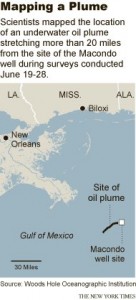
NYTimes: Gulf Oil Plume Is Not Breaking Down Fast, Research Says, see map of location

http://www.nytimes.com/2010/08/20/science/earth/20plume.html?_r=1&hp

By JUSTIN GILLIS and JOHN COLLINS RUDOLF

New research confirms the existence of a huge plume of dispersed oil deep in the Gulf of Mexico and suggests that it has not broken down rapidly, raising the possibility that it might pose a threat to wildlife for months or even years.

The study, the most ambitious scientific paper to emerge so far from the Deepwater Horizon spill, casts some doubt on recent statements by the federal government that oil in the gulf appears to be dissipating at a brisk clip. However, the lead scientist in the research, Richard Camilli, cautioned that the samples were taken in June and circumstances could have changed in the last two months.

The paper, which is to appear in Friday’s issue of the journal Science, http://www.sciencemag.org/ , adds to a welter of recent, and to some extent conflicting, scientific claims about the status of the gulf. While scientists generally agree that the risk of additional harm at the surface and near the shore has diminished since the well was capped a month ago, a sharp debate has arisen about the continuing risk from oil in the deep waters.

So far, scientific information about the gulf has emerged largely from government reports and statements issued by scientists. Many additional research papers are in the works, and it could be months before a clear scientific picture emerges.

The slow breakdown of deep oil that Dr. Camilli’s group found had a silver lining: it meant that the bacteria trying to eat the oil did not appear to have consumed an excessive amount of oxygen in the vicinity of the spill, alleviating concerns that the oxygen might have declined so much that it threatened sea life. On this point, Dr. Camilli’s research backs statements that the government has been making for weeks.

Dr. Camilli, of the Woods Hole Oceanographic Institution in Woods Hole, Mass., said the plume, at the time he studied it, was dissipating so slowly that it could still be in the gulf many months from now. Assuming that the physics of the plume are still similar to what his team saw in June, “it’s going to persist for quite a while before it finally dissipates or dilutes away,” he said.

Concentrations of hydrocarbons in the plume were generally low and declined gradually as the plume traveled through the gulf, although Dr. Camilli’s team has not yet completed tests on how toxic the chemicals might be to sea life.

In a report on Aug. 4, a team of government and independent scientists organized by the National Oceanic and Atmospheric Administration estimated that 74 percent of the oil from the leak had been captured directly from the wellhead; skimmed, burned, dispersed chemically or by natural processes; evaporated from the ocean surface; or dissolved into the water in microscopic droplets.

The report found that the remaining 26 percent of the oil had mostly washed ashore or collected there, was buried in sand and sediment, or was still on or below the surface as sheen or tar balls.

While the government report expressed concern about the continuing impact of the spill, it was widely viewed as evidence that the risk of additional harm in the gulf was declining.

This week, scientists at the University of Georgia, who in May were among the first to report the existence of the large plume studied by Dr. Camilli’s team, sharply challenged

the government’s assessment. They contended that the government had overestimated rates of evaporation and breakdown of the oil.

“The idea that 75 percent of the oil is gone and is of no further concern to the environment is just incorrect,” said Samantha Joye, a professor of marine sciences at the University of Georgia. She has studied the spill extensively but has not yet published her results.

Responding to the University of Georgia criticism, Jane Lubchenco, the NOAA administrator, said the government stood by its calculations. “Some of those numbers we can measure directly,” she said. “The others are the best estimates that are out there.”

Dr. Lubchenco has noted repeatedly that some of the remaining oil existed in the form of undersea plumes and cautioned that this subsurface oil could pose a threat to marine life.

In another report http://usfweb3.usf.edu/absoluteNM/templates/?a=2604&z=120

( also see )

this week, researchers from the University of South Florida said they had found oil droplets scattered in sediment along the gulf floor and in the water column, where they could pose a threat to some of the gulf’s most important fisheries.

The dispersed oil appeared to be having a toxic effect on bacteria and on phytoplankton, a group of micro-organisms that serves as a vital food for fish and other marine life, the scientists said, although they cautioned that further testing was needed.

Dr. Camilli’s paper tends to support the view that considerable oil may be lingering below the surface of the gulf. He said he was not especially surprised by the slow rate of breakdown, considering that the deep waters of the gulf are cold, about 40 degrees Fahrenheit in the vicinity of the plume.

“In colder environments, microbes operate more slowly,” Dr. Camilli said. “That’s why we have refrigerators.”

For weeks, BP, the company that owned the out-of-control well, disputed claims from scientists that a huge plume of dispersed oil droplets had formed in the gulf, with its chief executive at the time, Tony Hayward, declaring at one point, “There aren’t any plumes.” http://topics.nytimes.com/top/reference/timestopics/people/h/tony_hayward/index.html?inline=nyt-per

NOAA, while initially skeptical, ultimately confirmed the existence of such plumes in two reports. The new paper appears to dispel any lingering doubt, providing detailed evidence that one major plume and at least one minor plume existed and that they contained large quantities of hydrocarbons, albeit dispersed into tiny droplets.

Dr. Camilli’s team measured the main plume at roughly 3,600 feet below the surface; it extended for more than 20 miles southwest of the well. It was more than a mile wide in places and 600 feet thick, traveling at about four miles a day.

At the time his team studied it in June, the plume appeared to have narrowed from measurements reported early in the spill by a team that included Dr. Joye and Vernon Asper, a marine scientist from the University of Southern Mississippi, but Dr. Camilli’s results otherwise matched their report.

The slow breakdown of the plume, if verified by additional research, suggests that scientists may find themselves tracking the toxic compounds from BP’s well and trying to discern their impact on sea life for a long time.

“I expect the hydrocarbon imprint of the BP discharge will be detectable in the marine environment for the rest of my life,” Ian MacDonald, an oceanographer at Florida State University, told Congress in prepared testimony on Thursday. “The oil is not gone and is not going away anytime soon.”

Special thanks to Richard Charter

LA Times: Gulf oil spill: Most of the oil remains

http://latimesblogs.latimes.com/greenspace/2010/08/noaa-official-concedes-majority-of-gulf-oil-still-there.html

— Kim Murphy in New Orleans
August 19, 2010 | 4:52 pm

The National Oceanic and Atmospheric Administration released
http://articles.latimes.com/2010/aug/05/nation/la-na-oil-spill-20100805
a controversial “oil spill budget”
http://www.deepwaterhorizonresponse.com/posted/2931/Oil_Budget_description_8_3_FINAL.844091.pdf
Aug. 2 estimating that a large part of the oil released into the Gulf of Mexico by the Deepwater Horizon spill was gone. But in a hearing
http://energycommerce.house.gov/index.php?option=com_content&view=article&id=2106:heairng-on-the-bp-oil-spill-accounting-for-the-spilled-oil-and-ensuring-the-safety-of-seafood-from-the-gulfq&catid=130:subcommittee-on-energy-and-the-environment&Itemid=71
on Capitol Hill, a NOAA official conceded that three-fourths of the pollutants from the 4.1 million barrels spewed into the gulf are still lingering in the environment.

Bill Lehr, senior scientist with NOAA’s Office of Restoration and Response, said booming and burning probably cleaned up only about 10% of the spilled oil. Much of the oil has evaporated or dispersed, but remains a source of hydrocarbons in the ecosystem, he said.

“This is a continuing operation,” Lehr emphasized. “The spill is far from over. We’re beginning a new phase, and NOAA and all the other agencies will be involved in this.”

“We have seen some premature celebration,” said Rep. Edward Markey, (D-Mass.), who convened the House Energy and Environment subcommittee hearing. “What we have learned today is that the oil is not gone. The oil remaining in the Gulf waters or washed up on the shore is equivalent to 10 Exxon Valdez spills, and could be much more.”

The report released recently by NOAA and the Department of Interior — in which the agencies said the “vast majority” of the oil had been either recovered, dispersed or evaporated — rendered more optimistic figures because it counted as recovered the 800,000 barrels of oil captured directly by ships, Lehr conceded under questioning by Markey.

He said agency scientists also have not tallied the significant quantities of methane gas and heavy metals released into the gulf as a result of the spill.

If only 10% of the spilled oil was actually recovered, that is equivalent to the 10% to 15% recoveries scientists estimated were possible from a major spill at the time of the 1989 Exxon Valdez disaster, Markey noted. “So it seems to me that BP comes in only at the low end of what was possible 20 years ago…. I think it’s important that even using a 21-year-old grading system, that BP has done a very poor job in cleaning up the gulf.”

Lisa Suatoni, senior scientist at the Natural Resources Defense Council, added in her testimony: “We understand that the government wants to turn the corner and wants to signal that the gulf is on its way to recovery. However, the facts simply do not bear that out. There is still a huge amount of oil in the environment.”

Scientists from the Environmental Protection Agency and the Food and Drug Administration said they are confident that seafood coming from the newly opened areas of the gulf is safe to eat. Testing for hydrocarbons and residuals from the 1.8 million gallons of chemical dispersants used to break up the oil showed no dangerous contaminants, they said.

In tests of 500 shrimp and crabs for exposure to the polycyclic aromatic hydrocarbons (PAHs) that are one of the most dangerous elements in crude oil, all showed levels “below levels of concern” by a factor of 500 to 1,000 “essentially similar to prior to the oil spill,” said Donald Kraemer, acting deputy director of the FDA’s Center for Food Safety and Applied Nutrition.

In testing of 3,000 water samples, only two showed signs of dispersant. Moreover, all dispersants used when tested directly showed up as non-toxic or slightly toxic, and in combination with crude oil, no more toxic than the oil itself, which is considered moderately toxic, said Paul Anastas, an assistant EPA administrator.

— Kim Murphy in New Orleans

Special thanks to Richard Charter

Washingtonpost.com/Huffpost Reporting: NOAA Claims Scientists Reviewed Controversial Report; The Scientists Say Otherwise

http://www.huffingtonpost.com/2010/08/20/noaa-claims-scientists-re_n_689428.html

The last sentence says it all: “The consistent theme,” MacDonald said, “seems to be to minimize the impact of the oil — and to act as a bottleneck for information.” This has been another in a series of government cover-ups and complicity with Big Oil. We expected better of Lubchenko and Obama. DV
First Posted: 08-20-10 04:23 PM | Updated: 08-20-10 10:14 PM

In responding to the growing furor over the public release of a scientifically dubious and overly rosy federal report about the fate of the oil that BP spilled in the Gulf of Mexico, NOAA director Jane Lubchenco has repeatedly fallen back on one particular line of defense — that independent scientists had given it their stamp of approval.

Back at the report’s unveiling on August 4, Lubchenco spoke of a “peer review of the calculations that went into this by both other federal and non-federal scientists.” On Thursday afternoon, she told reporters on a conference call: “The report and the calculations that went into it were reviewed by independent scientists.” The scientists, she said, were listed at the end of the report.

But all the scientists on that list contacted by the Huffington Post for comment this week said the exact same thing: That although they provided some input to NOAA (the National Oceanic and Atmospheric Administration), they in no way reviewed the report, and could not vouch for it.

The skimpy, four-page report dominated an entire news cycle earlier this month, with contented administration officials claiming it meant that three fourths of the oil released from BP’s well was essentially gone — evaporated, dispersed, burned, etc. But independent scientists are increasingly challenging the report’s findings and its interpretation — and they are expressing outrage that the administration released no actual data or algorithms to support its claims.

HuffPost reached seven of the 11 scientists listed on the report. One declined to comment at all, six others had things to say.

In addition to disputing Lubchenco’s characterization of their role, several of them actually took issue with the report itself.

In particular, they refuted the notion, as put forth by Lubchenco and other Obama administration officials, that the report was either scientifically precise or an authoritative account of where the oil went.

“What we were trying to do was give the Incident Command something that they could at least start with,” said Ed Overton, an emeritus professor of environmental science at Louisiana State University. “But these are estimates. There’s a difference between data and estimates.”

Overton said NOAA asked him: “How much did I think would evaporate?” He responded with some ideas, but noted: “There’s a jillion parameters which are not very amenable to modeling.”

He said he didn’t know what NOAA did with his input. “I pretty much did my estimates and let that go,” he said.

And Overton bridled at the way the report was presented — with very precise percentages attributed to different categories. For instance, the report declared that 24 percent of the oil had been dispersed.

“I didn’t like the way they say 24 percent. We don’t know that,” Overton said. “They could have said a little bit more than a quarter, a little bit less than a quarter. But not 24 percent; that’s impossible.”

Michel Boufadel is on the list, but told HuffPost he did not review the report or its calculations. And the Temple University environmental engineer also said its specificity was inappropriate.

“When you look at that dispersed amount, and it says 8 percent chemically dispersed and 16 percent naturally dispersed, there’s a high degree of uncertainty here,” he said. “Naturally dispersed could be 6 or it could be 26.”

Ron Goodman, a 30-year veteran of Exxon’s Canadian affiliate who now runs his own consulting company, was incorrectly listed on the report with an academic affiliation: “U. of Calgary.” He is only an adjunct there. He said he responded to a series of questions from NOAA — “and that was it.”

And once the report came out, he said, “I was concerned that the amount dispersed was very low. I think it was higher by maybe a factor of two or three.”

In another example of how people are reading too much into the report, there has been some discussion suggesting that its estimate that 8 percent of the oil was chemically dispersed provides a new data point regarding how well those controversial chemicals worked. Goodman, however, said he believes the government scientists didn’t base their conclusion on evidence, but on faith.

“They took the amount of dispersant that was applied, and multiplied it by 20 which is the manufacturer’s suggested amount,” he said.

Merv Fingas, a former chief researcher for Canada’s environmental protection agency, said he thought the report was purely operational in nature. “The purpose of this was for the responders, and to tell them what to do — as opposed to saying ‘golly, the oil’s all gone.’ That was never the impression. That was very badly misinterpreted.”

Fingas said the scientists stressed how broad the ranges should be for the estimates. “On the pie chart, if you say 15 percent, it could maybe be 30, it could maybe be 5.”

Told how much certainty administration officials expressed in the estimates — “we have high degree of confidence in them,” is how Lubchenco put it — Fingas was blunt.

“That’s what happens when stuff goes from scientists to politicians,” he said. “It was exactly the opposite with the scientists. We had a lot of uncertainty.”

Juan Lasheras, an engineering professor at University of California, San Diego, on the list explained: “My involvement with the estimation of the oil spill budget has been minimal. I simply assisted Bill Lehr (NOAA) in a minor way with the estimation of the size of the oil droplets generated by the rising plume. I have not been involved in any of the other calculations or in the discussion and the writing of the report.”

Jim Payne, a private environmental consultant on the list, declined to comment beyond saying: “I really don’t know that much about how that was calculated.”

Also worth noting: Four of the “independent scientists” listed on the report work for the oil industry, have until recently, and/or work for consulting companies that do business with the oil industry.

What happened here? Why did ballpark estimates clearly created to guide emergency responders suddenly get cast as a conclusive scientific facts? (See my story from a few hours ago, Questions Mount About White House’s Overly Rosy Report On Oil Spill.)

Why did administration officials mislead the public about those findings — and then claim that independent scientists had reviewed them, when the evidence suggests that they did not?

NOAA public affairs officials did not respond to requests for comment before my deadline.

Ian R. MacDonald, an oceanographer at Florida State University who was not one of the scientists on NOAA’s list, sees this latest incident as part of an ongoing problem.

Lubchenco had previously been a key figure in the patently low-ball estimates for the oil flow, and fervently resisted acknowledging the existence of underwater oil plumes, he said.

“I’ve worked with NOAA essentially all my career and I have many good friends there, and people I respect in the agency, scientists who are really solid,” MacDonald said.

“Throughout this process, it’s been troubling to me to see the efforts of people like that passed through a filter where the objective seems to be much more political and public relations than making comments to inform the public.

“The consistent theme,” MacDonald said, “seems to be to minimize the impact of the oil — and to act as a bottleneck for information.”

Special thanks to Richard Charter

"Be the change you want to see in the world." Mahatma Gandhi