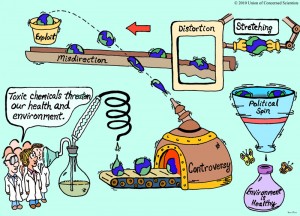
 Why Gulf Spill and Dispersants Confuse Administration
MSNBC: Crude still coats marshes and wetlands along Gulf (video)
video at:
http://www.msnbc.msn.com/id/38587494/ns/us_news-environment
Kerry Maloney / AP
Oil from the Deepwater Horizon disaster is visible in Barataria Bay, Thursday Aug. 5, 2010. BP finished pumping fresh cement into its blown-out oil well as aimed to seal for good the ruptured pipe that for months spewed crude into Gulf of Mexico in one of the world’s worst spills. (AP Photo/Kerry Maloney)
By GREG BLUESTEIN, JASON DEAREN
–
ON THE GULF OF MEXICO – Much of the crude still in the Gulf and coastal areas more than three months after BP’s blowout has permeated deep into marshes and wetlands, complicating cleanup.
Crews are still finding plenty of crude in those interior areas, even as government officials say spotting oil from the air on the Gulf’s surface is taking longer on each trip.
“The good news is people are seeing less oil, but the bad news is the oil trapped in the marshes is moving out with the tides and sticking on the marsh cane,” said Maura Wood, an oceanographer with the National Wildlife Foundation, on a boat trip to the marshes of Pass-A-Loutre, La. “And that could kill it.”
The sometimes frustrating search for oil underscores the difficulties facing the small army of federal officials and cleanup crews tasked with purging what remains. Rear Adm. Paul Zukunft, the government’s on-scene coordinator, said he’s had to spend a growing amount of his time taking flights over the Gulf to search for the remaining crude.
“There is very little observable oil out there,” he said, saying that Coast Guard responders are not seeing much on the surface. But he added: “We can’t turn a blind eye … If we don’t see oil, I’m not assuming it doesn’t exist.”
Engineers, meanwhile, were working to make sure no new oil would seep from the busted well. They scored another victory Thursday by finishing the pumping of a steady stream of fresh cement down the throat of the well, and crews planned to wait at least a day for it to dry.
The cement was one of the last steps in the so-called “static kill.” The effort started Tuesday with engineers pumping enough mud down the top of the well to push the crude back to its underground source for the first time since an oil rig exploded 50 miles off the Louisiana coast on April 20, killing 11 workers and triggering the spill.
Crews followed it up Thursday by sealing the well with a torrent of cement. After it dries, the last step begins: Finishing the drilling of the last 100 feet of the relief well, which government officials said will be used to seal the underground reservoir from the bottom with mud and cement.
“This is not the end, but it will virtually assure us that there will be no chance of oil leaking into the environment,” retired Adm. Thad Allen, who oversees the spill response for the government, said in Washington.
The progress was another bright spot as the tide appeared to be turning in the monthslong battle to contain the oil, with a federal report this week indicating that only about a quarter of the spilled crude remains in the Gulf and is degrading quickly.
Despite the progress on the static kill, BP executives and federal officials won’t declare the threat dashed until they use the relief well – though lately they haven’t been able to publicly agree on its role.
Federal officials including Allen have insisted that crews will shove mud and cement through the 18,000-foot relief well, which should be completed within weeks. Crews can’t be sure the area between the inner piping and outer casing has been plugged until the relief well is complete, he said.
But for reasons unclear, BP officials have in recent days refused to commit to pumping cement down the relief well, saying only that it will be used in some fashion. BP officials have not elaborated on other options, but those could include using the well simply to test whether the reservoir is plugged.
The vast oil reservoir beneath the well could still be worth billions of dollars even after it spewed crude into the Gulf of Mexico for more than three months, but BP isn’t saying whether it plans to cash in on this potential windfall.
BP insisted Thursday it had no plans to use it or its two relief wells to produce oil. But the company won’t comment on the possibility of drilling in the same block of sea floor someday or selling the rights to the entire tract to another oil company.
Whether the well is considered sealed yet or not, there’s still oil in the Gulf or on its shores – nearly 53 million gallons of it, according to the report released Wednesday by the Interior Department and the National Oceanic and Atmospheric Administration.
That’s still nearly five times the size of the Exxon Valdez spill, which wreaked environmental havoc in Alaska in 1989.
But almost three-quarters of the nearly 207 million gallons of oil that leaked overall has been collected at the well by a temporary containment cap, been cleaned up or chemically dispersed, or naturally deteriorated, evaporated or dissolved, the report said.
Some residents are worried that now that the well has flatlined, the nation’s attention will shift from the coast.
“I’m losing trust in the whole system,” said Willie Davis, a 41-year-old harbormaster in Pass Christian, Miss. “If they don’t get up off their behinds and do something now, it’s gonna be years before we’re back whole again.”
In Pass-A-Loutre, where oil still clung stubbornly to marsh cane, each day’s high tide picks up the goo and leaks it back into the ocean. But Jeremy Ingram, the Coast Guard official who oversees cleanup crews here, said it’s cleaner than it was when he arrived 60 days ago. Back then, he said, he couldn’t even see water through the thick ooze.
“I’d say it’s a lot less than what was here, but if you see on the canes it’s still heavily saturated with oil. So the job’s not done yet, there’s still a lot more work to get done,” he said. “As the tide comes up and washes oil off that cane, somebody and some thing has to be here to catch it.”
___
Bluestein reported from New Orleans. Contributing to this report were Associated Press writers Jennifer Kay in Pensacola Beach, Fla., Brian Skoloff in Pass Christian, Miss., Harry R. Weber and Jeff McMillan in New Orleans and Jay Reeves in Birmingham, Ala.
Special thanks to Richard Charter
CNN: Mississippi county fights BP over oil spill waste being dumped in landfill
http://www.cnn.com/2010/US/07/27/bp.landfill.dispute/index.html?hpt=T2
By the CNN Wire Staff
July 28, 2010 5:16 a.m. EDT
(CNN) — What happens to all the tar balls, oily sand and vegetation, and soiled gloves and suits from the thousands of temporary BP workers who’ve been working to clean up beaches along the Gulf of Mexico?
It’s being dumped in nine landfills along the Gulf coast, under agreements involving BP, landfill operators and the Unified Command, the federal agencies overseeing the cleanup efforts.
But some communities are not happy about it, amid fears of soil and water contamination, and one local government is fighting back.
Supervisors in Harrison County, Mississippi, where the Pecan Grove Landfill is based, have been fuming over what the county estimates is 1,200 tons of oil-tainted byproduct dumped there.
The board of supervisors passed a resolution this summer not to accept BP waste.
That effort didn’t go far, because the landfill is owned and operated by a Mississippi company, Waste Management, which answers to the state.
But now, Waste Management has agreed not to dump more waste there, instead keeping it in huge bins in a nearby “staging area” pending further talks with local officials.
The company, BP representatives and federal and local officials are holding more talks Thursday, according to Tim Holleman, an attorney for the board of supervisors.
And the board has instructed Holleman to prepare an injunction to stop the dumping if the negotiations don’t end in an agreement.
Holleman said he couldn’t tip his hand on all the legal arguments that might be employed in an injunction.
But one argument is that dumping the waste in landfills is the “least preferred” option under a series of disposal methods outlined under the Unified Command’s waste management plan. It’s also one of the easiest.
“It’s sort of like throwing a can of trash in your front yard, then picking it up and throwing it in your backyard and saying you’re sorry,” Holleman said.
He said a far more effective method would be to incinerate the waste. And in fact, another company in Mississippi specializes in just that.
Waste Oil Collectors Inc. of Gautier, Mississippi, wrote Holleman several weeks ago, describing a process in which the waste is shredded into uniform bits and then incinerated at 2,500 degrees in a kiln.
That recovers energy from the waste and breaks it down into mineral components, some of which can be used in asphalt.
Waste Management says that all the oil waste that has been stored at the landfill is classified as “non-hazardous,” after being tested by the EPA and the Mississippi Bureau of Environmental Quality. It adds that there is a liner underneath the landfill, and groundwater there is monitored.
“You don’t bring anything to a landfill unless it’s been tested,” said Ken Haldin, director of communications for Waste Management. “We would not be bringing anything to a landfill unless it hadn’t been profiled.”
Waste Management also operates landfills that have been receiving oil waste in Mobile County in Alabama and Jackson County in Florida.
Haldin said he’s unaware of any local controversies at those other two landfills.
“All of our processes have been running smoothly,” he said.
But local officials in Harrison County aren’t easily assured. They point out that 250 homes are within a half-mile of the landfill.
And a supervisors meeting Monday didn’t go all that smoothly.
“That landfill is in Harrison County for our waste,” Supervisor William Martin said. “That’s why it was built there. And now to allow BP to put all this waste in it, it’s wrong.”
It didn’t help that a BP representative at the meeting did not have the authority to commit to anything. The representative was sent home.
“We have that landfill space available for municipal use and not for a company that’s been negligent,” said Connie Rocko, president of the board of supervisors.
Rocko dryly notes that although the waste is classified as not hazardous, the workers who collect it wear protective suits.
“We know that there are alternatives available, and we want BP and Waste Management to use those alternatives,” she said.
Special thanks to Richard Charter
Sourcewatch.org: News Release–Questions to EPA on Gulf and Dispersants, from Expert at EPA
http://www.readersupportednews.org/off-site-news-section/49-49/2590-questions-to-epa-on-gulf-and-dispersants-from-expert-at-epa
August 4, 2010
HUGH KAUFMAN
A noted expert at the Environmental Protection Agency, Kaufman today produced a list of questions for EPA Assistant Administrator for Research and Development Paul Anastas, whose testimony before the Senate Environment and Public Works Subcommittee is currently on C-SPAN:
1) Do you believe EPA had enough technical and scientific information, in April, to make a correct decision as to whether or not to use dispersants in this situation?
2) Did EPA authorize the use of dispersants by BP when the oil spill began in April of this year? If EPA did not, who did? Please give the name of the person who authorized this action. If you don’t know who did, who does know?
3) In your press conference on Monday, you said that EPA has not found dispersants in the water except at the well head where the oil was escaping. NOAA [National Oceanic and Atmospheric Administration] has documented plumes of dispersed oil throughout thousands of square miles of the Gulf of Mexico. Has EPA — or anybody — tested these plumes of dispersed oil for the ingredients in the dispersants? If so, who and what are the results?
4) At your press conference Monday, you said NOAA and FDA [Food and Drug Administration] found that the food chain in the Gulf was not affected by the oil and/or the dispersants. Have NOAA and the FDA done testing of food chain marine life for the presence of the ingredients of dispersants?
5) Has the air been tested for dispersant ingredients in the areas where workers, including personnel from the Coast Guard, are conducting cleanup of the oil and dispersant mixture on the surface of the water? If so, who tested it, what instruments were used? What were the results?
6) At your press conference Monday, you stated that the temperatures of the water used in doing your toxicity tests on living shrimp were not the same temperatures as those to which the oil/dispersant mixtures are being exposed in the Gulf. Why did you not do this testing at the actual temperatures that the oil/dispersant mixture is in, in the Gulf of Mexico?
7) Congressman Edward Markey provided documentation over the weekend that two to three times the amount of the dispersant Corexit was spread over the floating oil than was reported to have been spread by EPA and the Government. Do you agree or disagree with Congressman Markey’s documented allegation? If you agree, what actions will you take to correct the record?
8) At your press conference Monday, you stated that biodegradation of the oil spilled in the Gulf was 50 percent faster when dispersants were used. This assertion is in direct conflict with evidence of a report describing the Amoco Cadiz oil spill in France in 1978, in which dispersed oil is still not biodegraded. What scientific basis do you have for your conflicting assertion?
9) Did EPA do any ambient air pollution testing for the ingredients of the dispersant Corexit in the communities adjacent to the Gulf? If the answer is yes, which ingredients were tested for and what were the results?
10) Did EPA use wet chemistry in analyzing the ambient air pollution in the communities adjacent to the Gulf?
11) Did EPA use gas chromatographs and mass spectrometers in analyzing the ambient air pollution in the communities adjacent to the Gulf?
12) Does anyone at EPA, to your knowledge, disagree with the use of dispersants in the Gulf of Mexico oil spill disaster? Who? Do you know why?
Background: Kaufman “led the investigation for the EPA’s Ombudsman that uncovered Environmental Protection Agency and Occupational Safety and Health Administration cover-up[s] of the environmental effects of the 9/11 World Trade Center attack at the behest of the Bush White House.”
http://www.sourcewatch.org/index.php?title=Hugh_Kaufman
For more information, contact at the Institute for Public Accuracy:
Sam Husseini, (202) 347-0020
Special thanks to Richard Charter
From the Coral-list August 9, 2010
Dr Goreau wrote: They’re saying it’s disappeared, gone, evaporated, bugs ate it
up, “nobody” knows “where” it is! But of course the “missing” oil is just
floating dispersed in the water column (killing the larval fish and plankton)
and on the bottom, killing the shrimp and the benthos. 40 years after the
Buzzard’s Bay oil spill every strong storm mixes up oil buried in sediments and
causes new invertebrate mass mortalities.
*************************************
Dr. James M. Cervino
Visiting Scientist
Woods Hole Oceanographic Institute
Contact Information:
NYC Address: 9-22 119st
College Point New York, 11356
Cell: 917-620*5287
************************************
AOLnews.com: BP May go back to ruptures Gulf well for more oil
http://www.aolnews.com/gulf-oil-spill/article/bp-may-go-back-to-ruptured-gulf-well-for-more-oil/19584376
This is the height of arrogance; BP should just walk away from this one. Their greed is showing when they should be showing their green. DV
Updated: 11 minutes ago
(Aug. 6) — BP may eventually try to tap the oil in its Macondo well, which spewed 4.1 million barrels of crude into the Gulf of Mexico in the worst environmental disaster in U.S. history.
“There’s lots of oil and gas here,” Chief Operating Officer Doug Suttles told reporters today. “We’ll have to think about what to do with that at some point.”
Suttles made the comments as BP waited for tons of cement it pumped into the blown-out well to dry. Assuming it holds, there is little chance of future leaks.
The reservoir of oil thousands of feet below the surface could contain almost $4 billion worth of crude, Bloomberg News
That’s a huge asset for any company to just sit on, especially one that is facing a cleanup bill of tens of billions of dollars. BP is in the process of selling assets in Colombia, the U.S., Canada and Egypt to raise funds.
The national incident commander, retired Adm. Thad Allen, skirted the topic of any future drilling, saying BP had not discussed any such plans with him
“I’d assume that’s a policy issue,” Allen told reporters.
BP plans to test the cement on the well with a burst of pressure today. The company has resumed drilling a relief well that should represent the ultimate solution to the busted well.
Once completed, the relief well will pump mud and cement into the bottom of the 13,000-foot-long bore. This so-called bottom kill technique will seal the reservoir from the bottom.
BP had left it ambiguous as to how the two relief wells it has been drilling would be used. If the bottom kill wasn’t carried out, the relief wells could theoretically have been used to extract oil and gas.
Federal authorities have been adamant that the bottom kill was the solution to the spill and that the “static kill” — filling the well from the top with mud and cement — was merely a step on the way.
Still, BP does not discount drilling elsewhere on the oil field.
“What we’ve stated is, the original well that had the blowout and the relief wells will be abandoned,” Suttles said, according to Agence-France Presse.
The disaster began back on April 20, when the Deepwater Horizon rig exploded, killing 11 workers. The ruptured oil well then began to spew out enormous quantities of crude, defying several attempts by BP to seal it. It took BP nearly three months to halt the flow of oil, which was accomplished when the company was finally able to cap the well on July 15.
Nearly three-quarters of the oil that was released has been removed, dispersed or naturally broken down.
Suttles declined to comment when asked if BP would consider donating the proceeds from the sale of oil from the well to compensate victims of the disaster.
“We just haven’t thought about that,” Suttles said. “”What we’ve been focused on is the response right now.”
Special thanks to Richard Charter