OceanLeadership.org: Much Gulf Oil Remains, Deeply Hidden and Under Beaches, New U.S. Gulf oil spill report called “ludicrous.”

http://www.oceanleadership.org/2010/much-gulf-oil-remains-deeply-hidden-and-under-beaches/

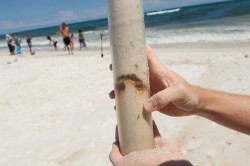
Oil in a core sample taken from Pensacola Beach, Florida, in early July. (Photograph by Chris Combs, National Geographic)

Posted by Will Ramos on Friday, August 6th, 2010 at 11:34 am
Filed under: Discovery,Gulf Oil Spill,News & Resources

(Click to enlarge) Oil in a core sample taken from Pensacola Beach, Florida, in early July. (Photograph by Chris Combs, National Geographic)

(From National Geographic / by Christine Dell’Amore) — As BP finishes pumping cement into the damaged Deepwater Horizon wellhead Thursday, some scientists are taking issue with a new U.S. government report that says the “vast majority” of the Gulf of Mexico oil spill has been taken care of by nature and “robust” cleanup efforts.

In addition, experts warn, much of the toxic oil from the worst spill in U.S. history may be trapped under Gulf beaches-where it could linger for years-or still migrating into the ocean depths, where it’s a “3-D catastrophe,” one scientist said.

The U.S. government estimated Monday that the Deepwater Horizon spill had yielded about 4.9 million barrels’ worth of crude.

On Wednesday a National Oceanic and Atmospheric Administration (NOAA) report said that about 33 percent of the spilled oil in the water has been burned, skimmed, dispersed, or directly recovered by cleanup operations. (See “Gulf Oil Cleanup Crews Trample Nesting Birds.”)

Another 25 percent has evaporated into the atmosphere or dissolved in the ocean, and 16 percent has been dispersed via natural breakup of the oil into microscopic droplets, the study says. (Read more about how nature is fighting the oil spill.)

The remaining 26 percent, the report says, is still either on or just below the surface, has washed ashore or been collected from shores, or is buried along the coasts.

Oil Spill Report “Almost Comical”?

For all their specificity, such figures are “notorious” for being uncertain, said Robert Carney, a biological oceanographer at Louisiana State University (LSU) in Baton Rouge.

That’s in part because the fluid nature of the ocean means that it’s “exceedingly hard” to track oil.

“Water is always moving-if I go out to the spill site tomorrow and look for hydrocarbons, I might not find much, because the oiled water is already gone.”

But to accurately figure out how much oil is left, you need to know how much went into the Gulf to begin with, he said.

“Once you start off with that fundamental measure”-the total amount of oil spilled-“being an educated guess, then things aren’t that great.”

To University of South Florida chemical oceanographer David Hollander, the NOAA estimates are “ludicrous.”
“It’s almost comical.”

According to Hollander, the government can account for only about 25 percent of the spilled Gulf oil-the portion that’s been skimmed, burned off, directly collected, and so on.
The remaining 75 percent is still unaccounted for, he said.

For instance, the report considers all submerged oil to be dispersed and therefore not harmful, Hollander said. But, given the unknown effects of oil and dispersants at great depths, that’s not necessarily the case, he added.
“There are enormous blanket assumptions.”

Oil Trapped Deep in Gulf Beaches

The new report comes after days of speculation about where the Gulf oil has gone. After the damaged well had been capped July 19, U.S. Coast Guard flyovers didn’t spot any big patches of crude on the water.

But oil cleanup is mostly getting rid of what’s on the surface, Carney said. There’s a common perception that “as long as you keep it off the beach, everything’s hunky dory,” he added.

In fact, scientists are still finding plenty of spilled Gulf oil-whether it’s bubbling up from under Louisiana’s islands, trapped underneath Florida’s sugar-white beaches, or in the ocean’s unseen reaches. (See pictures of spilled Gulf oil found just under Florida beaches.)

This week, biological oceanographer Markus Huettel and colleague Joel Kostka dug trenches on a cleaned Pensacola beach and discovered large swaths of oil up to two feet (nearly a meter) deep.

Oil gets trapped underground when tiny oil droplets penetrate porous sand or when waves deposit tarballs and then cover them with sand, said Huettel, of Florida State University in Tallahassee.

Whether microbes munch the oil-the most common way oil breaks down-depends on how much oxygen is available for the tiny organisms to do their work. (See marine-microbe pictures.)

“So far, we haven’t seen any rapid degradation in these deep layers,” Huettel said, though he noted oil at the top of the sand has been disappearing within days.

With little oxygen, the buried oil may stay for years, until a storm or hurricane wipes away the upper sand layers.

Previous oil spills suggest that the buried beach oil may continuously migrate not only out to sea but also into groundwater, where it can harm wildlife, Huettel said.

Oil-laden groundwater in Alaska following the Exxon Valdez spill, for instance, led to “significantly elevated” death in pink salmon embryos between 1989 and 1993, he said. (Related: “Exxon Valdez Pictures: 20 Years on, Spilled Oil Remains.”)

Gulf Oil Microbe Cleanup “Total Bull”

Microbes are not an oil-cleanup panacea either, LSU’s Carney cautioned.
For instance, oil-eating bacteria can’t stomach asphalt, the heaviest part of an oil molecule and the same material used to pave roads, he said.

The leftover asphalt falls to the seafloor, where another kind of microbe may chew on it-making the molecule shorter and thus more toxic, according to Carney.

“The sentimentality that bacteria turn everything into fish food and CO2 is total bull,” he said.

What’s more, microbes cherry-pick whatever piece of oil is easiest to process-and on their own time, said Christopher Reddy, a marine chemist at the Woods Hole Oceanographic Institution in Massachusetts.

Counting on microbes to quickly clean up an oil spill is “like asking a teenager to do a chore. You tell them to do it on a Friday, to do it when it’s most advantageous, and they do it on a Saturday,” Reddy said.

“It can be frustrating that you can’t constrain the role of microbes and overall natural cleanup.”

Deep-Sea Oil Spills are “Unchartered Territory”

Another “open question” remains, FSU’s Huettel noted: What is happening to the oil deep in the Gulf?

For the first time during an oil-spill response, officials used chemical dispersants to break up oil at ocean depths between 4,000 and 5,000 feet (1,200 and 1,500 meters). The dispersant-treated oil bits may have sunk to the seafloor, Huettel said.

In the cold, dark ocean, this mixture of oil and chemical dispersants may be suspended and preserved, causing long-term problems for deep-sea animals, Texas Tech University ecotoxicologist Ron Kendall said during August 4 testimony before the U.S. Congress.
“We have very limited information on the environmental fate and transport of the mixture of dispersant and oil, particularly in the deep ocean,” Kendall said.

Some oil fragments are so tiny they can’t be seen with the human eye, said the University of South Florida’s Hollander. Others are big enough to be gobbled up by baby fish that mistake the oil for food. (See pictures of ten animals at risk from the Gulf oil spill.)

Predicting what will happen to the deep-sea ecosystem is “uncharted territory,” said Hollander, who’s studying what the oil is doing to deep-sea creatures during a series of research cruises this summer and fall.

“Could be a bottom-up collapse, could be nothing happens,” he said. But he suspects a “real large chunk of food chain is being disrupted.”

“We’re getting into something different than the 2-D petroleum spill” on the Gulf’s surface, he added. “All of the sudden you’ve taken this 2-D disaster and turned it into a 3-D catastrophe.”

Special thanks to Richard Charter

Politico.com: Greens defend climate tactics

http://www.politico.com/news/stories/0810/40680.html

By: Darren Samuelsohn

August 5, 2010 04:30 AM EDT

Environmentalists went with an all-or-nothing strategy for the 111th
Congress. Nothing won.

Now, green groups licking their wounds after spending tens of millions of dollars to pass a cap-and-trade bill must answer serious questions about whether they are capable of playing another round of hardball.

But D.C. environmental groups aren’t looking to clean house. Activists at the Natural Resources Defense Council, Environmental Defense Fund, Union of Concerned Scientists and Clean Energy Works said leading officials won’t be fired because Obama isn’t signing a climate bill into law.

Steve Cochran, who ran EDF’s national climate campaign, actually got a promotion to run the entire global warming team, including state and international efforts.

“The reason why I’m not looking around, hearing a lot of people scared for their jobs, I think the general view within the environmental community is consistent with mine: We ran a very effective, well-coordinated effort,” said Dan Lashof, director of NRDC’s climate center.

“We fell victim to much broader politics that were beyond our control that really didn’t have to do with the specifics of either the issue or the campaign,” Lashof added.

After Senate Majority Leader Harry Reid (D-Nev.) last month scrapped
plans for a vote, the White House made clear it wasn’t impressed with the environmentalists’ effort.

“They didn’t deliver a single Republican,” an administration official told POLITICO just hours after Reid pulled the plug on the climate bill. “They spent like $100 million, and they weren’t able to get a single Republican convert on the bill.”

How much money was spent is difficult to pin down. NRDC, the Sierra Club and Clean Energy Works declined to open up their books to show how much they spent on the climate campaign. EDF had spent $20 million on
climate legislation since October 2008. Al Gore’s Alliance for Climate
Protection pledged in 2006 to spend $300 million, but it’s unclear how much it ended up using.

Enraged environmentalists flooded the White House with phone calls
after the quotation appeared in publication. Publicly, they decried the finger-pointing and insisted they aren’t alone in deserving fault, saying President Barack Obama failed to use his bully pulpit and moderate Senate Republicans weren’t allowed by their leaders to fully negotiate.

“The Washington environmental community did absolutely everything they possibly could,” said Bill McKibben, a Vermont-based environmental author and co-founder of the advocacy group 350.org.

“All the rest of us owe them a great debt of gratitude,” he added. “But
they demonstrated you can make every possible compromise, and it’s still not enough to get you anywhere with these guys.”

Some activists acknowledge missteps that undercut their pro-climate spending during the past two years.

“My sense is we did fail,” said Kevin Knobloch, president of the Union of Concerned Scientists. “I think there’s no sugarcoating it.”

At the beginning of 2009, everything seemed lined up: a Democratic president with large majorities in Congress, leaders committed to bringing a bill to the floor and seemingly no shortage of money and staff.

But after the House passed cap-and-trade legislation last summer, the subsequent anti-Obama, anti-Big Government protests – led by the tea party movement and several industry-funded groups – caught the environmentalists off-guard by attacking “yes” votes in the House.

Opponents led an effective bumper-sticker-style campaign denouncing the Democrats’ “national energy tax.” The environmentalists’ response was
too wordy, too complicated and too late.

“We tapped out a lot of donors getting to that point,” said one
official from a major group. “We didn’t have a bigger war chest waiting to support their vote.”

“We really got our ass kicked in August during the town halls,” EDF
spokesman Tony Kreindler said.

The response to the tea party attacks was to create Clean Energy Works, a coalition staffed by environmental, labor, national security and religious interest groups that numbered about 45 people at its peak. Paul Tewes, Obama’s 2008 Iowa field chief, led the campaign.

“Anywhere there was a senator who was not squarely on the side of passing a climate bill, we were there,” said David Di Martino, a Clean Energy Works spokesman.

Once they began talking to senators, however, activists said, they got their wires crossed with Reid’s office over who was in charge of counting votes.

“We were stuck in a Catch-22,” Kreindler said. “There was an
expectation by the environmental community to deliver a certain amount of votes. There was an expectation in the environmental community that leadership would deliver a certain amount of votes. But there never was a clear understanding of how those two efforts would work together.”

Reid’s office would not comment for this story but pointed to past
statements from the majority leader that Sens. John Kerry (D-Mass.) and Joe Lieberman (I-Conn.) were tasked with collecting 60 votes on the carbon cap measure. A White House spokesman declined comment on its climate bill whip operations.

Senate Majority Whip Dick Durbin (D-Ill.) defended the greens’ efforts. “This became a very hot political issue,” he said. “They’re trying hard to help us. And we’re working with them. We’re going to have our day. I wish we’d have it sooner, rather than later. But we’re going to have our day.”

Durbin insisted that environmental groups also still garner plenty of
sway in the Senate. “A lot of us pay attention,” he said.

But there’s a difference between paying attention and action.

GOP senators targeted as possible swing votes said the
environmentalists offered little incentive for them to change their
minds during an economic recession and with little threat of political payback if they didn’t go along.

“They don’t have much infrastructure on the Republican side,” said Sen. Lindsey Graham (R-S.C.). “So when you hear the environmental community
is mad at you, everyone says, ‘Tell me something new.’ It’s not like a
support group you’ve lost.”

The environmental movement needs a radical overhaul if Congress is ever going to pass a climate bill, McKibben said. That means lawmakers need
to be aware of the political consequences if they don’t side with the greens.

“We weren’t able to credibly promise political reward or punishment,” McKibben said. “The fact is, scientists have been saying for the past few years the world might come to an end. But clearly that’s insufficient motivation. Clearly, we must communicate that their careers might come to an end. That’s going to take a few years.”

Sen. Bob Corker (R-Tenn.), whom environmentalists once considered as a possible vote on climate, never got the message. “I hate to tell you, I just don’t wake up thinking about it,” said Corker, who questions the complexity of cap-and-trade systems. “I’m aware and all that. But I think it’s the wrong message.”

Special thanks to Richard Charter

Keys. net: Resource Managers give oil spill Overview

http://www.keysnet.com/2010/08/04/244520/resource-managers-give-oil-spill.html

By KEVIN WADLOW
kwadlow@keynoter.com
Posted – Wednesday, August 04, 2010 11:00 AM EDT

Surface oil from the Deepwater Horizon disaster may never reach the Florida Keys, but effects of the estimated remaining 172 million gallons of crude oil that flowed into the northern Gulf of Mexico remain unknown.

“No one knows with any level of confidence what’s going to happen in the Gulf,” said Paul Johnson, a former Reef Relief president now working as a marine consultant to the Natural Resources Defense Council. “Just because [BP] has capped the leak does not necessarily make all that oil go away.”

At 6 p.m. Aug, 4 in Key West, several marine experts will talk about possible ramifications to the Keys from the spill, apparently the largest in U.S. history.

“The Gulf Disaster and the Florida Keys: What Are the Environmental Impacts and How to Help” is the topic of the open seminar at the Florida Keys Eco-Discovery Center, at the Truman Waterfront at the end of Southard Street in Key West.

Conservation groups Oceana and the Natural Resources Defense Council host the event, intended to discuss “potential impacts on Keys habitats and wildlife.” Billy Causey, southeast regional director of the National Marine Sanctuaries Program, will make opening remarks.

Other experts scheduled to speak include David Vaughan, director of the Mote Center for Tropical Coral Reef Research; Jim Fourqurean, a marine biologist at Florida International University; and marine scientist Patrick Rice of Florida Keys Community College.

On Friday, the National Oceanic and Atmospheric Administration said the latest analysis of the spill extent indicates “Southern Florida, the Florida Keys and the East Coast are unlikely to experience any effects from the remaining oil on the surface of the Gulf as a result of the Deepwater Horizon oil spill.”

A current eddy in the Gulf of Mexico appears to have contained most of the oil and kept it from reaching the Loop Current that many experts feared would bring the oil to the Florida Straits and the Keys.

For the foreseeable future, NOAA said, “There is no clear way for oil to be transported to southern Florida or beyond. At that point, it is expected that the majority of remaining surface oil will have dissipated.”

The nearest point of the visible oil spill remains an estimated 425 miles from the Keys. However, the biological effects of dissipated oil in the water column, along with chemical dispersants, remain unclear.

“All we can do is continue to monitor it, look at what kinds of impacts we might expect, and what we can do about it,” Johnson said.

Lessons from the Deepwater Horizon disaster may prove useful if Cuba expands oil exploration and drilling in its territorial waters, he said.

“It’s an example for our community on how vulnerable we are to drilling off our shores,” Johnson said. A federal panel reported Monday that the Deepwater Horizon spill off Louisiana may have dumped more than 200 million gallons of crude oil into the Gulf of Mexico. BP managed to recover an estimated 33 million gallons, but the balance remains in gulf waters.

In other recent oil-spill developments:

•Monroe County businesses may be eligible for emergency loans from the U.S. Small Business Administration, under a July 24 declaration. Proof of economic loss will be required. Loan applications can be downloaded from www.sba.gov/services/disasterassistance.

•Singer Jimmy Buffett, a former Key West resident, in July donated a specially designed boat to the Friends of the Bon Secour National Wildlife Refuge, in Alabama. The shallow-draft boat allows rescuers to reach marshy areas affected by the spill to perform bird and wildlife rescues.

Working Waterfront Maine: Fathoming: Oil in the Gulf of Mexico: Not as far away as you think

http://www.workingwaterfront.com/articles/Fathoming-Oil-in-the-Gulf-of-Mexico-Not-as-far-away-as-you-think/13980/

The final line in this report is the bomb. DV

by Dr. Heather Deese and Catherine Schmitt

Filaments of warm Gulf Stream water are visible approaching the continental shelf south of Georges Bank and Cape Cod. Source: Dr. Andy Thomas, Satellite Oceanography Data Laboratory, University of Maine. http://wavy.umeoce.maine.edu/

Hundreds of sea turtles, more than sixty porpoises and a sperm whale have been found dead in the Gulf of Mexico region since the BP oil disaster began. As of mid-July, an area of almost 84,000 square miles, over one-third of the Gulf of Mexico, was closed to fishing.

While the impacts of the spill are most visible and devastating in the immediate area, the highly fluid nature of the ocean environment and highly migratory nature of some birds and marine species could transport effects of the oil over large distances.

Oil affects animals in several ways. The most obvious are the immediate, direct physical smothering and coating that impedes movement, vision and temperature control, and poisoning from ingestion of oil. Slower, less obvious. but no less harmful effects result from contamination of the environment, otherwise known as food and habitat. Less food is available as smaller prey organisms die, or else food is polluted. Oil on beaches, marshes, and flats poses a threat to eggs and juveniles. As eggs are contaminated, breeding success rates-which for protected species have been the subject of decades of time, money, and effort-decline.

Will oil from the Gulf of Mexico travel to the Gulf of Maine?

Susan Lozier, an oceanographer at Duke University and an expert on circulation in the North Atlantic Ocean, said it is not likely that substantial amounts of oil will reach Cape Cod, Georges Bank or the Gulf of Maine. She noted that initial reports that highlighted the potential for oil to move through the Florida Straits, along the Atlantic seaboard and across the North Atlantic in the Gulf Stream were based on the physics of how ocean currents would carry something that didn’t move or change over time.

Once the effects of oil evaporation, stirring, mixing and degradation are included, the projected concentrations of oil at significant distances from the source drop dramatically. Lozier predicts “oil will likely be seen only in trace quantities in the area north of Cape Hatteras, with a highly patchy distribution.”

Aside from breakdown of the oil en route, the Gulf Stream itself poses a major barrier to northward transport. Amy Bower, a physical oceanographer at Woods Hole Oceanographic Institution emphasized that surface water in the Gulf Stream moves northeastward and eastward so rapidly that cross-stream movement is difficult. According to Bower, “long, thin filaments of water can be pinched off from Gulf Stream meanders or rings”, which do deliver warm, southern water onto the New England shelf. However, Bower echoed Lozier’s assessment that any oil in Gulf Stream filaments is likely to be highly diluted.

What will be the impacts on animals that move between the two Gulfs?

The most prominent animal that spends time in both the Gulf of Mexico and the Gulf of Maine is the bluefin tuna. This species, which fuels a highly valued recreational and commercial fishery in New England, spawns in the Gulf of Mexico from April to June and then migrates north for the summer, mixing with eastern Atlantic and Mediterranean stocks.

NOAA Fisheries has intensified their regular larval surveys and satellite tracking in the Gulf of Mexico to monitor the impact on bluefin. “We are very concerned,” said Guillermo Diaz, a research fisheries biologist with the NOAA Fisheries in Silver Spring, Maryland, “We are not taking this lightly. It’s a dynamic situation changing on a daily basis.”

Molly Lutcavage, an expert on bluefin tuna who runs the Large Pelagics Research Laboratory, formerly of University of New Hampshire and now of University of Massachusetts, said that only two bluefin spawning areas have been documented in the western Atlantic ocean. Both are in the Gulf of Mexico and one is directly in line with the oil spill impact zone. “If bluefin eggs and larvae come in direct contact with surface oil, it will kill them,” according to Lutcavage, “while slightly older larvae and juvenile tuna could die from indirect effects through ingesting copepods or other prey.” Diaz confirms the potential for damage, “It is very difficult to predict the impact on bluefin tuna at this point, but it could be significant.” Lutcavage does emphasize that over half of the bluefin tagged in the Gulf of Maine and Atlantic Canada each summer don’t visit the Gulf of Mexico in their annual migrations, which may provide an ‘escape hatch’ for the species to survive the spill.

Other species, including sharks, rays, swordfish, molas, black sea bass, tilefish, triggerfish, sea turtles and whales occasionally visit both gulfs. Researchers have been working for years to understand the annual migrations of right whales, humpback whales, sperm whales, leatherback turtles, loggerhead turtles and Kemp’s ridley turtles that are seasonal Gulf of Maine residents, but at this point the extent of migration to the Gulf of Mexico remains uncertain for all of these highly protected species.

Gordon Waring, of NOAA Fisheries Protected Species Branch in Woods Hole, Mass., notes that “Right whales migrate between winter calving grounds off the Florida and Georgia coasts and the greater Gulf of Maine. They are infrequently sighted in the Gulf of Mexico, and it is possible that those animals are among the group that feeds in the greater Gulf of Maine region in spring and summer”.

As with right whales, south-migrating humpback whales have been recorded in the Gulf of Mexico occassionally, said Keith Mullin from NOAA’s Southeast Fishery Science Center. Mullin also noted that male sperm whales leave the Gulf of Mexico and travel to northern latitudes and are occasionally seen in the Gulf of Maine region.

Sea turtles, including leatherback, loggerhead, and Kemp’s Ridley spend summer months in the Gulf of Maine feasting on jellyfish and salps. Tagging studies and DNA typing continue to shed light on whether these seasonal visitors spend their winters in the Gulf of Mexico, or in other nesting areas along the southeast U.S. and throughout the Carribean, but at this point the answer is not well known. Lutcavage, from UMass, notes that unlike bluefin tuna, which are highly attuned to chemical signals in the water, turtles may be less able to sense and avoid oiled areas, and may thus be more heavily impacted. In what’s being called an “unprecedented intervention,” the US Fish & Wildlife service and state wildlife officials are moving sea turtle eggs from Gulf of Mexico beaches to the Atlantic side of the Florida coast.

Above the sea, many Gulf of Maine birds are migratory, stopping on their seasonal migrations between nesting grounds in Boreal and Arctic Canada and the Southeastern US, Central and South America.

“This spill happened in one of the worst places possible from a bird-centric view,” said Jeff Wells of the Boreal Songbird Initiative. In a blog post in June, Wells outlined the impacts of the oil on bird species.

Wells anticipates that as summer progresses into fall, birds migrating south will intersect with the oil slick. Species that breed in the Northern Forest but migrate to the Gulf of Mexico for the winter, including mallard, Northern pintail, green-winged teal, American wigeon, ring-necked duck and greater and lesser scaup, face a “ticking time bomb,” according to Wells.

Wells said shorebirds that pepper Maine’s beaches in spring and fall, such as black-bellied and semipalmated plover, yellowlegs, solitary and least sandpipers, dunlin, short-billed dowitcher and Wilson’s snipe, will stop in the Gulf of Mexico to rest and feed before continuing down to their winter homes in the Caribbean and South America.

While the transport of oil to Maine shores appears unlikely, the effects of the oil on species that spend time in the Gulf of Maine may be substantial.

This article is made possible, in part, by funds from Maine Sea Grant and the Oak Foundation. Heather Deese holds a doctorate in oceanography and is the Island Institute’s director of marine programs. Catherine Schmitt is communications coordinator for Maine Sea Grant.

Special thanks to Richard Charter

Washington Independent: Administration Defends Use of Dispersants After Oil Spill

http://washingtonindependent.com/93666/administration-defends-use-of-dispersants-after-oil-spill

By ANDREW RESTUCCIA 8/4/10 11:19 AM

At a Senate hearing today, Obama administration officials defended BP’s use of dispersants to break up oil in the Gulf of Mexico.

Testifying before the Senate Environment and Public Works Committee, Paul Anastas, assistant administrator at the Environmental Protection Agency’s Office of Research and Development, said that the agency allowed dispersants in the Gulf only after much consideration. “The decision to use dispersants was a decision not taken lightly,” Anastas said, adding later, “That said, when you look at all of the tools to combat this tragedyŠdispersants have been shown to be one important tool in that toolbox.”

David Westerholm, director of the Office of Response and Restoration at the National Oceanic and Atmospheric Administration, compared using dispersants to treating a fast moving, potentially fatal disease like cancer. Long-term research might give doctors more information about the disease and better, less risky ways to fight it, but “at the moment in time, you have to make that decision.”

The administration’s comments come as Rep. Edward Markey and others have raised serious concerns about the use of dispersants in the Gulf of Mexico to respond to the oil spill, arguing that the chemicals used are toxic and could have negative impacts on human health and the environment. At the same time, EPA this week released the results of an analysis of dispersants that found oil mixed with dispersants has a similar toxicity to oil alone.

Special thanks to Richard Charter

"Be the change you want to see in the world." Mahatma Gandhi