McClatchy Washington Bureau: Gulf oil flow was 12 times more than feds’ original estimate

http://www.mcclatchydc.com/2010/08/02/98512/government-revises-gulf-oil-flow.html

Posted on Mon, Aug. 02, 2010

Erika Bolstad and Lesley Clark | McClatchy Newspapers

last updated: August 02, 2010 09:19:01 PM
WASHINGTON – As BP neared a fix that’s expected to kill for good the runaway well that’s wreaked economic and environmental catastrophe in the Gulf of Mexico, the government Monday said that 10 to 12 times the amount of oil had been flowing from the well than it originally thought.

New estimates released Monday by a government-led team of scientists found that as much as 62,000 barrels of oil were leaking from the well each day at its peak – far beyond the initial estimate of 5,000 barrels a day and more in line with what scientists told McClatchy it was.

The new estimates raise questions about whether the early response ever anticipated the disaster’s actual size and scope. The well gushed an estimated 4.9 million barrels for nearly three months before BP put in place a temporary cap 18 days ago.

The government now estimates that 53,000 barrels were leaking each day before BP installed the cap. Only 800,000 barrels – about 16 percent of the total – was captured before flowing into the ocean.

Now, BP is finalizing plans to begin what’s called a “static kill,” a process that would force down any remaining oil and gas in the well by pumping heavy drilling mud into it.
“We’ll just be slowly pumping the mud in initially and it will gradually build up pressure,” BP’s Kent Wells said Monday during a technical briefing. “We’ll be carefully monitoring the pressures and the volumes. The team will be looking and making sure we do everything to get this well killed, if at all possible.”

That procedure is expected to begin Tuesday and could stretch into Wednesday. If it works – and the White House said it is “watching cautiously” – BP will move quickly this week to begin cementing the well closed permanently.

The company still must decide how best to cement the well closed: from the top, or through one of the relief wells currently being drilled. There’s still some uncertainty about the conditions deep inside the well, and until they pump mud into it, company officials won’t know the safest way to proceed, said Thad Allen, the top federal official in charge of the spill response. It would make him most comfortable to close the well in from the bottom using the relief wells they’ve drilled, Allen said.

“I think everybody would like to have this thing ended as soon possible,” Allen said, “but my duty as the National Incident Commander is to give you my best view. It may be a little conservative, but I think we need to understand: We don’t know the condition of the well until we start to put mud in it.”

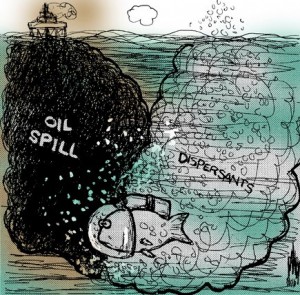
Meanwhile, both Allen and the Environmental Protection Agency on Monday defended the safety of chemicals credited with breaking up the oil into tiny droplets and dispersing it into the Gulf. The EPA said Monday those dispersants hastened the decomposition of the oil, a process that may also have kept vast quantities of oil from fouling the shoreline. BP, which used more than 1.84 million gallons of dispersants, stopped applying them shortly after it put the cap in place.

The EPA said Monday its new study found the dispersants used to break up oil in the Gulf are no more toxic when mixed with oil than the oil is on its own.
Dispersants were used as a “last resort and necessary tool, when all other measures were not adequate” against the oil, said Paul Anastas, the EPA’s assistant administrator for research and development. Oil, Anastas said, was “enemy No. 1.”

So far, the government’s monitoring data shows no accumulation of dispersant in marine life that was tested, including on juvenile shrimp and small fish that are found in the Gulf and are commonly used in toxicity testing.

All eight dispersants were found to be less toxic than the dispersant-oil mixture to both species. Oil was more toxic to shrimp than the eight dispersants when tested alone. Oil alone had similar toxicity to shrimp as the dispersant-oil mixtures, with exception of one other dispersant, which was found to be more toxic than oil.

However, Anastas also said there’s “ongoing monitoring” by a number of federal agencies, including the Food and Drug Administration, to ensure the food chain is not affected. The EPA hasn’t found any dispersant “away from the wellhead,” Anastas said, including in sediment or near coastal wetlands.

He called it “interesting to see that the dispersant/oil mixture was about the same toxicity as oil alone. That shows us that the effect of oil plus dispersant seemed to be a wise decision and that oil itself is the hazard we’re concerned about.”

Often, Allen said, the government was making decisions “without complete information, and sometimes under conditions of uncertainty because we have never used dispersants at this level before.”

“That was done, and to the extent there’s an issue about it, I’m the National Incident Commander and I’m accountable,” he said.

Yet scientists say many questions remain about the use of the chemicals, and congressional investigators still plan a hearing Wednesday to examine why the U.S. Coast Guard allowed BP to continue using dispersants in the face of multiple warnings from the EPA.

“The Coast Guard proceeded to approve use of surface dispersants 74 times over a period of 48 days,” said Rep. Ed Markey, D-Mass. “That is not ‘rare’ by anyone’s understanding of the word, and it raises questions regarding whether an excessive amount of surface dispersant may have been used.”

Jerald Ault, a professor at the University of Miami’s Rosenstiel School of Marine and Atmospheric Science, said he’s worried about the potential cascading effects of the dispersant in marine life and how it could effect physical growth, reproduction and mortality. Some of the effects on the environment may not play out for some time, he said.
“It’s good to say it’s in the same ballpark as oil, but from where I sit, that’s one plus one,” he said. “I buy that it’s a tradeoff, but the question is: ‘What are the consequences of the tradeoff?’ I’m not sure we have the ability to determine that at this point.”

Other scientists have linked subsea plumes of oil to the well, and fear that the tiny droplets 4,300 feet below the surface of the Gulf will be more readily absorbed and ingested by marine animals.

“These particles of dispersed oil are small enough to be easily absorbed by filter feeding animals such as oysters, and also absorbed into the bodies of crabs and shrimp,” said Gina Solomon, a senior scientist with the Natural Resources Defense Council. “Big globs of oil wouldn’t get into these creatures as easily. That may mean a higher likelihood of contamination in the food chain, which would be bad news for predators in the ocean and also maybe for humans if seafood becomes more contaminated with oil residues.”

Special thanks to Richard Charter
OpEdNews.com: Over 60 Percent of BP Waste Dumped in Minority Communities

http://www.opednews.com/articles/Over-60-Percent-of-BP-Wast-by-Robert-Bullard-100730-66.html

For OpEdNews: Robert Bullard – Writer

As of July 15, more than 39,448 tons of BP oil spill waste was disposed in nine approved landfills in Alabama, Florida, Louisiana, and Mississippi. Five of the nine the landfills receiving BP oil-spill solid waste are located in communities where people of color comprise a majority of residents living within a one-mile radius of the waste facilities.

A significantly large share of the BP oil-spill waste, 24,071 tons out of 39,448 tons (61 percent),was dumped in people of color communities. This is not a small point since African Americans make up just 22 percent of the coastal counties in Alabama, Florida, Mississippi, and Louisiana, while people of color comprise about 26 percent of the population in coastal counties.These numbers present significant environmental justice implications that have not been addressed by government, including the U.S. EPA.

It is clear that theflow of BP oil-spill waste to Gulf Coast communities is not random. A disproportionately large share of the oil waste is headed to African American and other people of color communities. Dumping BP disaster waste on communities of color is not “green” nor is it a pathway to recovery and long-term sustainability,

Allowing BP, Gulf Coast states, and the private disposal industry to select where the oil-spill waste is dumped only adds to the legacy of environmental racism and unequal protection. Environmental justice communities and their allies are demanding that BP end the unfair waste dumping practice. They also want to see EPA and the U.S. Coast Guard engage in a more rigorous oversight of BP’s waste plan to ensure that no single community or population in the Gulf Coast states becomes the oil-spill waste dumping grounds.

_________________________

http://dissidentvoice.org/2010/07/bp’s-waste-management-plan-raises-environmental-justice-concerns/

BP’s Waste Management Plan Raises Environmental Justice Concerns
by Robert D. Bullard / July 29th, 2010

Much attention the past three months has been focused on the British Petroleum (BP) oil spill disaster and clean up efforts. Government officials estimate that the ruptured well leaked between 94 million and 184 million gallons of oil into the Gulf. However, not much attention has been given to which communities were selected as the final resting place for BP’s oil-spill garbage.

A large segment of the African American community was skeptical of BP, the oil and gas industry, and the government long before the disastrous Gulf oil disaster, since black communities too often have been on the receiving end of polluting industries without the benefit of jobs and have been used as a repository for other people’s rubbish.

Given the sad history of waste disposal in the southern United States, it should be no surprise to anyone that the BP waste disposal plan looks a lot like “Dumping in Dixie,” and has become a core environmental justice concern, especially among low-income and people of color communities in the Gulf Coast – communities whose residents have historically borne more than their fair share of solid waste landfills and hazardous waste facilities before and after natural and man-made disasters.

For decades, African American and Latino communities in the South became the dumping grounds for all kind of wastes – making them “sacrifice zones.” Nowhere is this scenario more apparent than in Louisiana’s “Cancer Alley,” the 85-mile stretch along the Mississippi from Baton Rough to New Orleans. Gulf Coast residents, who have for decades lived on the fenceline with landfills and waste sites, are asking why their communities are being asked again to shoulder the waste disposal burden for the giant BP oil spill. They are demanding answers from BP and the EPA in Washington, DC and the EPA Region 4 office in Atlanta and EPA Region 6 office in Dallas – two EPA regions that have a legacy of unequal protection, racial discrimination, and bad decisions that have exacerbated environmental and health disparities.
Today we are seeing a disturbing pattern re-emerge in the disposal of the BP oil-spill waste. Because of the haphazard handling and disposal of the wastes from the busted well, the U.S Coast Guard and the U.S. EPA leaned on BP and increased their oversight of the company’s waste management plan. BP’s waste plan, “Recovered Oil/Waste Management Plan Houma Incident Command,” was approved on June 13, 2010.

BP hired private contractors to cart away and dispose of thousands of tons of polluted sand, crude-coated boom and refuse that washed ashore. The nine approved Gulf Coast solid waste landfills, amount of waste disposed, and the percent minority residents living within a one-mile radius of the facilities are listed below:

Alabama
Chastang Landfill, Mount Vernon, AL, 6008 tons (56.2%) Magnolia Landfill, Summerdale, AL, 5,966 tons (11.5%)

Florida
Springhill Regional Landfill, Campbellton, FL, 14,228 ton (76.0%)

Louisiana
Colonial Landfill, Ascension Parish, LA, 7,729 (34.7%) Jefferson Parish Sanitary Landfill, Avondale, LA, 225 tons (51.7%) Jefferson Davis Parish Landfill, Welsh, LA, 182 tons (19.2%) River Birch Landfill, Avondale, LA, 1,406 (53.2%) Tide Water Landfill, Venice, LA, 2,204 tons (93.6%)

Mississippi
Pecan Grove Landfill, Harrison, MS, 1,509 tons (12.5%)

According to BP’s Oil Spill Waste Summary, as of of July 15, more than 39,448 tons of oil garbage had been disposed at nine approved landfills in Alabama, Florida, Louisiana, and Mississippi. More than half (five out of nine) of the landfills receiving BP oil-spill solid waste are located in communities where people of color comprise a majority of residents living within near the waste facilities.

In addition, a significantly large share of the BP oil-spill waste, 24,071 tons out of 39,448 tons (61 percent), is dumped in people of color communities. This is not a small point since African Americans make up just 22 percent of the coastal counties in Alabama, Florida, Mississippi, and Louisiana, while people of color comprise about 26 percent of the population in coastal counties.

Clearly, the flow of BP oil-spill waste to Gulf Coast communities is not random. The mix of waste and race was the impetus behind the Environmental Justice Movement in Warren County, North Carolina more than twenty-five years ago. In 1982, toxic PCBs were cleaned up from North Carolina roadways and later dumped in a landfill in mostly black and poor Warren County. We also saw the pattern in 2009 when 3.9 million tons of toxic coal ash from the massive Tennessee Valley Authority (TVA) power plant spill in East Tennessee was cleaned up and shipped more than 300 miles south by train and disposed in a landfill in rural and mostly black Perry County, Alabama.

The largest amount of BP oil-spill solid waste (14,228 tons) was sent to a landfill in a Florida community where three-fourths of the nearby residents are people of color. Although African Americans make up about 32 percent of Louisiana’s population, three of the five approved landfills (60 percent) in the state that received BP oil-spill waste are located in mostly black communities. African American communities in Louisiana’s Gulf Coast were hardest hit by Hurricane Katrina and have experienced the toughest challenge to rebuild and recover after five years. Dumping more disaster waste on them is not a pathway to recovery and long-term sustainability.

Clearly, Environmental Justice Executive Order 12898, “Federal Actions to Address Environmental Justice in Minority Populations and Low-Income Populations,” signed by President William J. Clinton in 1994, requires the EPA and the U.S. Coast Guard to do a better job monitoring where BP oil-spill waste ends up to ensure that minority and low-income populations do not bear an adverse and disproportionate share of the burdens and negative impacts associated with the disastrous BP oil spill. Allowing BP, Gulf Coast states, and the private disposal industry to select where the oil-spill waste is dumped only adds to the legacy of environmental racism and unequal protection.

Robert D. Bullard is director of the Environmental Justice Resource Center (EJRC) at Clark Atlanta University and author of Race, Place, and Environmental Justice After Hurricane Katrina: Struggles to Reclaim, Rebuild, and Revitalize New Orleans and the Gulf Coast (Westview 2009). He can be reached at: rbullard4ej@worldnet.att.net. Read other articles by Robert D., or visit Robert D.’s website.

This article was posted on Thursday, July 29th, 2010 at 7:59am and is filed under Discrimination, Environment, Oceans/Seas, Oil, Gas, Pipelines. SPecial thanks to Richard Charter

New York Times: Gulf Spill Is the Largest of Its Kind, Scientists Say

August 2, 2010,

By CAMPBELL ROBERTSON and CLIFFORD KRAUSS

NEW ORLEANS — The BP spill is by far the world’s largest accidental release of oil into marine waters, according to the most precise estimates yet of the well’s flow rate, announced by federal scientists on Monday.

Nearly five million barrels of oil have gushed from BP’s well since the Deepwater Horizon rig exploded on April 20, according to the latest data. That amount outstrips the estimated 3.3 million barrels spilled into the Bay of Campeche by the Mexican rig Ixtoc I in 1979, previously believed to be the world’s largest accidental release.

The BP spill was already thought to be the largest spill in American waters, but it was unclear whether it had eclipsed Ixtoc.

‘We’ve never had a spill of this magnitude in the deep ocean,” said Ian R. MacDonald, a professor of oceanography at Florida State University.

“These things reverberate through the ecosystem,” he said. “It is an ecological echo chamber, and I think we’ll be hearing the echoes of this, ecologically, for the rest of my life.”

Federal science and engineering teams, citing data that are “the most accurate to date,” estimated that 53,000 barrels of oil a day were pouring from the well just before BP was able to cap it on July 15. They also estimated that the daily flow rate had diminished over time, starting at about 62,000 barrels a day and decreasing as the reservoir of hydrocarbons feeding the gusher was gradually depleted. Before Monday’s announcement, federal scientific teams had estimated the spill in a range from 35,000 to 60,000 barrels a day.

The teams believe that the current estimates are accurate to within 10 percent. They also reported that of the roughly 4.9 million barrels that had been released from the well, about 800,000 had been captured by BP’s containment efforts. That leaves over four million barrels that gushed into the Gulf of Mexico from April 20 to July 15.

As the estimates of the number of barrels spilled increases, so, too, do the penalties under the Clean Water Act, which calls for fines of $1,100 per barrel, or $4,300 per barrel if the government finds that gross negligence led to the spill.

At 4.9 million barrels, that means that the total fine could be $5.4 billion — and, if gross negligence led to the spill, $21 billion. If BP successfully argues that the 800,000 barrels it has recovered should mitigate the penalty, then the figure drops to $4.5 billion and $17.6 billion, respectively.

The amount of oil estimated to be pouring from the well has been a matter of dispute from the earliest days of the spill. Federal and BP officials initially announced that no oil appeared to be leaking, then 1,000 barrels a day, then 5,000 a day, frequently repeating that spill estimates are rough at best and that the main goal was to stop the well. But criticism mounted that no effort was being made to measure the leak with more certainty.

The Obama administration announced the creation of a scientific group dedicated to analyzing the flow rate, which came up with a new estimate of 12,000 to 19,000 barrels a day in late May, a figure that was met with skepticism. That, too, was later revised upward several times before Monday’s announcement. Previous estimates came from analysis of videos from remote-controlled vehicles at the wellhead, modeling of the reservoir and measurements of the oil that was collected by surface ships in the response effort.

After BP capped the well, these measurements could be reinforced by pressure readings within the well. Those pressure readings were compared with pressure estimates when the well was first drilled to determine whether the rate had changed over time, which it apparently had.

The government is continuing to study the data and may refine the estimate.

Meanwhile, BP continued efforts Monday to permanently seal the well. It said it was preparing to conduct final testing on Tuesday to determine whether to go ahead with a plan to pump heavy drilling mud into the runaway Macondo well, in hopes of permanently sealing it by the end of the week.

During the tests, a surface ship will slowly inject small amounts of mud into the well to make sure the mud will reach the oil reservoir from the column of pipes and valves that sit atop it. If that is accomplished, BP will pump higher volumes of mud, and possibly cement, into the well, in an operation known as a static kill or bullheading.

BP executives said Monday that they expected positive results from the tests, which will also check the pressure of the well to ensure that it is safe to pump the mud.

The efforts come 18 days after BP placed a tight-fitting cap on the well that put a temporary end to months of leaking. Engineers had planned to begin the tests on Monday but had to delay when they found a small hydraulic leak in the capping control system above the well.

Kent Wells, senior vice president for exploration and production at BP, said on Monday that a day or two after the pumping of mud began, engineers would consider pumping cement into the well, which could permanently plug it. Engineers might also decide to wait for a relief well to be completed before pumping cement in. There is also a chance that they will pump cement during the static kill and later through the relief well, to make sure the runaway well is sealed.

“We want to end up with cement in the bottom of the hole, completely filling the entire Macondo well,” Mr. Wells said Monday. “Whether that comes from the top or whether it comes from the relief well, those will be decisions made along the way.”

An estimated 2,000 pounds of mud is to be flooded into the well this week.

Thad W. Allen, the retired Coast Guard admiral who is leading the federal response to the spill, cautioned against rushing to declare the static kill a final victory over the well. “I don’t think we can see this as the end-all, be-all, until we actually get the relief wells done,” he said.

Mr. Wells said the last 100 feet of the first of two relief wells should be completed by Aug. 15. A final killing of the well by pouring mud and cement just above the reservoir could take a few days or as much as a few weeks. If the first relief well somehow misses its target, a second one is being drilled for insurance.

Campbell Robertson reported from New Orleans, and Clifford Krauss from Houston. Catrin Einhorn and John Schwartz contributed reporting from New York. Special thanks to Richard Charter

Las Vegas Sun: Preventing more spills: Senate should follow House by tightening offshore oil drilling regulations

I just sent emails to my Florida senators urging them to pass this bill now, before the recess, and before the November elections, when it may become even harder to move energy legislation forward. This is a good first step, not comprehensive by any means, but at least SOMETHING. DV

Tuesday, Aug. 3, 2010 | 2:05 a.m.
http://www.lasvegassun.com/news/2010/aug/03/preventing-more-spills/

It is unfortunate that it often takes a tragedy before Congress acts on needed legislation, whether the subject is Wall Street reform, product safety or homeland security. The debacle of the past four months caused by the massive BP oil spill in the Gulf of Mexico, a mishap caused by an oil rig explosion in April that killed 11 workers, is the latest example of a tragedy that cries for a legislative response.

The Democratic-controlled House, in a vote split mostly along party lines, took the common- sense route last week when it approved legislation that would eliminate the $75 million liability cap for oil companies responsible for spills. This cap has to go because taxpayers and businesses affected by a spill should not be forced to pay for any economic harm that exceeds $75 million. That onus should fall on the oil companies responsible.

The House bill also calls for needed offshore safety and environmental measures, such as regulations on the installation of safety devices intended to prevent oil well blowouts. There is also a ban on additional offshore drilling leases for companies that have shown a disregard for worker safety and the environment.

Had such measures been in place before the Deepwater Horizon disaster, they likely would have spared 11 lives and prevented as much as 184 million gallons of oil from gushing into the Gulf. Wildlife would have been saved, beaches would have remained clean and the Gulf’s fishing industry would have been free from disruption.

We encourage the Senate to swiftly approve similar legislation sponsored by Majority Leader Harry Reid. In addition to the tougher offshore drilling regulations, Reid’s bill would create jobs by subsidizing the production and sale of vehicles that use electricity or natural gas. And homeowners would be rewarded with subsidies to make their homes more energy efficient.

Reid said his bill would prevent BP from repeating what it has done to the American people. Who would want to argue with that? The Nevada Democrat doesn’t stop there, though. He also recognizes the need for this country to forge a broader energy strategy that helps both the economy and the environment.

“We also want to lessen our dependence on foreign oil,” he said. “So we’re going to move to converting our truck fleets to natural gas.”

It should not come as a shock that Senate Republicans, who are beholden to Big Oil, will do everything in their power to make sure BP and fellow offshore oil drillers continue to go about their business without regard for worker safety or environmental protection. It was bad enough that BP acted irresponsibly. But the fact that Republicans refuse to join Democrats in passing such crucial legislation compounds the tragedy.
Special thanks to Richard Charter

"Be the change you want to see in the world." Mahatma Gandhi