Truthout: Experts: Health Hazards in Gulf Warrant Evacuations

It is so utterly senseless that our government is not only allowing, but is actually facilitating the poisoning of its people. There is no other way to interprete this. DV
http://www.truth-out.org/toxic-dispersants-causing-widespread-illness61604

Thursday 22 July 2010
by: Rose Aguilar, t r u t h o u t | Report

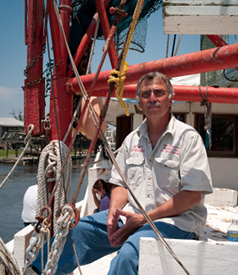
George Barisich has been a fisherman in New Orleans for over 40 years. Some experts are concerned that toxic chemicals being used to help clean up the oil spill in the Gulf are seriously endangering the health of those living near the water. (Photo: bbcworldservice / Flickr)
When Louisiana residents ask marine toxicologist and community activist Riki Ott what she would do if she lived in the Gulf with children, she tells them she would leave immediately. “It’s that bad. We need to start talking about who’s going to pay for evacuations.”
In 1989, Ott, who lives in Cordova, Alaska, experienced firsthand the devastating effects of the Exxon Valdex oil disaster. For the past two months, she’s been traveling back and forth between Louisiana and Florida to gather information about what’s really happening and share the lessons she learned about long-term illnesses and deaths of cleanup workers and residents. In late May, she began meeting people in the Gulf with symptoms like headaches, dizziness, sore throats, burning eyes, rashes and blisters that are so deep, they’re leaving scars. People are asking, “What’s happening to me?”
She says the culprit is almost two million gallons of Corexit, the dispersant BP is using to break up and hide the oil below the ocean’s surface. “It’s an industrial solvent. It’s a degreaser. It’s chewing up boat engines off-shore. It’s chewing up dive gear on-shore. Of course it’s chewing up people’s skin. The doctors are saying the solvents are making the oil worse.”
In a widely watched YouTube video, from Project Gulf Impact, a project that aims to give Gulf residents a voice, Chris Pincetich, a marine biologist and campaigner with the Sea Turtle Restoration Project, said Coast Guard planes are flying overhead at night spraying Corexit on the water and on land.
Ott says people who are experiencing discomfort of any kind, especially children, pregnant women, cancer survivors, asthma sufferers and African-Americans because they’re prone to sickle cell anemia, should wear a respirator and see a doctor that specializes in chemical poisoning immediately. She also recommends contacting the detox specialists at The Environmental Health Center in Dallas, Texas. “People don’t have the information to know that the burning sore throat is actually chemical poisoning,” she said. “And this isn’t getting any attention, but it’s very important. There are no vaccinations for chemical poisoning. None.”
Because she’s gotten to know the locals and has done a number of national media interviews, she’s now receiving a barrage of daily phone calls and emails from people who are concerned and don’t know where else to turn. She recommends they read this Sciencecorps resource about potential health hazards.
In the video above, author and journalist Summer Burke talks about her experience being sprayed with the toxic dispersant Corexit.
Ott shared these stories on a recent trip to the Bay Area with Diane Wilson, former Texas shrimper turned rabble-rousing activist. Ott was coughing and constantly clearing her throat during our two-hour conversation. “I can still smell the oil,” she said.
Media outlets have been reporting on public health concerns and taking water quality samples, but Ott says they’ve only scratched the surface. “If I were in charge of the media, I would be talking be about public safety and public health every day. They should also be exposing the truth about how our federal standards are outdated and no longer protective of public health or worker safety. We knew in 1989 that OSHA had a loophole in it that’s big enough to drive every single sick worker through. It exempts the reporting of colds and flus. That loophole has not been closed since Exxon Valdez.”
Ott expressed her concerns during a May meeting with Environmental Protection Agency (EPA) administrator Lisa Jackson. “I was sitting across from her. She said, quote, ‘I am walking a fine line between truth and hysteria. We don’t want to create a panic.’ This shows you how much our government is beholden to oil and cannot imagine a future without oil. We the people have got to imagine this. We have to. This is way worse than people think.”
On Tuesday, Mother Jones’ Kate Sheppard reported that Hugh Kaufman, a whistleblower who works as a senior policy analyst in the EPA’s Office of Solid Waste and Emergency Response, is accusing the agency of deliberately downplaying public health threats and its own role in regulating the chemicals being dumped into the Gulf “to protect itself from liability and keep the public from getting too alarmed.”
The cause for alarm can’t be more apparent. In addition to the health problems people are already experiencing, WKRG News 5 reporter Jessica Taloney recently collected samples of water and sand from five Alabama beaches and took them to a local lab to be tested.
Bob Naman, a chemist with nearly 30 years of experience, told Taloney that he wouldn’t expect to see more than five parts per million of oil and petroleum in the water. The sample of the water taken in Gulf Shores beach, where adults and kids were swimming and playing, showed 66 parts per million. The sand had 211 parts per million. When Naman began to test the sample collected from Dauphin Island Marina, it exploded. “We think that it mostly likely happened due to the presence of methanol or methane gas or the presence of the dispersant, Corexit.”
“What’s going on in the Gulf is the same cover-up that was going with the 9/11 environmental issue,” the EPA’s Kaufman told Sheppard. “The Bush White House ordered EPA to lie about the environmental and public health situation at the World Trade Center because of economic ramifications. So they did.”
On Democracy Now!, Kaufman accused the EPA of being “sock puppets for BP in this cover-up.”
I called Kaufman to find out if he agrees with Ott’s decision to sound the alarm about evacuations. The short answer? Yes. “If you’re getting sick, it’s because you’re being poisoned,” he said. “Those chemicals can cause cancer 20 years down the line and that’s why Riki Ott is saying some areas have to be evacuated. That’s true. We don’t know how bad it is because the EPA is not doing adequate air testing. They’re taking some measurements so they can tell the public that everything is safe [when in fact the public has] an increased risk of getting cancer and dying early. They’re pawns in a money game.”
Kaufman and Ott both say the media need to follow the money. The reason why the EPA is covering this up, they say, is because the cost to BP would be astronomical. “The dispersants hide the oil,” said Ott. “If you put dispersants in the water, you don’t know how much oil was really spilled. Oil fines are based on how much oil was spilled, so it’s all about money.”
If a group listed as a terrorist organization had caused the oil disaster, Kaufman says their assets would be seized immediately and their members would be arrested. So, why hasn’t the US government seized BP’s assets? Kaufman points to an April Vanity Fair article about Larry Fink, one of the most powerful men on Wall Street. Fink’s BlackRock money-management firm controls or monitors more than $12 trillion worldwide, including a billion shares of BP. According to the article, BlackRock “has effectively become the leading manager of Washington’s bailout of Wall Street,” thanks to Fink’s close relationship with former Treasury Secretary Henry Paulson and Treasury Secretary Timothy Geithner.
“It’s all about money,” says Kaufman. “Follow the money.”
So, where does this leave the people whose lives have been destroyed by this disaster? Where does this leave the people who will face long-term health problems? Where does this leave our oceans, wildlife and environment? What’s next?
“The more the public knows, the more the media cover it, the more the people tell officials to help, the better it is,” says Kaufman. “It’s a game of momentum.”
Ott says she plans to stay in the area to assist where she can (getting respirators for workers is near the top of her list), get the truth out and continue the conversations and community meetings she’s having with self-described Tea Partiers, evangelicals and fifth and sixth generation fisherman. “Here’s something positive for you,” she said. “I’m starting to hear, ‘We all live on one planet and there really is a climate crisis here. This can’t continue.’ I’m having conversations with the Christian Right. I’m staying in an oilman’s camper. Oilmen are starting to see that we need alternatives. I’m having tea party people come up to me and say, ‘How can I help?’ Corporations want to divide the nation into red and blue, Democrat and Republican. I’m seeing that crashing down. The frames are dissolving. The South is rising. I’m talking about the Deep South. This is the most hopeful sign I’m seeing.”
Former shrimper Diane Wilson hopes to see more direct action. “This is a crisis. If this oil gusher does not move people to force a change in Washington, then it will never happen. We are seeing the end of the United States as we know it. If people hold their planet dear, they better be out there. Folks are too well behaved. We need to be unreasonable.”

FAIR USE NOTICE: This may contain copyrighted material the use of which has not always been specifically authorized by the copyright owner. Such material is made available to advance understanding of ecological, political, human rights, economic democracy, scientific, moral, ethical, and social justice issues, etc. It is believed that this constitutes a “fair use” of any such copyrighted material as provided for in section 107 of the US Copyright Law. In accordance with Title 17 U.S.C. Section 107, this material is distributed without profit to those who have expressed a prior general interest in receiving similar information for research and educational purposes. For more information on this topic go to: http://www.law.Cornell.edu/uscode/17/107.html

Special thanks to Ashley Hotz

New Orleans Times-Picayune: Storm’s passage reveals problems with oil spill response

http://www.nola.com/news/gulf-oil-spill/index.ssf/2010/07/storms_passage_reveals_problem.html

Published: Monday, July 26, 2010, 8:45 AM Updated: Monday, July 26, 2010, 8:46 AM
Jeff Adelson, The Times-Picayune

Photo by Eliot Kamenitz / The Times-Picayune
Drilling rigs and support ships return to the Deepwater Horizon accident site on Sunday after their evacuation from Tropical Storm Bonnie.

As officials surveyed a coastline left nearly unchanged by the passage of Tropical Storm Bonnie on Sunday, crews worked to restart key operations aimed at permanently stopping the flow of oil from the damaged BP well into the Gulf of Mexico.

Though Bonnie had little effect on the oil in the Gulf, the storm’s passage revealed some new problems with the booms used to protect the coastline, and it strained the relationships in the web of local and federal officials charged with defending the area from the oil.

Now that the latest threat of stormy weather has passed, officials are working on new plans to scale back the amount of boom they deploy, to prevent the barriers themselves from damaging sensitive marshes.

Officials are also working to refine plans to prevent the “misunderstandings” that led to a series of complaints and threats from parish leaders over the redeployment of resources as Bonnie approached.

Of the spill-fighting vessels returning to the area around the damaged well, “the critical ones are out there right now,” said Thad Allen, the National Incident Commander overseeing the response to the Deepwater Horizon response, in an 11 a.m. news briefing. All assets should be back at the site sometime today, said Allen, a retired U.S. Coast Guard admiral.

The waters above the spill off the Louisiana coastline were emptier of ships than they have been since the immediate aftermath of the explosion on the Deepwater Horizon rig. Oil began flowing into the Gulf after that explosion, which killed 11 workers on the platform, and the subsequent sinking of the rig.

During an overflight Sunday afternoon, the two rigs working on relief wells could be seen back at the site, and several other large support vessels had already moved back into the area. There was no sign of heavy oil near the wellhead.

Work resumes

Crews are working to re-extend the pipeline running from the rig working on the primary relief well and expected to have latched back onto the well by midnight Sunday, Allen said. The “static kill, ” which will be attempted after the relief wells connect to the well that was attached to the Deepwater Horizon, will pump material into the well in an effort to staunch the flow of oil. Officials believe they can go ahead with that effort sometime during the first week of August.

The relative quiet in the Gulf was a blessing of sorts for responders who had a chance to conduct seismic tests without interference from other vessels, Allen said.

The cap on the Macondo well is still holding, and its pressure has risen above 6,900 pounds per square inch, he said. That should be taken as a sign of “a well that has integrity, ” Allen said. More resources are being moved into the area to allow about 80,000 barrels a day to be pumped out of the capped well, he said.

In St. Tammany, crews began to redeploy the barges that guard the Rigolets from oil, though crosswinds delayed those efforts. Parish President Kevin Davis said they will be put into place as soon as possible and noted that a skimmer used to gather oil in the area had been brought back into service Sunday.

Throughout the day, flights searched for oil near the coast. Much of the oil now seems to have moved toward the Mississippi Sound, the Chandeleur Islands and Breton Sound, and responders will be sent to protect those areas and determine what, if any, damage has already been caused, Allen said.
There was no sign that oil had been pushed closer to Lake Pontchartrain, Davis said.

‘Family fight’

As the threat from Bonnie passed, officials found themselves dealing with the aftermath of another storm, one of words and proclamations. With a tropical storm bearing down on the area, Allen ordered that oil-cleanup vessels and equipment not needed on the scene to deal specifically with the storm be moved to be kept out of danger.

This drew protests by Plaquemines Parish President Billy Nunngesser and threats from Davis, who issued an executive order calling for the arrest of anyone who attempted to move equipment needed to protect the Rigolets and the Lake Pontchartrain.

Both officials worried that the order would leave their parishes vulnerable just as they needed the most protection from oil borne by storm surge.

Federal and local officials downplayed their disagreements Sunday, with New Orleans Mayor Mitch Landrieu referring to the spat as “typical family fight.”
“I’m very happy with what I saw today,” Landrieu said. “We were concerned about the ability to redeploy assets quickly, and the Coast Guard has done that, I think, with great expertise. Everyone is back in the fight.”

Allen did not back down from his earlier stance Sunday, recalling scenes from his work with the Coast Guard after Hurricane Katrina to drive the point home. He said he is “still haunted” from a flyover of the city on Sept. 6, 2005, when he saw lines of school buses that could have been used to aid in an evacuation sitting flooded in a lot.

Whenever there is a threat of gale-force winds, those over 39 mph, “for the safety of the personnel, we need to pull them back,” Allen said.
But, he added: “We didn’t pull them way far away.”

Practice run

To plan for future storms — and prevent similar “misunderstandings” between local and federal officials — Coast Guard Rear Adm. Paul Zukunft said he plans to meet with local leaders this week to discuss how the government will respond to storms from here on out.

The effort has given officials the practice of a dry run and a chance to work out these issues before a serious storm hits, said Zukunft, the federal on-scene coordinator for the response.

And, responding to concerns that once equipment left the area it would not be brought back, Zukunft said: “At no point are we talking about any diminishment of the level of effort.”

But the relief over Bonnie’s dissipation was mixed with a seemingly counter-intuitive regret that the storm had not kept its strength and continued on its path, an outcome that could have helped clean contaminated marshes.
Steve Lehmann, a scientific support coordinator at the National Oceanographic and Atmospheric Administration, said the northern winds that would have hit New Orleans had Bonnie remained a cyclone and come from the east would have flushed oily water out of the marshes.

Officials have also discovered a new problem with the strategy aimed at protecting those marshes. Boom that surrounded marshes in some areas were pushed into the wetlands by the rising water, becoming bludgeons that smashed the delicate plant life they once protected.

“Just the mechanical action of the boom being dragged over the marshes is not desirable,” he said. “That may cause more damage to the marsh than the oil would if it was there.”

Lehmann later referred to the issue by noting that the boom are “terrific technology that has become a liability.”

With evidence that the boom that was laid around hundreds of miles of coast may now be a threat, officials are considering a much more scaled-back deployment in the future. Rather than string boom around the coast, the floating barriers will be kept ready for deployment and laid out in areas only when it appears oil will shortly become a threat.

“We’ll be more surgical about where we put boom,” Zukunft said.

Jeff Adelson can be reached at jadelson@timespicayune.com or 985.645.2852.

1

Comments Feed

marlinfish July 26, 2010 at 9:00AM
Follow

NOAA maps show new oil landing all along the LA Coast. Where are the reports on this? And when is someone going to start testing for the toxic dispersant COREXIT. Scientist Terry Hazen from Berkeley, CA reported that after the 1970’s oil spill in NORMANDY France, areas untreated with dispersants recovered in 5 years but that areas treated with dispersants have still not recovered.

Special thanks to Richard Charter.

Christian Science Monitor: Activists frustrated at Obama’s environmental record

http://www.csmonitor.com/Environment/2010/0725/Activists-frustrated-at-Obama-s-environmental-record

Environmental activists were delighted to have Barack Obama replace George W. Bush as president. But greens are increasingly unhappy with Obama’s record – especially on climate change.

President Barack Obama surveys damage along the Louisiana coastline caused after a BP oil line ruptured in the Gulf of Mexico. Environmental activists say Obama should have used the Gulf oil spill to push for a cap on carbon emissions linked to global warming.
Larry Downing/Reuters

By Brad Knickerbocker, Staff writer / July 25, 2010
When Barack Obama took over the White House from George W. Bush, environmental activists breathed a collective sigh of relief.

Under Bush and vice president Dick Cheney, resource extraction – logging, mining, drilling for oil and gas – as often as not were favored over protection of habitat and endangered species. So was carbon-emitting energy production over conservation and “green” renewable energy.

No surprise there, since both Bush and Cheney had been oil men. It was more than symbolic that environmentalists got short shrift in the backroom meetings of Cheney’s energy task force.

But things would be different with a progressive, young Democrat in the White House, enviros thought.

‘A green, dream team’

Just as important to those looking for a change in direction were Obama’s appointments to high environmental offices: Carol Browner, who’d headed the EPA under Bill Clinton, as White House climate and energy policy chief; Lisa Jackson, former head of the New Jersey Department of Environmental Protection, as EPA administrator; former director of the Colorado Department of Natural Resources and US Senator Ken Salazar as secretary of the Interior; and as secretary of Energy, Nobel Prize-winning physicist Steven Chu.
Together, they were seen as “a green dream team,” as Gene Karpinski, head of the League of Conservation Voters, put it at the time.

Indeed, things did change – particularly regarding climate change and declared energy policy as it relates to creating jobs and improving the economy. And from the California Bay Delta to the Great Lakes to Chesapeake Bay, the Obama administration pushed new strategies for environmental protection and restoration.

But recently, Obama and his administration have been taking flak from the left on the environment.

This past week, the Center for Biological Diversity sued the US Forest Service for failing to monitor and protect endangered species and habitat in Arizona and New Mexico national forests.

“The big picture for species recovery in southwestern national forests is grim,” said Taylor McKinnon, the group’s public lands campaigns director. “In addition to failing to monitor and protect endangered species while implementing the current forest plans, the Forest Service is aiming to roll back species protections in its new plans. In the long run, that’s a recipe for extinction.”

Another lawsuit

A week earlier, the same organization sued Interior Secretary Salazar for not turning over emails, phone logs, and notes from his meetings with oil-industry lobbyists before the BP oil spill when the administration agreed to more offshore oil and gas drilling.

“We want to know who Salazar was talking to, what was said, and what deals were made,” said Kierán Suckling, executive director of the organization. “The Obama administration pledged to be open and transparent in its decision-making, but when it comes to meeting with oil industry lobbyists, this administration is as secretive as the Cheney-Bush White House.”

In the Pacific Northwest, environmentalists are urging Obama to not allow the shipping of large equipment up the Columbia and Snake Rivers – habitat for threatened and endangered salmon – to a tar sands oil project in Alberta.

“Canadian tar sands development is one of the largest, most destructive industrial projects on earth,” warns Save Our Wild Salmon, a coalition of conservation groups and businesses.

Meanwhile, some government scientists say they still feel pressure to adjust their work for political considerations.

“We are getting complaints from government scientists now at the same rate we were during the Bush administration,” Jeffrey Ruch, who heads the whistleblower group Public Employees for Environmental Responsibility, told the Los Angeles Times.

But it is the inability to get comprehensive energy and climate legislation that environmental advocates see as Obama’s biggest failure.

“Obama is the first president in history to articulate in stark terms both the why and how of the sustainable clean energy vision,” writes physicist and author Joseph Romm. “But the question now is whether he really believed what he said.”

Writing in the current issue of Rolling Stone, Tim Dickinson says, “Obama, so far, has shown no urgency on the issue, and little willingness to lead – despite a June poll showing that 76 percent of Americans believe the government should limit climate pollution.”

‘Did Obama kill the climate bill?”

The headline on Josh Harkinson’s piece in Mother Jones reads “Did Obama Kill the Climate Bill?”

“After BP’s well blew out, Obama’s infamously milquetoast address from the Oval Office never connected the disaster with the need for a cap on carbon,” Harkinson writes. “All of this wasn’t for a lack of pressure from his allies. Nine high-profile environmental groups wrote a letter to the president pleading that ‘nothing less than your direct personal involvement’ will break the logjam in the Senate.”

This past week, Senate Majority Leader Harry Reid acknowledged that he didn’t have the votes to pass the kind of cap-and-trade energy reform bill approved by the House a year ago. Instead, Reid is expected to detail a much-slimmed-down energy bill, minus any climate provision that would have capped carbon dioxide and other greenhouse gas emissions.

Many of Obama’s critics in the environmental community are spring-loaded to sound the alarm – or file a lawsuit – no matter who is in the White House. For some, it’s a good fund-raising tactic.

But for now, activists are finding that the “dream team” they once rejoiced in is not so green.

Special thanks to Richard Charter

McClatchy Washington Bureau: Researchers confirm subsea Gulf oil plumes are from BP well

Big surprise…..DV

http://www.mcclatchydc.com/2010/07/23/98088/researchers-confirm-subsea-gulf.html
Posted on Fri, Jul. 23, 2010

Sara Kennedy | McClatchy Newspapers

last updated: July 24, 2010 01:33:33 PM

ST. PETERSBURG, Fla. – Through a chemical fingerprinting process, University of South Florida researchers have definitively linked clouds of underwater oil in the northern Gulf of Mexico to BP’s runaway Deepwater Horizon well – the first direct scientific link between the subsurface oil clouds commonly known as “plumes” and the BP oil spill, USF officials said Friday.

Until now, scientists had circumstantial evidence, but lacked that definitive scientific link.

The announcement came on the same day that the National Oceanic and Atmospheric Administration announced that its researchers have confirmed the existence of the subsea plumes at depths of 3,300 to 4,300 feet below the surface of the Gulf. NOAA said its detection equipment also implicated the BP well in the plumes’ creation.

Together, the two studies confirm what in the early days of the spill was denied by BP and viewed skeptically by NOAA’s chief – that much of the crude that gushed from the Deepwater Horizon well stayed beneath the surface of the water.

“What we have learned completely changes the idea of what an oil spill is,” said chemical oceanographer David Hollander, one of three USF researchers credited with the matching samples of oil taken from the water with samples from the BP well. “It has gone from a two-dimensional disaster to a three-dimensional catastrophe.”

The other scientists involved in making the link, USF said, were biological oceanographer Ernst Peebles and geological oceanographer David Naar.

The finding is important because oil that escaped from the mile-deep, blown-out well had been treated with dispersants, which broke the oil in the water column into tiny droplets, and therefore did not form an oil slick at the surface, said Richard H. Pierce, senior scientist and director of the Center for Ecotoxicology at Sarasota’s Mote Marine Laboratory.

“It’s more readily taken up and absorbed and ingested by marine animals,” he explained.

Although dispersed oil degrades more quickly over the long-run, in the short-term, it poses a more toxic threat to marine life, Pierce said.

“So, we’ve been very concerned, and it is critical USF has verified it,” he said.

The full report was not released Friday, but will be available sometime next week, USF spokeswoman Vickie Chachere said.

BP declined to comment on the USF discovery. “We have only seen media reports, and have not yet seen the report and underlying data,” BP spokesman Phil Cochrane said in an e-mail.

USF scientists found microscopic droplets of biodegraded oil at varying depths beneath the Gulf’s surface, the university said in a statement.

One layer was 100 feet thick; it was found 45 nautical miles north-northeast of the well site, officials said.

The researchers found the plumes after models created by a USF expert in ocean currents, Robert Weisberg, predicted subsurface oil from the Deepwater Horizon well would move toward the north-northeast, USF said.

“The clouds were found near the DeSoto Canyon, a critical area that interacts with Florida’s spawning grounds,” USF said.

The NOAA study made similar findings. According to the report, which was reviewed by 19 scientists known as the Joint Analysis Group, data collected by five research ships deployed in the Gulf from May 19 to June 19 showed oil suspended in the water between 1,000 and 1,300 meters – about 3,280 feet to 4,265 feet.

The NOAA scientists detected the oil by measuring its fluorescence – many of the droplets are too small to detect otherwise – and said that that measurement linked it to the BP well.

The report said the oil had been detected in heaviest concentrations near the BP well and that its concentrations dropped as the ships moved away from the well, but that not enough samples had been taken to determine the full “horizontal extent” of the plumes.

The report also said the impact of the oil on sealife had yet to be determined. Even at low concentrations, the report said, the oil “might be biologically meaningful” because of the length of time fish and other organisms would be exposed to it.

The report also said that scientists had detected lower levels of dissolved oxygen in the water at depths below 3,280 feet, but that they couldn’t determine why the levels were low with certainty. They said the levels were not so low as to be fatal to sealife.

Steven Murawski, chief scientist for NOAA’s National Marine Fisheries Service, said the data confirm that the subsea plumes of oil were the result of the Deepwater Horizon well.

“That’s a real smoking gun, as far as we’re concerned,” he said. “It really is a flow” from the well.

In May, when scientists first reported that they had discovered oil beneath the Gulf’s surface and blamed it on the Deepwater Horizon spill, they were denounced by both BP and NOAA chief Jane Lubchenco.

BP CEO Tony Hayward denied that such plumes existed and Lubchenco called the reports “misleading, premature and, in some cases, inaccurate.”

Special thanks to Richard Charter

Politico.com–Morning Energy: Senate pulls plug on energy/climate bill, oil spill site evacuated ads Tropical Storm Bonnie approaches, House panel votes to halt offshore drilling, and more…..

By Coral Davenport
July 23, 2010

SENATE PULLS PLUG ON ENERGY/CLIMATE BILL. HERE’S HOW IT FELL APART – “It would seem the stars had been aligned like never before for climate legislation. But by Thursday, the White House’s biggest energy and environmental initiative sat in tatters, relegated to an unknown election-year abyss after Senate Majority Leader Harry Reid said he didn’t yet have 60 votes and would instead move to the lowest hanging energy fruit. Exactly when the Senate legislation came apart will now be open to historical interpretation – but the blame game has already begun.” http://politi.co/aZbpan

JOIN THE DEBATE – In Energy Arena, POLITICO asks: How have the political fortunes of Govs. Haley Barbour, Bobby Jindal and Charlie Crist been affected by the Gulf oil spill? Have they helped or hurt their chances for higher office? Join the conversation at: http://www.politico.com/arena/energy/

Good Friday morning and welcome to Morning Energy, and the aftermath of yet another failed Senate climate change bill – the chance many advocates say was the last, best shot of getting a bill through for the foreseeable future. What comes next? Email thoughts on the new climate landscape to cdavenport@politico.com

AMERICA PUNTS ON CLIMATE; CHINA ACTS – Chinese officials have decided to move ahead with a carbon cap-and-trade system. http://bit.ly/duKY4A

FINGER-POINTING – No surprise that Ds blame Rs, Rs point to Ds’ fractured caucus, advocates blame election-year timeline and chide Obama for not pushing the issue. But here’s a new one: White House blames enviros: As Darren reports, ” One exasperated administration official on Thursday lambasted the environmentalists – led by the Environmental Defense Fund – for failing to effectively lobby GOP senators. ‘They didn’t deliver a single Republican,’ the official told POLITICO. ‘They spent like $100 million and they weren’t able to get a single Republican convert on the bill.'”

THE BILL THAT WILL go to the floor: will have at its core a package of provisions aimed at tightening offshore drilling safety regulations and codifying the restructuring of the Interior Department, plus the Home Star building efficiency program, a clutch of provisions to boost natural gas vehicles, and full funding for the Land and Water Conservation Fund. Each of these pieces has already moved through committee or been co-sponsored with bipartisan support, and none represent a major change in energy policy — so it’s expected the package as a whole will move through fairly quickly. Final details aren’t yet available – Reid’s staff will spend the weekend stitching together pieces from the existing bills, and we’re told reporters will be briefed on the final product on Monday.

** A message from America’s Natural Gas Alliance: Natural gas is helping small businesses grow across the country, meaning more jobs for hard-working Americans. See how natural gas production in Texas has helped Mindy’s family trucking business. http://bit.ly/9jsZjC **

STILL NOT GIVING UP – At least in spirit, are disappointed Senate Democrats. It’s no surprise that the ever-passionate Kerry and dogged Joe Lieberman say they refuse to give up the ghost on climate – both now characterize Reid’s dumping of climate as a new time window to win over electric utilities before bringing up a power-plant-only bill this fall. But even Midwestern and coal-state moderates like Ohio’s Sherrod Brown and Pennsylvania’s Bob Casey said they want to keep pushing, despite the odds. “I think a lot of people are disappointed. But we still have time this summer to keep working and lining up votes, and September as well, and we just have to keep working,” Casey tells Morning Energy. “What the leader has proposed is a series of important steps but I think it’s still only one chapter. We’ve got some bigger chapters to go and we’ve got to work to try to get the votes, work with the White House, work to get votes on the other side. Š One thing we can’t do is let this be the end of the discussion. None of us will accept that. We’re still going to do awful lot of climate and energy work between now and [August recess]. The leader can go though the bill he’s got but we’re going to work on this. I don’t see that as starting in September.”

GLIMMER OF HOPE? – The Hill reports on a July 19 draft outline of agreement on key points between utilities and major environmental groups, whose earlier failure to reach a compromise had seemed to doom prospects for a bill. http://bit.ly/9Xdfrv

MORE PAINFUL IRONY – A staffer notes that one of the biggest losers in Thursday’s news was John Kerry, who over the past year has devoted untold hours and effort to the cause of a climate change bill, only to see it thrown under the bus in the face of midterm elections. One of Thursday’s biggest winners: T. Boone Pickens, the oil magnate who financed the Swift Boat ads during Kerry’s presidential campaign. As he worked to build support for his climate bill, Kerry made a tremendous diplomatic gesture in reaching out to Pickens, and promised to include pieces of the “Pickens Plan” to promote natural gas-fueled vehicles in a comprehensive climate change bill. In the end, Reid jettisoned the big energy and climate package, and instead will offer a narrow spill bill bundled with cherry-picked energy provisions – including pieces of the Pickens Plan. So Pickens’ provisions are slated to move through the Senate with relative ease next week – on a bill sponsored by the Senate Majority Leader, no less – while the work Kerry staked his political comeback on molders on the cutting-room floor.

NEW BATTLEGROUND: RENEWABLE ELECTRICITY – Groups on both sides of the debate tell Morning Energy that while the fight for carbon caps seems lost for the year, they’re still marshalling their forces to debate the other key energy policy dumped from the package: the renewable electricity standard. Renewable power companies are now lobbying Democrats to introduce Sen. Jeff Bingaman’s 15 percent standard as a floor amendment to the spill bill next week. “It is incredibly urgent for the industry, the head of a major U.S. renewable energy company tells Morning Energy. “We believe we have 60 votes for that, probably more.” It remains to be seen whether Reid will even allow amendments to be offered next week. But a fossil-fuel lobbyist tells Morning Energy that if it doesn’t come up next week, their industry is gearing up to fight it in the fall. Meanwhile, a former Senate Democratic aide closely involved in the climate negotiations says that if Dems are willing to be flexible on the definition of the electricity standard – allowing clean coal and possibly nuclear energy to count under the mandate, which Republicans such as Richard Lugar and Lindsey Graham support -there could still be room for a compromise bill this fall. “In the shadow of the ballot box, it’s either a bigger tent or fold up tent,” said the former aide.

SPILL SITE EVACUATED AS TROPICAL STORM BONNIE APPROACHES – From Thad Allen at midnight: “Due to the risk that Tropical Storm Bonnie poses to the safety of the nearly 2,000 people responding to the BP oil spill at the well site, many of the vessels and rigs will be preparing to move out of harm’s way beginning tonight. This includes the rig drilling the relief well that will ultimately kill the well, as well as other vessels needed for containment. Some of the vessels may be able to remain on site, but we will err on the side of safety Š While these actions may delay the effort to kill the well for several days, the safety of the individuals at the well site is our highest concern. We are staging our skimming vessels and other assets in a manner that will allow us to promptly re-start oil mitigation efforts as soon as the storm passes and we can ensure the safety of our personnel.”

SALAZAR PLEDGES TO LIMIT INTERIOR’S REVOLVING DOOR – WaPo reports: “Interior Secretary Ken Salazar told lawmakers Thursday that he will use his regulatory authority to impose strict new rules to remedy the revolving-door problems in his department Š His statement came after Rep. Jackie Speier (D-Calif.) asked about a Washington Post article that reported that dozens of former Interior officials had crossed over into the oil industry and that three out of four industry lobbyists had once worked for the federal government. The rate is more than double the norm in Washington, where industries recruit about 30 percent of their lobbyists from the government, according to data from the nonpartisan Center for Responsive Politics. With more than 600 registered lobbyists, the industry has among the biggest and most powerful contingents in Washington, The Post reported.” http://bit.ly/bmLmkx

HOUSE PANEL VOTES TO HALT OFFSHORE DRILLING LEASING – And to boost funds for climate change research. CQ story: http://bit.ly/9awnbH

Go to Morning Energy Now >> http://www.politico.com/morningenergy

Special thanks to Richard Charter

"Be the change you want to see in the world." Mahatma Gandhi