Examiner.com: Oil spill update: EPA whistleblower speaks on Corexit, says dolphins, people hemorrhaging (video)

July 22, 2010

http://www.examiner.com/x-58009-Oil-Spill-Recovery-Examiner~y2010m7d22-Oil-spill-updatl-EPA-whistleblower-speaks-on-Corexit-says-dolphins-people-hemorrhaging–video

http://www.democracynow.org/embed_show_v2/300/2010/7/20/story/epa_whistleblower_accuses_agency_of_covering

EPA whistleblower Hugh Kaufman spoke on Democracy Now about the BP coverup regarding Corexit and the effects it is having on the Gulf of Mexico and the life forms that it comes in contact with. He also alleges that the EPA is covering up the toxic effects that will result from using nearly 2 million gallons of the chemical dispersant since the start of the catastrophic oil spill.

Hugh Kaufman is a former US Air Force Captain and joined the EPA in its beginning stages in 1971. He also helped write the laws that are on the federal books regarding the disposal, storage, handling and treatment of solid and hazardous waste. Though the EPA has approved the use of Corexit as an oil dispersant, Hugh Kaufman alleges that it is extremely toxic, dangerous and shows proof that the chemical was linked to many health problems when used in the Exxon Valdez oil spill.

Hugh Kaufman also believes that BP’s conspiracy includes using the chemical dispersant to dissolve as much oil as possible to prevent the public from ever truly knowing how vast the spill actually is. Kaufman also alleges that people who are coming in contact with Corexit now, are suffering internal bleeding and hemorrhaging. You may see the full report in the video player, but here is a clip.

“… Consequently, we have people, wildlife, we have dolphins that are hemorrhaging. People who work near it are hemorrhaging internally. And that’s what dispersants are supposed to do. EPA now is taking the position that they really don’t know how dangerous it is, even though if you read the label, it tells you how dangerous it is.

And, for example, in the Exxon Valdez case, people who worked with dispersants, most of them are dead now. The average death age is around fifty. It’s very dangerous, and it’s an an economic protector of BP, not an environmental protector of the public.”

Special thanks to Richard Charter

Miami Herald: Judge halts oil, gas development on Chukchi Sea

http://www.miamiherald.com/2010/07/21/1741164/judge-halts-oil-gas-development.html

Posted on Wednesday, 07.21.10
BY DAN JOLING
ASSOCIATED PRESS WRITER
ANCHORAGE, Alaska — A federal judge on Wednesday stopped companies from developing oil and gas wells on billions of dollars in leases off Alaska’s northwest coast, saying the federal government failed to follow environmental law before it sold the drilling rights.

The lease sale in February 2008 brought in nearly $2.7 billion for the federal government from the sale of 2.76 million acres in the Arctic waters of the Chukchi Sea, including $2.1 billion in high bids submitted by Shell Gulf of Mexico Inc.

U.S. District Judge Ralph Beistline said that the Minerals Management Service failed to analyze the environmental effect of natural gas development despite industry interest and specific lease incentives for such development.

The agency analyzed only the development of the first field of 1 billion barrels of oil – despite acknowledging that the amount was the minimum level of development that could occur on the leases.

Beistline enjoined all activity under the lease sale pending additional environmental reviews.

The decision comes after the massive oil spill from a BP PLC well in the Gulf of Mexico and is a blow to the unit of Royal Dutch Shell PLC, which had hoped to drill three exploratory wells this summer in the Chukchi Sea. Those plans were halted with President Barack Obama’s decision in May to delay offshore oil drilling in the Arctic Ocean until at least 2011.

Offshore drilling is strongly supported by Alaska Gov. Sean Parnell and other elected officials in the state, where upward of 90 percent of general fund revenue is provided by the petroleum industry.

However, environmental and Alaska Native groups have long contended it would be impossible to clean up a spill in icy Arctic waters, far from deep water ports and airports.
The nearest Coast Guard base is on Kodiak Island more than 1,000 miles away.

Read more: http://www.miamiherald.com/2010/07/21/1741164/judge-halts-oil-gas-development.html#ixzz0uMvKy8OK

++++++++++++++++++++

http://www.kgw.com/news/business/98974654.html

KGW-TV

Business News

Judge halts oil, gas development on Chukchi Sea
Posted on July 21, 2010 at 6:00 PM
Updated today at 6:00 PM

ANCHORAGE, Alaska (AP) – A federal judge on Wednesday stopped companies from developing oil and gas wells on billions of dollars in leases off Alaska’s northwest coast, saying the federal government failed to follow environmental law before it sold the drilling rights.

The lease sale in February 2008 brought in nearly $2.7 billion for the federal government from the sale of 2.76 million acres (1.12 million hectares) in the Arctic waters of the Chukchi Sea, including $2.1 billion in high bids submitted by Shell Gulf of Mexico Inc.

U.S. District Judge Ralph Beistline said that the Minerals Management Service failed to analyze the environmental effect of natural gas development despite industry interest and specific lease incentives for such development.

The agency analyzed only the development of the first field of 1 billion barrels of oil – despite acknowledging that the amount was the minimum level of development that could occur on the leases.

Beistline enjoined all activity under the lease sale pending additional environmental reviews.

The decision comes after the massive oil spill from a BP PLC well in the Gulf of Mexico and is a blow to the unit of Royal Dutch Shell PLC, which had hoped to drill three exploratory wells this summer in the Chukchi Sea. Those plans were halted with President Barack Obama’s decision in May to delay offshore oil drilling in the Arctic Ocean until at least 2011.

Offshore drilling is strongly supported by Alaska Gov. Sean Parnell and other elected officials in the state, where upward of 90 percent of general fund revenue is provided by the petroleum industry.

However, environmental and Alaska Native groups have long contended it would be impossible to clean up a spill in icy Arctic waters, far from deep water ports and airports.
The nearest Coast Guard base is on Kodiak Island more than 1,000 miles (1,600 kilometers) away.

Special thanks to Richard Charter

AP: Pipeline repaired as China works to contain spill

Pipeline repaired as China works to contain spill

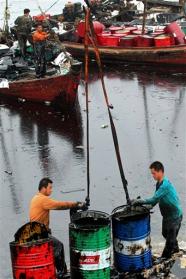
In this photo taken Wednesday, July 21, 2010, workers clean and collect crude oil near a polluted beach after a pipeline explosion in Dalian, in northeast China’s Liaoning province. China National Petroleum Corp. said Thursday the vital pipeline has resumed operations after an explosion caused the country’s largest reported oil spill. (AP Photo)

By CARA ANNA (AP) – 1 hour ago

BEIJING — China and environmental observers said cleanup efforts on the country’s largest reported oil spill were progressing Thursday, but the environmental and economic damage was clear.

The cleanup — marred by the drowning of a worker this week, his body coated in crude — continued over a 165 square mile (430 square kilometer) stretch of the Yellow Sea off the northeastern city of Dalian, one of China’s major ports and strategic oil reserve sites.

China National Petroleum Corp. said Thursday that the pipeline that exploded and caused the oil spill last Friday had resumed operations. The blast had reduced oil shipments from part of China’s strategic oil reserves to the rest of the country. The cause of the explosion that started the spill was still not clear.

The company, Asia’s biggest oil-and-gas producer by volume, also said more than 400 tons of oil had been cleaned up by 9 a.m. Wednesday, according to a posting on its website.

The environmental group Greenpeace China released photos Thursday of local fishermen cleaning up oily sludge at Weitang Bay with shovels, and of an employee scooping up dead snails at Guotai Water Products Farm, about 1 kilometer (0.6 miles) from the site of the explosion and spill.

“Dalian’s seafood farming and tourism industries have taken critical hits,” Greenpeace China said in a statement. It estimated 10,000 shellfish farms have been contaminated.

Fishing in the waters around Dalian has been banned through the end of August, the state-run Xinhua News Agency reported.

Greenpeace China also saw progress in the cleanup at Jinshitan, one of Dalian’s most popular beaches.

“On Jinshitan beach, several hundred fishermen, citizens and paramilitary police were using straw mats to absorb the oil,” said Zhong Yu, a Greenpeace China worker. “The cleanup there was almost done, but the air still remained smelly.”

The Dalian Daily newspaper cited an official in charge of cleanup efforts as saying the polluted area was shrinking, but no update on the spill size was issued Thursday.

It remained unclear exactly how much oil has spilled, but state media has said no more is leaking into the sea.

China Central Television earlier reported an estimate of 1,500 tons of oil has spilled. That would amount roughly to 400,000 gallons (1,500,000 liters) — as compared with 94 million to 184 million gallons in the BP oil spill off the U.S. coast.

The ecological harm from the spill could last a decade, Zhao Zhangyuan, a researcher with the China Environmental Science Research Institute, told the Shanghai Morning News earlier this week.

“The most critical is the effect on people, the effect on health,” Zhao said, because the decomposing oil will produce some carcinogenic substances that could move along the food chain to humans.

Associated Press writer Gillian Wong and researcher Yu Bing in Beijing contributed to this report.

USA Today: Ships ready to leave leaky Gulf well as storm brews

http://www.usatoday.com/news/nation/2010-07-22-storm-approaches-gulf-oil_N.htm

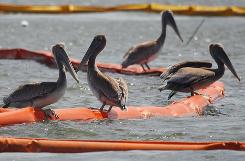
Image By Chris Graythen, Getty Images

Pelicans sit on boom that is protecting Queen Bess Island on Wednesday in Grand Isle, Louisiana. A possible storm that may head into the Gulf of Mexico where BP is drilling a relief well would suspend oil spill containment projects.

ON THE GULF OF MEXICO (AP) — Dozens of ships were preparing Thursday to pull out of the Gulf of Mexico as a tropical storm brewed in the Caribbean, halting deep-sea efforts to plug BP’s ruptured oil well.

Though the rough weather was hundreds of miles (kilometers) from the spill site, officials ordered technicians to suspend work Wednesday as they would need several days to clear the area. The government’s oil spill chief was waiting to see how the storm developed before deciding whether to order the ships to evacuate.

Anxiety was building among the 75-member crew aboard the cutter Decisive, the Coast Guard’s primary search and rescue vessel, which would be the last of about 65 ships to leave in the event of an evacuation.

“It’s a controlled chaos out there,” Lt. Patrick Montgomery told an Associated Press reporter aboard the cutter heading to the spill site from Pascagoula, Mississippi.

The technicians were forced to halt their work just days from completing a relief well to permanently throttle the free-flowing crude.

Worse yet, foul weather could require reopening the cap that has contained the oil for nearly a week, allowing oil to gush into the sea again while engineers wait out the storm.

“This is necessarily going to be a judgment call,” said retired Coast Guard Adm. Thad Allen, the government’s point man on the crisis, on Wednesday.

The cluster of thunderstorms passed over Haiti and the Dominican Republic on Wednesday, and was forecast to move into the Gulf over the weekend with a 40% chance it would becoming a tropical depression or tropical storm by Friday.

Crews stationed some 50 miles (80 kilometers) out in the Gulf had planned to spend Wednesday and Thursday reinforcing with cement the last few feet (meters) of the relief tunnel that will be used to pump mud into the gusher and block it once and for all. But BP instead placed a temporary plug called a storm packer inside the tunnel in case it has to be abandoned while the storm passes.

“What we didn’t want to do is be in the middle of an operation and potentially put the relief well at some risk,” BP vice president Kent Wells said.

If the work crews are evacuated, it could be two weeks before they can resume the effort to plug the well. That would upset BP’s timetable for finishing the relief tunnel this month and plugging the blown-out well by early August.

Scientists have been scrutinizing underwater video and pressure data for days, trying to determine if the capped well is holding tight or in danger of rupturing and causing an even bigger disaster. If the storm prevents BP from monitoring the well, the cap may simply be reopened, allowing oil to spill into the water, Allen said.

BP and government scientists were discussing whether the cap could be monitored from shore.

As the storm drew closer, boat captains hired by BP for skimming duty were sent home for five or six days, said Tom Ard, president of the Orange Beach Fishing Association in Alabama.

In Florida, crews removed booms protecting the Panhandle’s waterways, as high winds and storm surges could carry the booms into sensitive wetlands.

Also, Shell Oil began evacuating employees out in the Gulf.

The storm could affect oil containment and cleanup efforts even if it does not hit the area directly. Last month, Hurricane Alex stayed 500 miles (805 kilometers) away but skimming in Alabama, Mississippi and Florida was curtailed for nearly a week.

The relief tunnel extends about 2 miles (3 kilometers) under the seabed and is about 50 to 60 feet (15 to 18 meters) vertically and 4 feet (1.2 meters) horizontally from the ruptured well. BP plans to cement a final string of casing, or drilling pipe, into place and give it up to a week to set before attempting to punch through to the blown-out well and kill it.

BP’s broken well spewed between 94 million and 184 million gallons (356 million to 697 million liters) before the cap was attached. The crisis — the biggest offshore oil spill in U.S. history — unfolded after the BP-leased Deepwater Horizon rig exploded April 20, killing 11 workers.

The cause of the blast is still under investigation, but rig workers have repeatedly questioned the rig’s equipment and safety conditions.

The New York Times reported early Thursday that rig workers expressed concern in a confidential survey before the blast about safety and the condition of equipment.

The Times said another report for Transocean by Lloyd’s Register Group found that several pieces of equipment — including the rams in the failed blowout preventer on the well head — had not been inspected since 2000, despite guidelines calling for inspection every three to five years. Transocean said most of the equipment was minor and the blowout preventer was inspected by manufacturer guidelines.

A spokesman for Transocean, the owner of the rig leased by BP, confirmed the existence of the reports to The Associated Press.

“As part of Transocean’s unwavering commitment to safety and rigorous maintenance discipline on all our rigs, we proactively commissioned the safety survey and the rig assessment review,” Transocean spokesman Lou Colasuonno said in an e-mail Thursday. “A fair reading of those detailed third-party reviews indicates clearly that while certain areas could be enhanced, overall rig maintenance met or exceeded regulatory and industry standards and the Deepwater Horizon’s safety management was strong and a culture of safety was robust on board the rig.”
"Be the change you want to see in the world." Mahatma Gandhi