Yubanet.com: Gulf oil spill could widen, worsen ‘dead zone’

http://yubanet.com/usa/Gulf-oil-spill-could-widen-worsen-dead-zone.php

Published on Jul 6, 2010 – 7:20:58 AM
By: Michigan State University

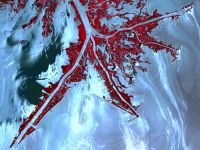
A NASA satellite image recorded May 24 showing areas of oil approaching the Mississippi River delta, shown in false color to improve contrast.

EAST LANSING, Mich. June 4, 2010 – While an out-of-control gusher deep in the Gulf of Mexico fouls beaches and chokes marshland habitat, another threat could be growing below the oil-slicked surface.

The nation’s worst oil spill could worsen and expand the oxygen-starved region of the Gulf labeled “the dead zone” for its inhospitability to marine life, suggests Michigan State University professor Nathaniel Ostrom. It could already be feeding microbes that thrive around natural undersea oil seeps, he says, tiny critters that break down the oil but also consume precious oxygen.

“At the moment, we are seeing some indication that the oil spill is enhancing hypoxia,” or oxygen depletion, Ostrom said. “It’s a good hint that we’re on the right track, and it’s just another insult to the ecosystem – people have been worried about the size of the hypoxic zone for many years.”

The dead zone is believed to stem from urban runoff and nitrogen-based fertilizers from farmland swept into the Gulf by the Mississippi River. Higher springtime flows carry a heavier surge each year, nourishing algae blooms that soon die and sink. Those decay and are eaten by bacteria that consume more oxygen, driving out marine life and killing that which can’t move, such as coral. The dead zone can grow to the size of a small state.

With the spill overlapping a section of the dead zone, the impact on that region is unknown. As it happened, Ostrom earlier had tapped zoology major Ben Kamphuis to be on the Gulf in late May for a research cruise focused on nitrogen cycling. When the British Petroleum Deepwater Horizon offshore drilling rig blew out and sank April 20, Ostrom and collaborator Zhanfei Liu from the University of Texas at Austin quickly landed federal support to expand their inquiry.

Kamphuis, a junior from Holland, Michigan, learned far more than water sampling techniques during his week aboard the research vessel Pelican.

“Down there, (the oil spill) really affects a ton of people. I really didn’t realize it before going, but after going on the trip I realized how much we can help the people in that area.”

With dozens of water samples now returned to the lab, Ostrom, Kamphuis and food science sophomore Sam DeCamp, another undergraduate research associate, are setting up equipment to analyze them in the coming months. They want to know whether the oil in the water will promote oxygen starvation, and if so, how.

Oil-hungry microbes can be expected to consume more oxygen from the water as they feast on hydrocarbons, Ostrom says. But the oil slick and chemical dispersants also could reduce the flow of oxygen from the atmosphere to the ocean, and possibly reduce the sunlight available to nourish oxygen-producing marine plant life.

Financial support for the project came from the National Science Foundation and the MSU College of Natural Science.

A jack of many science trades, Ostrom is on faculty in the MSU Department of Zoology and the MSU Environmental Science and Policy Program. He is a biogeochemist who focuses his studies on the interaction of organisms with their chemical and physical environments.

Michigan State researchers were in the right place at the right time to contribute to our understanding of the effects of such a massive oil spill, he says, pointing to the oil-eating microbes as likely the biggest, if unrecognized, players in the drama.

“We’re fortunate to have them,” he said. “They’re doing the cleanup – not BP.”

Special thanks to Richard Charter

E&E: Large Enviro Groups turn up pressure on Obama

07/06/2010

Robin Bravender, E&E reporter

A coalition of major environmental groups is urging the White House to take a bigger stake in Senate climate and energy negotiations.

As the Senate prepares to begin a floor debate on climate and energy legislation later this month, nine major advocacy groups sent a letter to President Obama, urging him to get personally involved to “produce a bill, in conjunction with key Senators, that responds to the catastrophe in the Gulf, cuts oil use, and limits carbon pollution while maintaining current health and other key legal protections.”

The Alliance for Climate Protection, the BlueGreen Alliance, the Center for American Progress Action Fund, Environment America, the Environmental Defense Fund, the League of Conservation Voters, the National Wildlife Federation, the Natural Resources Defense Council and the Union of Concerned Scientists signed on to the letter.

The groups said a growing number of their millions of active members are “deeply frustrated at the inability of the Senate and your Administration to act in the face of an overwhelming disaster in the Gulf, and the danger to our nation and the world.”

They urged the president to work with the Senate to bring the bill to the floor before the August recess.

“White House leadership is the only path we see to success, just as your direct leadership was critical in the passage of the recovery plan, health care reform, and other administration successes,” they said.

Special thanks to Richard Charter

Here’s the letter:

The President
The White House
Washington, D.C. 20500

July 2, 2010

Dear Mr. President:
Thank you for your forceful and eloquent expression of the absolute necessity for bold action to accelerate America’s transition to clean energy. Time and again you have described to Americans the benefits of clean energy reform. Your administration has taken important actions by making unprecedented investments in clean energy technology, setting more efficient fuel economy standards, and adopting many other measures. Now is the time to take the next essential steps.

Even as Americans see heartbreaking and infuriating images of damage to the Gulf coast, well-funded and powerful special interests have been working furiously to defeat progress and maintain the status quo. They have recruited their allies to help paralyze the Senate’s deliberations over whether and how to reduce oil use and cut global warming pollution, using tactics that have derailed efforts by Presidents for the last 40 years to curtail our ever-growing dependence on oil. A rapidly growing number of our millions of active members are deeply frustrated at the inability of the Senate and your Administration to act in the face of an overwhelming disaster in the Gulf, and the danger to our nation and world.

The Senate needs your help to end this paralysis. With the window of opportunity quickly closing, nothing less than your direct personal involvement, and that of senior administration officials, can secure America’s clean energy future. We strongly urge you to produce a bill, in conjunction with key Senators, that responds to the catastrophe in the Gulf, cuts oil use, and limits carbon pollution while maintaining current health and other key legal protections. We further urge you to work with the Senate to bring that bill to the floor for passage before the August recess. White House leadership is the only path we see to success, just as your direct leadership was critical in the passage of the recovery plan, health care reform, and other administration successes.

Two weeks ago, in an address to the nation from the Oval Office, you laid out the issue in stark terms: “The consequences of our inaction are now in plain sight. We cannot consign our children to this future… Now is the moment for this generation to embark on a national mission to unleash American innovation and seize control of our own destiny.” We emphatically agree. America’s future prosperity, the health of our environment, our ability to create good quality clean-energy jobs and to meet our international commitments, and our national security rest on the action you take in the days ahead.

Sincerely,

Maggie Fox, President and CEO
Alliance for Climate Protection

David Foster, Executive Director
BlueGreen Alliance

John Podesta, President and CEO
Center for American Progress Action Fund

Margie Alt, Executive Director
Environment America

Fred Krupp, President
Environmental Defense Fund

Gene Karpinski, President
League of Conservation Voters

Larry Schweiger, President
National Wildlife Federation

Peter Lehner, Executive Director
Natural Resources Defense Council

Kevin Knobloch, President
Union of Concerned Scientists

NRDC: Oil and Gas Activities in the Gulf of Mexico Cause Harm to Marine Mammals

http://www.californiaprogressreport.com/site/?q=node/7914

California Progress Report

Posted on 02 July 2010
By Zak Smith
Natural Resources Defense Council

As we continue to hear more about animals trapped in the toxic sludge that is the BP oil disaster fall out in the Gulf, NRDC joined a coalition in suing the renamed Minerals Management Service (MMS) – it now styles itself the Bureau of Ocean Energy Management, Regulation, and Enforcement (as if rebranding will solve the agency’s problems) – for its failure to comply with our nation’s bedrock environmental law, the National Environmental Policy Act (NEPA), when permitting seismic exploration for oil and gas in the Gulf of Mexico.

Thousands of endangered animals live in the Gulf and are subjected to harassment and injury by seismic exploration in the form of air gun explosions as oil and gas exploration companies search for black gold at the bottom of the Gulf.

BP’s Deepwater Horizon explosion and oil spill has led to a thorough examination of how safety and environmental laws and regulations have been enforced (or ignored) with respect to oil and gas activities in the Gulf of Mexico and on the outer Continental Shelf generally. Unfortunately, it’s not a pretty picture and uncovering MMS’ record of ignoring basic environmental laws, especially in the Gulf of Mexico, has been disheartening.

The lawsuit we filed yesterday challenges MMS’ practice of approving seismic exploration in the Gulf of Mexico without completing a rigorous environmental review of the activity’s impacts on the environment (including marine mammals) in the form of an Environmental Impact Statement (EIS). An EIS is so important here because of the real harm to dolphins, whales, and fish that results from seismic exploration.

As NRDC noted even before the current disaster in the Gulf, seismic surveys use some of the loudest underwater sounds generated by humans to explore oil and gas reserves below the ocean floor. Day and night, for days and months at a time, thousands of square nautical miles of the Gulf are inundated with high-intensity sound pulses – billions of times more intense than noise levels known to compromise basic life functions of marine mammals and fish – such as feeding, breeding, navigating, and communicating.

With impacts so profound, there is no good excuse as to why MMS has not completed an EIS for seismic exploration – it’s doing one for the same activities planned to take place off the Atlantic Coast and the National Marine Fisheries Service says that one is necessary for the Gulf of Mexico. Knowing that laziness and bowing to the wishes of the oil industry are not legal defenses – at least not yet – how will MMS justify its failure to comply with America’s most fundamental environmental law?

But regardless of why MMS has failed to prepare an EIS, it must do so now so that the public and decision makers will have a better understanding of how seismic exploration continues to harm marine animals that are already struggling to survive in the wake of the BP disaster. With oil blanketing Gulf shores – destroying wildlife, habitat, fisheries, local economies, and ways of life that have been passed down for generations – shouldn’t we have a full reckoning of the impacts that oil and gas activities have on the environment, measured from the start, before oil is even found (when our government allows explosive noise to inundate Gulf waters, harming whales and endangered fish), to the end, when oil flows from the ocean floor to refineries and eventually into our cars? I think so, and hope this lawsuit plays a part in ensuring that understanding.

While our lawsuit focuses on MMS’ refusal to comply with NEPA for seismic exploration in the Gulf of Mexico, the outcome of the lawsuit is important to other areas of the outer Continental Shelf. Currently, there are no federal waters on the outer Continental Shelf that are safe from this destructive seismic exploration. If an oil company wants to conduct seismic exploration off the coast of California, it can.

And if MMS followed the same practice it has in the Gulf of Mexico when approving the activity, it could do so without completing a full environmental review, neglecting to analyze the impacts to California’s spectacular populations of whales and dolphins. But by compelling MMS to comply with the law in the Gulf of Mexico, we can help ensure that the agency will comply with the law wherever it approves this harmful activity.

Special thanks to Richard Charter

Herald Sun: More bad news for BP as Arsenic levels rise around Gulf of Mexico

http://www.heraldsun.com.au/news/more-bad-news-for-bp-as-arsenic-levels-rise-around-gulf-of-mexico/story-e6frf7jo-1225888311592

Herald Sun
Last Updated: July 07, 2010

AFP
July 06, 2010 7:35AM

BELEAGUERED energy giant BP was hit with further bad news this morning as it emerged dangerous arsenic levels have been found in seawater around the Gulf of Mexico.

British scientists warned that the oil spill is increasing the level of arsenic in the ocean, and could further add to the devastating impact on the already sensitive environment.

BP’s Deepwater Horizon rig has been spilling between 3,681,500 litres and 911,454,000 litres of oil into the sea per day since it exploded on April 22.

The spill is already being labeled as America’s worst environmental disaster and has turned into a economic and PR nightmare for the British company.

Seventy-five days into the spill, the oil has fouled some 715km of shoreline in four southeastern US states, killed wildlife and put a massive dent in the region’s multi-billion-dollar fishing industry.

The clean-up operation, which has already cost, $US3.12 billion ($3.7 billion), is expected to rise even further after efforts were hampered by technical setbacks to cap the leak and adverse weather conditions.

In a further blow, an operation to permanently cap the ruptured well on the seafloor far below the surface cannot begin until engineers finish drilling relief wells, in mid-August at the earliest.
Imperial College London researchers warned the effect on the environment could worsen unless clean up efforts were hastened.

Researchers published a study which found oil stops the ocean’s natural filtering process of arsenic.
They said the arsenic then gets “magnified” up the food chain, as fish eat small amounts of the deadly poison and may eventually impact humans, researchers said.

Professor Mark Sephton said arsenic, which is found in seawater, was normally filtered out of the ocean when it combined with sediment on the sea floor.

“But oil spills stop the normal process because the oil combines with sediment and it leads to an accumulation of arsenic in the water over time,” he said.

“Arsenic only needs to be a 10th of a part per billion to cause problems.”

He added: “Our study is a timely reminder that oil spills could create a toxic ticking time bomb, which could threaten the fabric of the marine ecosystem in the future.”

Prof Sephton called for a comprehensive mapping of arsenic levels around the world which would allow authorities to consider banning oil drilling in areas with dangerous levels of arsenic.

The findings were published this month in the journal Water Research.

The warnings come after Hurricane Alex sparked a five-day shutdown, raising new questions over how BP would pay for the mounting costs.

Meanwhile, cleanup workers arrived back on Grand Isle, Louisiana by the hundreds, spilling off school buses that shuttled them in from around the state with one worker claiming it’s the most oil he had seen so far.

However, while skimming operations resumed in Louisiana, rough seas kept vessels tied up in harbour in three other southeastern US states and no controlled burns were being carried out.
Skimming was suspended last week as Tropical Storm Alex, which later became the first Atlantic hurricane of the 2010 season, entered the Gulf.

BP is now pinning its hopes on the giant Taiwanese supertanker A Whale exponentially boosting the amount of oil and water mix being scooped up from the surface of the gulf.

The tanker should be able to vacuum up 78.75m litres of oily water a day, separate it and spit the seawater back out.

Tests on the 275-metre tanker-turned-skimmer were expected to be completed by Monday before officials decide whether to deploy it.

It also emerged last night that BP is now turning to rival oil groups and sovereign wealth funds to fend off a possible hostile takeover bid.

The National, an Emirati newspaper based in Abu Dhabi, reported that sovereign wealth funds in the oil-rich Middle East have proposed making a strategic investment in BP, which has pledged to place $US20 billion ($A23.74 billion) in an escrow account to pay for the cleanup in the Gulf.

The firms were also allegedly mulling buying key assets from BP and financially backing any capital the oil company might plan to raise after the British energy giant lost over half of its stock market value and saw its shares plunge in the wake of the disaster.

The National Oceanic and Atmospheric Administration meanwhile expanded the area closed to fishing in the Gulf beyond the current northwestern boundary off Louisiana, bringing to the closure to 210,258 square kilometres or 33.5 per cent of the Gulf’s federal waters.

Special thanks to Richard Charter

CBS: Oil Spill Volunteers Ready, but Many Go Unused

http://www.cbsnews.com/stories/2010/07/02/national/main6640388.shtml

July 2, 2010 New Orleans
(CBS/AP) BP and the Obama administration face mounting complaints that they are ignoring foreign offers of equipment and making little use of the fishing boats and volunteers available to help clean up what may now be the biggest spill ever in the Gulf of Mexico.

The Coast Guard said there have been 107 offers of help from 44 nations, ranging from technical advice to skimmer boats and booms. But many of those offers are weeks old, and only a small number have been accepted, with the vast majority still under review, according to a list kept by the State Department.

And in recent days and weeks, for reasons BP has never explained, many fishing boats hired for the cleanup have done a lot of waiting around.

A report prepared by investigators with the House Committee on Oversight and Government Reform for Rep. Darrell Issa, R-Calif., detailed one case in which the Dutch government offered April 30 to provide four oil skimmers that collectively could process more than 6 million gallons of oily water a day. It took seven weeks for the U.S. to approve the offer.

Special Section: Disaster in the Gulf

White House spokesman Robert Gibbs on Thursday scorned the idea that “somehow it took the command 70 days to accept international help.”

“That is a myth,” he declared, “that has been debunked literally hundreds of times.”

He said 24 foreign vessels were operating in the Gulf before this week. He did not specifically address the Dutch vessels.

The help is needed. Based on some government estimates, more than 140 million gallons of crude have now spewed from the bottom of the sea since the April 20 explosion that killed 11 workers on the Deepwater Horizon oil platform, eclipsing the 1979-80 disaster off Mexico that had long stood as the worst in the Gulf.

One possible option for the government is a huge new piece of equipment: the world’s largest oil-skimming vessel, which arrived Wednesday.

Officials hope the ship can scoop up to 21 million gallons of oil-fouled water a day. Dubbed the “A Whale,” the Taiwanese-flagged former tanker spans the length of 3½ football fields and is 10 stories high.

It just emerged from an extensive retrofitting to prepare it specifically for the Gulf, but it’s still waiting for the Environmental Protection Agency and Coast Guard to sign off on it’s use.

“It is absolutely gigantic. It’s unbelievable,” said Ed Overton, a Louisiana State University environmental studies professor who consults for the federal government on oil spills. He saw the ship last week in Norfolk, Va.

The vessel looks like a typical tanker, but it takes in contaminated water through 12 vents on either side of the bow. The oil is then supposed to be separated from the water and transferred to another vessel. The water is channeled back into the sea.

But the ship’s never been tested, and many questions remain about how it will operate. For instance, the seawater retains trace amounts of oil, even after getting filtered, requiring the EPA to sign off on allowing the treated water back into the Gulf.

“This is a no-brainer,” Overton said. “You’re bringing in really dirty, oily water and you’re putting back much cleaner water.”

The Coast Guard will have the final say in whether the vessel can operate in the Gulf. The owner, shipping firm TMT Group, will have to come to separate terms with BP, which is paying for the cleanup.

“I don’t know whether it’s going to work or not, but it certainly needs to be given the opportunity,” Overton said.

Meanwhile, more than 2,000 smaller boats have signed up for oil-spill duty under BP’s Vessel of Opportunity program. The company pays boat captains and their crews a flat fee based on the size of the vessel, ranging from $1,200 to $3,000 a day, plus a $200 fee for each crew member who works an eight-hour day.

Rocky Ditcharo, a shrimp dock owner in Buras, La., said many fishermen hired by BP have told him that they often park their boats on the shore while they wait for word on where to go.

“They just wait because there’s no direction,” Ditcharo said. He said he believes BP has hired many boat captains “to show numbers.”

“But they’re really not doing anything,” he added. He also said he suspects the company is hiring out-of-work fishermen to placate them with paychecks.

Chris Mehlig, a fisherman from Louisiana’s St. Bernard Parish, said he is getting eight days of work a month, laying down containment boom, running supplies to other boats or simply being on call dockside in case he is needed.

“I wish I had more days than that, but that’s the way things are,” he said.

Billy Nungesser, president of Louisiana’s hard-hit Plaquemines Parish, said BP and the Coast Guard provided a map of the exact locations of 140 skimmers that were supposedly cleaning up the oil. But he said that after he repeatedly asked to be flown over the area so he could see them at work, officials told him only 31 skimmers were on the job.

“I’m trying to work with these guys,” he said. “But everything they’re giving me is a wish list, not what’s actually out there.”

A BP spokesman declined to comment.

Newly retired Coast Guard Adm. Thad Allen, the government’s point man for the response effort, bristled at some of the accusations in Issa’s report.

“I think we’ve been pretty transparent throughout this,” Allen said at the White House. He disputed any suggestion that there aren’t enough skimmers being put on the water, saying the spill area is so big that there are bound to be areas with no vessels.

The Coast Guard said there are roughly 550 skimmers working in the Gulf, with 250 or so in Louisiana waters, 136 in Florida, 87 in Alabama and 76 in Mississippi, although stormy weather in recent days has kept the many of the vessels from working.

The frustration extends to the volunteers who have offered to clean beaches and wetlands. More than 20,000 volunteers have signed up to help in Florida, Alabama and Mississippi, yet fewer than one in six has received an assignment or the training required to take part in some chores, according to BP.

The executive director of the Alabama Coastal Foundation, Bethany Kraft, said many people who volunteered are frustrated and angry that no one has called on them for help.

“You see this unfolding before your eyes and you have this sense that you can’t do anything,” she said. “To watch this happen in our backyard and not be able to help is hard.”

Some government estimates put the amount of oil spilled at 160 million gallons. That calculation was arrived at by using the rate of 2.5 million gallons a day all the way back to the oil rig explosion. The AP, relying on scientists who advised the government on flow rate, bases its estimates on a lower rate of 2.1 million gallons a day up until June 3, when a cut to the well pipe increased flow.

By either estimate, the disaster would eclipse the Ixtoc disaster in the Gulf two decades ago and rank as the biggest offshore oil spill during peacetime. The biggest spill in history happened in 1991 during the Persian Gulf War, when Iraqi forces opened valves at a terminal and dumped about 336 million gallons of oil.

The total in the Gulf disaster is significant because BP is likely to be fined per gallon spilled. Also, scientists say an accurate figure is needed to calculate how much oil may be hidden below the surface, doing damage to the deep-sea environment.

“It’s a mind-boggling number any way you cut it,” said Ed Overton, a Louisiana State University environmental studies professor. “It’ll be well beyond Ixtoc by the time it’s finished.”
"Be the change you want to see in the world." Mahatma Gandhi