Hurricanes & Oil Will Mix: Managing the Risk Now. Briefing Open to the Public in Wash DC Wed. June 30th

Wednesday, June 30, 2010 | 3:30 p.m. – 4:45 p.m. | Capitol Visitors Center – SVC 202

Refreshments will be served

Seasonal forecasters predict that 2010 will produce between 14 and 23 named hurricanes–the most active season since 2005, when Hurricane Katrina and 27 other named storms swept the Atlantic and Gulf of Mexico. As economic challenges continue and oil spews from the damaged Deepwater Horizon well in the Gulf, the growing impacts to the region’s economic recovery and unique ecosystems are staggering. What risks does an active hurricane season pose for other energy-related infrastructure, for inland areas as storm surges push oil beyond beaches and marshland, and for stakeholders dealing with flooding in coastal communities in the Gulf and along the East Coast? Can recent advancements in hurricane prediction help manage these risks? Might related climate change impacts exacerbate them in the future? What does an increasing scale of catastrophic loss associated with hurricane activity mean for critical services provided by the insurance sector? Please join our panelists as they address these questions and discuss research results, institutions, and processes in place to help manage potential catastrophic risk of this hurricane season.

Opening Remarks:

Senator Mary Landrieu
Honorary host

Moderator:

Heidi Cullen
CEO and Director of Communications, Climate Central

Panelists:

Greg Holland
Director, NCAR Earth System Laboratory, National Center for Atmospheric Research

Rick Luettich
Professor & Director, Institute of Marine Sciences, University of North Carolina at Chapel Hill

Rowan Douglas
CEO, Global Analytics, Willis Re and Chairman, Willis Re Research Network

RSVP by Monday, June 28 to Gloria Kelly at gloriak@ucar.edu or (303) 497-2102.

RSVP needed for admission to the CVC.

This briefing is sponsored by the American Geophysical Union (AGU), the Congressional Hazards Caucus Alliance, the National Science Foundation (NSF), the Pew Center on Global Climate Change, the University Corporation for Atmospheric Research (UCAR) and the Weather Coalition.
Special thanks to Richard Charter.

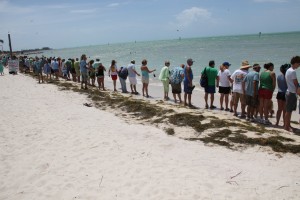
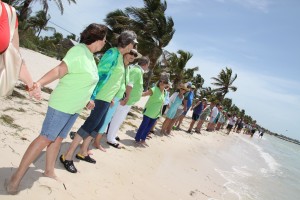
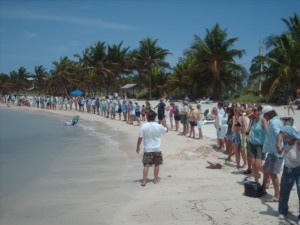
Key West Hands Across the Sand June 26th draws over 400; many take THE PLEDGE

Photos by Carol Tedesco
Key West Hands Across the Sand Draws Over 400 People; Many take the pledge

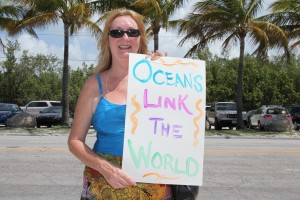
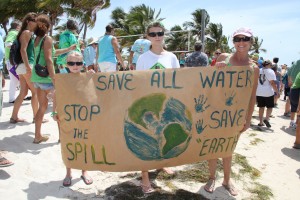
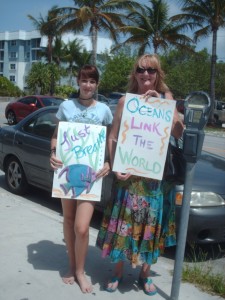
Today, Saturday, June 26, 2010, over 400 Key Westers joined ocean lovers around the world for the Hands Across the Sand demonstration of love for our ocean waters and opposition to offshore oil development and the ecological disasters it spawns. The pictures tell the story. A count of each participant was made as everyone held hands along the entire length of Smathers Beach on the oceanside of Key West. Each person called out their consecutive number for an actual count of 428, and they stretched to the end of the long beach, over the breakwater and back again onto the beach behind the main line of people. Some held up signs such as those that read, “Oil & Water Don’t Mix, “Oceans Link the World” and “Just Breathe.” It was a glorious Florida Keys day and spirits were positive.

“You can blame BP and you should; you can blame the White House and you should; but we are each of us responsible for the problem that consuming fossil fuels has on our planet and especially on fragile marine environments. We must personalize the challenge for a clean energy future and use less plastic, change our transportation habits, reduce our consumption, and conserve resources to reduce our use of oil every day,” noted organizer Erika Biddle. “Take the pledge today. Until then, nothing will have changed.”

The pledge Biddle referred to was signed by many at the event and is reproduced below for you to sign. Others signed a letter to the President asking for a clean energy future.

I PLEDGE
TO REDUCE MY DEPENDENCE UPON FOSSIL FUELS
Oil spills are terrible. We all abhor what BP has done to the water, the wildlife, and the way of life of citizens of the Gulf of Mexico and the world. However, I also understand the connection between OUR consumption of oil and the aggressive manner in which oil companies are feeding our addiction.
Therefore, I pledge to reduce my use of oil and all fossil fuels by 10%, starting today.
I pledge to carpool, walk, bike, or take public transportation instead of driving.
I pledge to stop using plastic bags (made from petroleum).
I pledge to stop buying things I don’t need, especially those made from plastic.
I pledge to use less electricity (fueled by oil).
I pledge to reduce my water consumption (pumped by oil).
I pledge to take one fewer trip on an airline per year.
I pledge to buy as much local food as possible.
I take this pledge now, as oil continues to leak into the water, to reduce
my dependence on fossil fuels by 10% NOW.

_______________________________________
Name

_______________________________________
Signature

_______________________________________
Email

Jakarta Globe: Timor Sea Oil Spill Forcing NTT Fishermen to Migrate

http://www.thejakartaglobe.com/news/timor-sea-oil-spill-forcing-ntt-fishermen-to-migrate/382331

Kupang. Thousands of fishermen in Kupang`s Oesapa area are preparing to migrate to Bangka Belitung in Sumatra to find a new livelihood, a fishermen’s spokesman said.

They will migrate because their fish catches from the Timor Sea have declined drastically since the waters were polluted by an oil spill originating in Australian territory.

“Since the Timor Sea was polluted by an oil spill from a blowout in the Montara oil field on August 21, 2009, local fishermen`s fish catches have dwindled drastically. Now they are thinking of migrating to Bangka Belitung to build a new life,” H Mustafa, chairman of the East Nusatenggara (NTT)`s Timor Sea Traditional Fishermen`s Alliance (Antralamor), told the press here Wednesday.

Some 3,500 fishermen grouped in Antralamor whose livelihoods had traditionally depended on fish from the Timor Sea had been affected by the oil spill following an explosion at an oil rig of PTTEP Australasia in the Montara oil field in the West Atlas Block in the Timor Sea, he said.

The fishermen have also pulled back most of the fish traps they had set in the sea along the Kupang coast because the contraptions no longer yielded the usual quantities of fish.

Meanwhile, an edible fat and oil biochemist at Nusa Cendana University (Undana), Dr Felix Rebhung, said the apparent pollution of the Timor Sea had forced deep sea fish in the waters to migrate to other waters.

“Deep-sea fishes are very sensitive to the conditions of their environment. If their environment or habitat is damaged or polluted, they will leave, and try to find a more friendly environment,” he said.

“So, the fishermen`s complaint about minimal fish catches is quite logical,” he added.

Rebhung who teaches at Undana`s faculty of agriculture said if a sea was contaminated by oil, oil condensate or lead, it would take many years for its ecology to return to normal.

Ferdi Tanoni, a local observer of Timor Sea affairs, said President Susilo Bambang Yudhoyono should address the Timor Sea pollution problem with the same care and firmness as US President Barack Obama had shown toward the Gulf of Mexico oil spill from a British Petroleum (BP) rig.

“If Barack Obama demanded 20 billion US dollars in damages from BP, the operator of the Monatara oil field should pay about 15 billion US dollars to compensate the losses of fishermen in the western part of East Nusatenggara and the islands of Rote, Sabu and Sumba,” he said.

Tanoni also urged the Australian government led by Prime Minister Kevin Rudd to disclose as soon as possible the results of its investigation into the Montara oil spill disaster.

The oil spill had caused thousands of fishermen and seaweed farmers in the western part of NTT to lose their source of living, making it “a humanitarian tragedy of huge proportions,” Tanoni said.

Antara
Special thanks to Richard Charter

Associated Press: Some oil spill events on Thursday, June 24, 2010

“House Majority Leader Steny Hoyer is urging the White House to hold a summit with East Coast governors and local officials to ensure they are prepared if oil from the Gulf spill makes its way up the Atlantic coastline. Hoyer, a Maryland Democrat, made the request in a letter to President Barack Obama on Wednesday. Computer models show that the oil could enter the Gulf’s loop current, go around the tip of Florida and up the coast.”

http://www.google.com/hostednews/ap/article/ALeqM5i-yfHJzPLDeBIhG5JDEF6VbaPR8QD9GHUJG82

By The Associated Press (AP) – 4 hours ago

A summary of events Thursday, June 24, Day 65 of the Gulf of Mexico oil spill that began with the April 20 explosion and fire on the drilling rig Deepwater Horizon, owned by Transocean Ltd. and leased by BP PLC, which is in charge of cleanup and containment. The blast killed 11 workers. Since then, oil has been pouring into the Gulf from a blown-out undersea well.

ANOTHER SETBACK

Earlier this month, BP boldly predicted the oil gushing from the bottom of the sea would be reduced to a “relative trickle” within days, and President Barack Obama told the nation last week that as much as 90 percent would soon be captured. But those goals seemed wildly optimistic Thursday after yet another setback a mile underwater. A deep-sea robot bumped into the cap collecting oil from the well, forcing a temporary halt Wednesday to the company’s best effort yet to contain the leak. The cap was back in place Thursday, but frustration and skepticism were running high along the Gulf Coast.

GUSHER

While the cap was off, clouds of black oil gushed unchecked again at up to 104,000 gallons per hour, though a specialized ship at the surface managed to suck up and incinerate 438,000 gallons. The oil-burning ship is part of an armada floating at the site of the rogue well some 50 miles off the Louisiana coast and the scene below the surface is no less crowded. At least a dozen robotic submarines dangle from ships at the surface on mile-long cables called “umbilicals,” with most of the undersea work taking place within a few hundred yards of the busted well.

COURTS

A federal judge who overturned a six-month moratorium on deepwater drilling imposed after the Gulf oil spill refused Thursday to put his ruling on hold while the government appeals. The Justice Department had asked U.S. District Judge Martin Feldman to delay his ruling until the 5th U.S. Circuit Court of Appeals in New Orleans can review it. Feldman rejected that request Thursday. On Tuesday, he struck down the Interior Department’s moratorium that halted approval of new permits for deepwater projects and suspended drilling on 33 exploratory wells. Feldman concluded the government simply assumed that because one deepwater rig went up in flames, others were dangerous, too.

MORATORIUM-SALAZAR

The Justice Department said in court papers that Interior Secretary Ken Salazar has instructed all employees not to enforce the moratorium. Rig operators are getting letters that say suspension notices they received have no legal effect right now. But the Justice Department argues that delaying Feldman’s ruling would eliminate the risk of another drilling accident while new safety equipment standards and procedures are considered.

PRAYER

The governors of Louisiana and Texas say Sunday will be a day to pray about the oil spill in the Gulf of Mexico. Louisiana Gov. Bobby Jindal issued a proclamation declaring a day of prayer for perseverance in coping with the environmental crisis caused by the spill. In Texas, Gov. Rick Perry is urging Texans to pray for the healing of individuals, the rebuilding of communities and the restoration of entire Gulf Coast environment. Experts say the current worst-case estimate of what’s spewing into the Gulf is about 2.5 million gallons a day from the blown well, polluting shorelines from Louisiana to Florida.

CRIMES

The nation would impose tougher penalties on polluters under legislation approved by the Senate Judiciary Committee. The bill would require restitution to victims when oil companies or others violate the Clean Water Act, the nation’s primary law against water pollution. Currently, restitution is not mandatory. Another provision would direct the U.S. Sentencing Commission to amend guidelines so that prison terms reflect the seriousness of an environmental crime. The Environmental Crimes Enforcement Act was sent to the full Senate on Thursday. It would apply to offshore drilling accidents.

REVOLVING DOOR

Interior Secretary Ken Salazar says he supports a two-year ban on government regulators going to work for the oil and gas industry. Salazar told the Senate Energy and Natural Resources Committee Thursday that a lifetime ban might be appropriate for some employees, depending on how high they are in the agency that regulates the industry. He made the comments under pointed questioning from Sen. Ron Wyden, an Oregon Democrat who has criticized the practice of senior Interior employees going to work for the oil and gas industries.

ONLINE HIT

The most memorable comedic take on the oil spill disaster in the Gulf of Mexico hasn’t come from “Saturday Night Live,” “The Daily Show” or a late-night monologue. Instead, a cheaply made video by an unlikely New York improv troupe has created the only commentary that has truly resonated online: a three-minute spoof that shows BP executives pathetically trying to clean up a coffee spill.___
Online:

Upright Citizens Brigade Theatre

OILED FLORIDA

In Florida, thick pools of oil washed up along miles of national park and Pensacola Beach shoreline Wednesday, as health advisories against swimming and fishing in the once-pristine waters were extended for 33 miles east from the Alabama line. An oily young dolphin beached in the sand in the Gulf Islands National Seashore died Wednesday before it could be taken to a rehabilitation center.

DUDLEY

The man who inherited the Gulf oil spill response from BP’s embattled CEO said Wednesday that Americans have been too quick to blame his company for the environmental disaster now in its third month. “I’m somewhat concerned there is a bit of a rush to justice going on around the investigation and facts,” BP PLC managing director Bob Dudley said. He said BP has been unusually open about making its internal investigation public and shared information that no other company would.

NORTH SEA

Deep-sea exploration will continue in North Sea oil fields off Scotland despite safety concerns raised by the Gulf spill, Britain’s energy minister said Thursday. Energy Secretary Chris Huhne told an energy conference in London that regulation is strong enough “to manage the risk of deep-water drilling.” Britain announced this month it was doubling the number of inspections at North Sea oil rigs following the Gulf disaster.

WORST-CASE ESTIMATE

The current worst-case estimate of what’s spewing into the Gulf is about 2.5 million gallons a day. Anywhere from 67 million to 127 million gallons have spilled since the April 20 explosion on the Deepwater Horizon rig that killed 11 workers and blew out the well 5,000 feet underwater. BP PLC was leasing the rig from owner Transocean Ltd.

WASTE DISPOSAL

A leaky truck filled with oil-stained sand and absorbent boom soaked in crude pulls away from the beach, leaving tar balls in a public parking lot and a messy trail of sand and water on the main beach road. A few miles away, brown liquid drips out of a disposal bin filled with polluted sand. BP PLC’s work to clean up the mess from the worst offshore oil spill in U.S. history already has generated more than 1,300 tons of solid waste, and companies it hired to dispose of the material say debris is being handled professionally and carefully. A spot check of several container sites by The Associated Press, however, found that’s not always the case.

BROWN PELICANS

More than five dozen brown pelicans rehabilitated from the oil spill in the Gulf of Mexico take flight in Texas. The 62 pelicans arrived on Coast Guard cargo planes Wednesday and were released in the Aransas National Wildlife Refuge about 175 miles south of Houston.

PLUMES

A federal report confirms what independent scientists have been saying for weeks about the Gulf oil spill: Undersea oil plumes extend for miles from the ruptured well. The report may help measure the effectiveness of spreading chemicals to break up the oil. A summary Wednesday of water sampling last month near the undersea gusher describes a cloud of oil starting around 3,300 feet deep up to 4,600 feet deep and stretching up to 6 miles from the well. The Environmental Protection Agency says there’s been no significant harm to sea life, but marine scientist Vernon Asper of the University of Southern Mississippi says the levels are enough to kill fish.

DEATHS

Coast Guard Adm. Thad Allen says two contract workers helping with the Gulf of Mexico oil spill cleanup have died. Neither death appears to have a direct connection to the spill. Allen said Wednesday in Washington that one man was killed by what investigators later called a self-inflicted gunshot wound. Allen said the other worker’s death involved swimming. He would not provide more details.

AQUARIUM-DEAD GULF

A new exhibit at an aquarium in Iowa had intended to showcase the beauty of the Gulf of Mexico. Instead, it will be void of life to underline the environmental impact of a massive oil spill in the ocean basin. The 40,000-gallon aquarium at the National Mississippi River Museum and Aquarium in Dubuque, Iowa, was supposed to have been teeming with sharks, rays and other fish. Instead, says executive director Jerry Enzler, the main tank will hold water and artificial coral, with window stickers that look like oil.

COMMISSION

The House has approved legislation that would give subpoena power to the presidential commission investigating the BP oil spill in the Gulf of Mexico. Rep. Lois Capps, a California Democrat, said Americans want answers from those responsible for the spill, and subpoena power will ensure “no stone goes unturned.” Wednesday’s only no vote was from Republican Rep. Ron Paul of Texas.

SUBPOENAS

The House Judiciary Committee subpoenaed BP claims documents Wednesday, after its chairman said the company has not met requests for information about its payments. The committee’s voice vote showed bipartisan agreement for Chairman John Conyers’ efforts to release claims information to the public. The committee also voted, 16-11, to approve a bill eliminating limits on the amount of money that vessel owners had to pay for deaths and injuries. The bill would let family members collect payments for non-monetary damages such as pain and suffering.

POLITICS

In need of political momentum, Democrats are exploiting Republican Rep. Joe Barton’s startling apology to BP for its treatment by the Obama administration, launching a steady, low-budget campaign of fundraising appeals, a pair of television commercials and Web ads. Little more than four months before midterm elections, party officials appear to be testing ways to maximize the gain from a comment that ricocheted across the Capitol at a furious pace last week, and that Republicans deemed significant enough to force Barton to recant.

MESSAGE MANAGEMENT

To a nation frustrated by the Gulf oil spill, BP’s attempts at damage control have sometimes been infuriatingly vague. But from a legal standpoint, that’s exactly the point. With the company facing more than 200 civil lawsuits and the specter of a Justice Department investigation, saying the wrong thing could expose BP to millions of dollars in damages or even criminal charges for its executives. It’s a balancing act with billions of dollars – perhaps even BP’s survival – at stake.

SUMMIT

House Majority Leader Steny Hoyer is urging the White House to hold a summit with East Coast governors and local officials to ensure they are prepared if oil from the Gulf spill makes its way up the Atlantic coastline. Hoyer, a Maryland Democrat, made the request in a letter to President Barack Obama on Wednesday. Computer models show that the oil could enter the Gulf’s loop current, go around the tip of Florida and up the coast.
Special thanks to Richard Charter
Florida Today: Oil Leak Threatens Baby Turtles’ Food

http://www.floridatoday.com/article/20100624/NEWS01/6240309/Gulf-oil-leak-threatens-baby-turtles-food

While researchers scoop up endangered sea turtles coated in oil in the Gulf, a scientist warns that this summer’s fragile turtle hatchings could choke on tiny tar balls as they feed off the Space Coast.

Blair Witherington of the Florida Fish and Wildlife Commission in Melbourne returned recently from working with a federal and multistate team to rescue turtles. They captured 64, mostly a species called Kemp’s Ridley, which is among the rarest in Florida.

Back on the Atlantic side, the worry is more about loggerheads that nest here in some of the highest numbers in the world.

As the eggs hatch in the coming weeks, the baby turtles must head immediately to sea, where they swim as many as 25 miles to feed on Sargassum seaweed along the Gulf Stream. If oil and tar foul that algae off Brevard’s coast, turtles could mistake the toxic bits for their favorite food.

Or petroleum could poison and kill that food before the hatchlings reach it.

“I don’t know what goes through their little heads, but they do eat tar,” said Witherington, whose ongoing research had identified tar as a threat to the turtle population before the spill. “They tend to eat anything that floats by that looks interesting to them.”

He said he has found plastic and tar in the guts of about 90 percent of the baby turtles he has captured during research trips in the Gulf Stream. Either their mouths were sealed shut with tar, or their guts are lined with plastic.

Prime time for sea-turtle nesting in Brevard began May 1 and continues until Oct. 31. Female turtles lay as many as 125 eggs per nest in four to seven nests per season.

But experts estimate only one in 1,000 hatchlings survives to adulthood, with their food sources expanding beyond the Sargassum. Fewer live the 30 years needed before they are ready for reproduction.

Sargassum seaweed floats in “convergence zones” in the Gulf of Mexico and the Gulf Stream.

Many of the animals that live among the weed have origins along the bottom, but have evolved into species specific to the Sargassum habitat.

“It’s the basis and structure of an entire community,” Witherington said.

Fish, crabs, sea slugs and shrimp-like creatures float with and live off it. Pools of fish gather beneath.

Like a similar large gyre in the Pacific Ocean, the Sargassum Sea in the Atlantic, near Bermuda, also accumulates plastics.

“Some of the tar that we find is actually coating plastics that the turtles are eating,” Witherington said.

Baby turtles accidentally swallow plastics from milk bottles, bleach bottles and clear plastic bags while seeking a meal among Gulf Stream Sargassum lines.

Those impacts are ongoing, but no one knows how the spill will affect sea turtle populations long-term.

“We’re seeing probably more oiled sea turtles than anyone’s ever seen,” Witherington said.

Oil Damage

On Witherington’s trip to the Gulf, researchers cleaned up most of the rescued turtles and took them to rehabilitation centers, although some were found dead.

Another rescue mission headed out Tuesday. They’re a joint effort between the National Oceanic and Atmospheric Administration and state wildlife agencies from Florida, Louisiana and Georgia.

According to statistics this week from NOAA, 504 sea turtles had been verified within the designated spill area since surveying began April 30. Of those, 387 turtles, or 77 percent, died.

A total of 90 stranded or captured turtles were found with visible oil on them.
Only four rescued turtles have been released so far and 106 are in rehabilitation centers, NOAA said, including 73 heavily-oiled sea turtles captured as part of the on-water survey and rescue operations.

Direct exposure studies are limited, but past research shows oil can be deadly to sea turtles. Breathing the fumes can lead to kidney and liver damage, brain dysfunction, immune suppression, anemia, reproductive failure or death. Swallowing it can be worse.
And only four days of oil exposure can cause their skin to fall off in sheets.

Aftermath

Other studies, however, have shown that oil spilled even a few weeks before nesting season has little effect on egg development and hatchling fitness.

“All of these effects are speculative,” Witherington said, adding that scientists haven’t had much experience studying turtle impacts from large-scale oil spills.

Little research was done on turtle impacts after the Mexican government’s oil rig, Ixtoc 1, blew out in 1979, spewing an estimated 140 million gallons into the Gulf.

In U.S. waters, the most prevalent spills historically have involved refined fuel oils from barges or freighters and usually were the result of ships grounding.

The most recent and closest oil spill here came in August 2000. Tar balls and oil mats washed up on beaches near Fort Lauderdale, fouling about 20 miles of shoreline.

Most of the 20,000 gallons of fuel oil was removed within a few days, but wildlife casualties included an estimated 7,800 sea turtle hatchlings and untold fish and birds.

The cleanup cost $2.2 million, tapped from a federal cleanup trust fund.

Contact Waymer at 242-3663 or jwaymer@floridatoday.com.
Special thanks to Richard Charter
"Be the change you want to see in the world." Mahatma Gandhi