Truth-out.org: Gulf Ecosystem in Crisis Three Years After BP Spill

Monday, 21 October 2013 09:29
By Dahr Jamail, Aljazeer
3 yrs later
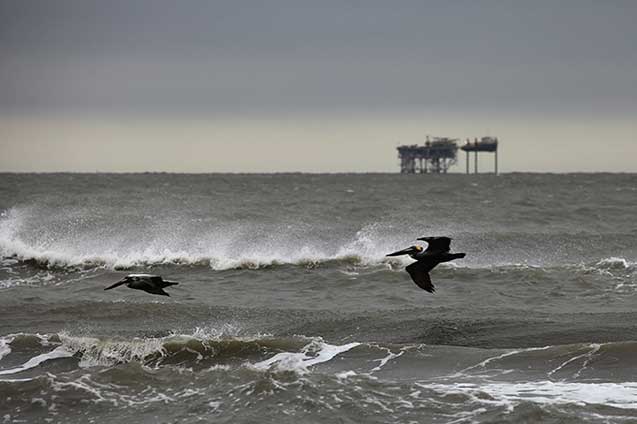
Three years after well blowout, declining seafood catches and deformities point to an environment in distress. (Photo: Erika Blumenfeld)

New Orleans – Hundreds of kilograms of oily debris on beaches, declining seafood catches, and other troubling signs point towards an ecosystem in crisis in the wake of BP’s 2010 oil disaster in the Gulf of Mexico.

“It’s disturbing what we’re seeing,” Louisiana Oyster Task Force member Brad Robin told Al Jazeera. “We don’t have any more baby crabs, which is a bad sign. We’re seeing things we’ve never seen before.”

Robin, a commercial oyster fisherman who is also a member of the Louisiana
Government Advisory Board, said that of the sea ground where he has harvested oysters in the past, only 30 percent of it is productive now.

“We’re seeing crabs with holes in their shells, other seafood deformities. The state of Louisiana oyster season opened on October 15, and we can’t find any production out there yet. There is no life out there.”

According to Robin, entire sectors of the Louisiana oyster harvest areas are “dead or mostly dead”. “I got 10 boats in my fleet and only two of them are operating, because I don’t have the production to run the rest. We’re nowhere near back to whole, and I can’t tell you when or if it’ll come back.”

State of Louisiana statistics confirm that overall seafood catch numbers since the spill have declined.
Over three million pounds of oiled material have been found in Louisiana this year. (Photo: Erika Blumenfeld / Al Jazeera)

Everything is down’
Robin is not the only member of the Gulf’s seafood industry to report bleak news. Kathy Birren and her husband own Hernando Beach Seafood, a wholesale seafood business, in Florida.
Shrimp with tumours continue to be found along the impact zone, from Louisiana to Florida. (Photo: Dean Blanchard)

“I’ve seen a lot of change since the spill,” Birren told Al Jazeera. “Our stone crab harvest has dropped off and not come back; the numbers are way lower. Typically you’ll see some good crabbing somewhere along the west coast of Florida, but this last year we’ve had problems everywhere.”

Birren said the problems are not just with the crabs. “We’ve also had our grouper fishing down since the spill,” she added. “We’ve seen fish with tar balls in their stomachs from as far down as the Florida Keys. We had a grouper with tar balls in its stomach last month. Overall, everything is down.”

According to Birren, many fishermen in her area are giving up. “People are dropping out of the fishing business, and selling out cheap because they have to. I’m in west-central Florida, but fishermen all the way down to Key West are struggling to make it. I look at my son’s future, as he’s just getting into the business, and we’re worried.”

Dean Blanchard, owner of a seafood business in Grand Isle, Louisiana, is also deeply troubled by what he is seeing. “We have big tar mats coming up on Elmers Island, Fouchon, Grand Isle, and Grand Terre,” Blanchard told Al Jazeera. “Every time we have bad weather we get fresh tar balls and mats.”

Blanchard said his business generates only about 15 percent of what it did before the spill. “It looks like it’s getting worse,” he said. “I told my wife when she goes to the mall she can only spend 15 percent what she used to spend.”

Blanchard has also seen shrimp brought in with deformities, and has taken photographs of shrimp with tumours (see above). Others lack eyes. He attributes the deformities to BP’s use of toxic dispersants to sink the spilled oil.

“Everybody living down here watched them spray their dispersants day in and day out. They sprayed our bays and our beaches,” he said. “We got a problem, because BP says they didn’t spray down here, but we had a priest that even saw them spraying. So either we got a lying priest, or BP is lying.”

BP and the Coast Guard have told the media they have never sprayed dispersants within 10 miles of the coast, and that dispersants have never been used in bays.
Eyeless shrimp, along with other seafood abnormalities, have become common in many areas along the Gulf Coast. (Photo: Erika Blumenfeld / Al Jazeera)

A decades-long recovery
On a more sombre note, Dr Ed Cake, a biological oceanographer and a marine biologist, believes it will likely take the Gulf decades to recover from the BP disaster.

“The impacts of the Ixtoc 1 blowout in the Bay of Campeche in 1979 are still being felt,” said Cake, referring to a large oil spill near the Mexican coast, “and there are bays there where the oysters have still not returned. My prediction is we will be dealing with the impacts of this spill for several decades to come and it will outlive me.”

According to Cake, blue crab and shrimp catches have fallen in Mississippi and Alabama since the spill, and he also expressed worries about ongoing dolphin die-offs. But his primary concern is the slow recovery of the region’s oyster population.

“Mississippi recently opened their season, and their oyster fisherman are restricted to 12 sacks of oysters a day. But they can’t even reach six,” Cake said. “Thirty sacks would be a normal day for oysters – that was the previous limit – but that is restricted now because the stocks just aren’t there.”

Cake’s conclusion is grim. “Here in the estuarine areas, where we have the oysters, I think it’ll be a decade or two before we see any recovery.”

BP previously provided Al Jazeera with a statement on this topic, a portion of which read: “Seafood from the Gulf of Mexico is among the most tested in the world, and, according to the FDA and NOAA, it is as safe now as it was before the accident.”

BP claims that fish lesions are naturally common, and that before the spill there was documented evidence of lesions in the Gulf of Mexico caused by parasites and other agents.

More oil found
The second phase of the ongoing federal trial against BP investigates whether the company’s actions to halt the flow of oil during the blowout were adequate, and aims to determine how much oil was released.

“BP is mounting an aggressive legal and public relations campaign to shield itself from liability and minimise the amount of oil spilled in the Gulf, as well as the ongoing impacts from the disaster,” said Jonathan Henderson, an organiser for the Gulf Restoration Network, an environmental group.

Even Louisiana’s Republican Governor Bobby Jindal agrees. Jindal recently said, “Three and a half years later, BP is spending more money – I want you to hear this – they are spending more money on television commercials than they have on actually restoring the natural resources they impacted.”

As far away from the blowout site as Florida, researchers continue to find oil in both Tampa Bay and Sarasota Bay.

In Louisiana, according to the LA Coastal Protection and Restoration Authority (CPRA), more than 200 miles of shoreline have “some degree of oiling”, including 14 miles that are moderately or heavily oiled. From March through August of this year, over three million pounds of oiled material have been collected in Louisiana, more than double the amount over the same time period last year.

In addition, the CPRA reports that “investigations into the chemical composition of MC252 [BP’s Macondo well] oil samples demonstrate that submerged oil is NOT substantially weathered or depleted of most PAH’s [polycyclic aromatic hydrocarbons],” and “disputesŠfindings relied on by the USCG [US Coast Guard] that Deepwater Horizon oil is non-toxic”.

The agency also expresses concerns that “submerged oil may continue to pose long term risk to nearshore ecosystems”.

“New impacts to the Gulf’s ecosystem and creatures also continue to emerge,” Henderson told Al Jazeera. “This year alone, the National Marine Fisheries Service has recorded 212 dolphins and other marine mammal standings in the northern Gulf. A new scientific study conducted by NOAA, BP and university researchers also shows significant negative impacts on tiny organisms that live on the sea floor in a 57 square mile area around the Deepwater Horizon well site.”

Numerous other impacts have been documented since the disaster began, including genetic disruptions for Gulf killifish, harm to deepwater corals,, and the die-off of tiny foraminifera that are an important part of the Gulf’s food chain.

Ongoing studies continue to reveal toxins from BP’s spill in water, soil, and seafood samples.

Meanwhile, fishermen in BP’s impact zone wonder if things will ever return to normal. “Our future is very, very dim, and there are no sponge crabs out there, which is the future,” Robin concluded. “I’ve never seen this in my lifespan. I’m not seeing a future, because everything out there is dead.”

Special thanks to Richard Charter
Inside Climate News–Behind Russia vs. Greenpeace Furor, Unreported Oil Pollution of the Arctic

http://insideclimatenews.org/news/20131016/behind-russia-vs-greenpeace-furor-unreported-oil-pollution-arctic

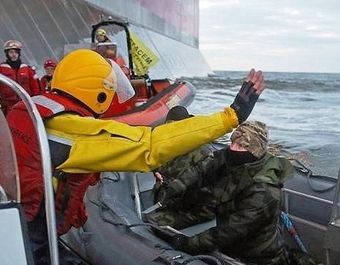
A Russian Coast guard officer is seen pointing a knife at a Greenpeace International activist as five activists attempt to climb the 'Prirazlomnaya,' an oil platform operated by Russian state-owned energy giant Gazprom platform in Russia s Pechora Sea.  This is one example of the disproportionate use of force by the Russian authorities during a peaceful protest. The activists are there to stop it from becoming the first to produce oil from the ice-filled waters of the Arctic.
About 4 million barrels of spilled oil, as much as BP’s Gulf of Mexico spill, is flowing into the Arctic Ocean every year, Greenpeace says.
By Zahra Hirji, InsideClimate News
Oct 16, 2013

A Russian Coast guard officer points a knife at a Greenpeace activist as protesters attempt to climb the Prirazlomnaya oil platform in the Arctic Ocean’s Pechora Sea. Credit: Greenpeace
Like

An environmental organization with a $350 million war chest, a giant protest vessel, 28 activists and a rubber raft have succeeded in drawing Russian President Vladimir V. Putin into a very public global dispute.

Attention is now focused on the Greenpeace activists-who were arrested last month by Coast Guard agents for trying to hang a protest banner on an Arctic Ocean oil platform-and whether they will languish in prison for up to 15 years each on dubious piracy charges.

“They are obviously not pirates,” Putin said in a speech to the International Arctic Forum last month. Yet Russian authorities so far seem to be throwing the book at the activists as international outrage grows to secure their freedom. Protests have been held at Russian consulates in about a half dozen cities worldwide to release the activists.

While the unfolding drama is now focused on issues of civil disobedience and human rights, underneath the uproar is a tangle of issues around Arctic drilling that Greenpeace has been campaigning to address for many years. And now it has secured the world’s attention and a chance to spark a discussion-and the stakes are high.

Earlier this year in a report called Point of No Return, the confrontational organization identified oil drilling in Arctic waters as one of the biggest climate threats being ignored by the world’s governments.

“Oil companies plan to take advantage of melting sea ice … to produce up to 8 million barrels a day of oil and gas,” Greenpeace said in the report. “The drilling would add 520 million tons of CO2 a year to global emissions by 2020.”

That Greenpeace would target Russia’s Prirazlomnoye oil platform-which this fall is expected be the world’s first offshore Arctic well-should not come as a surprise. And it is equally unsurprising that Russia, currently the world’s biggest oil producer, would react so sharply to protect its oil interests and the flagship project of its multibillion-dollar quest to drill, especially as the United States is overtaking Russia as the No. 1 energy producer.

“This is probably the strongest reaction we’ve gotten from a government since the French government blew up one of our ships [in 1985 in an anti-nuclear protest],” said Philip Radford, executive director of Greenpeace USA.

Hidden from view so far, however, has been the environmental damage the Arctic is already suffering at the hands of the Russian oil industry, a degradation that would likely get worse if the oil boom there continues without better regulation, according to Greenpeace and other Russian environmentalists and scientists.

Every year, according to Greenpeace, about 30 million barrels of oil products leak from wells and pipelines in Russia. An estimated four million barrels of that, roughly the size of BP’s Gulf of Mexico spill, flows straight into the Arctic Ocean through tributaries.

The precise impact of these spills on the fragile Arctic environment and its people is unknown but is likely substantial, Greenpeace says. For them the leaks-and the alleged lack of adequate means to deal with them-are an example of an inadequate safety culture in the country’s oil industry. And they’re causing deep concern about Russia’s aggressive push to start drilling for oil in open Arctic waters.

“Russia will not be ready for effective monitoring, supervising and working in the Arctic Ocean,” said Vladimir Chuprov, a Russian citizen and the head of energy for Greenpeace Russia in Moscow, the country’s main energy industry watchdog. Chuprov has been monitoring oil spills for the past decade.

Poor Record
While Russia produces 12 percent of the world’s oil, it is responsible for roughly half the world’s oil spills, according to Greenpeace Russia figures. Broken down, the numbers reveal that some 30 million barrels of petroleum leak from 20,000 inland spills each year.

Official government records paint a different picture. Russian environmental officials say there are only hundreds of inland spills a year. Among other omissions, however, those figures don’t include spills that dump less than 56 barrels, because companies aren’t required to report those incidents.

The two Russian oil companies that already received government approval to drill the Arctic have notorious records for oil accidents and spills.

The Prirazlomnoye platform in the Arctic’s Pechora Sea that Greenpeace targeted is owned and operated by Gazprom Neft Shelf LLC, a subsidiary of the state-run energy giant OAO Gazprom. Gazprom Neft was responsible for the country’s worst offshore oil disaster in December 2011, when a floating rig sank in the Sea of Okhotsk, killing 53 workers.
According to the company’s 2012 sustainability report, the company reported 2,626 pipeline ruptures that year and 3,257 ruptures in 2011.

Gazprom has landed several other licenses to build exploratory drilling wells and platforms in a half dozen other Russian Arctic seas.

Rosneft, another major state-run oil company and the country’s biggest oil producer, has also secured licenses and is expected to begin drilling its first well in early 2014.

Last year, Rosneft was named Russia’s worst environmental polluter by the regional paper Bellona after a government report found that the company had 2,727 reported spills in 2011 in a single northwestern province.

In an interview with InsideClimate News, Vladimir Antoshchenko, a Gazprom Neft Shelf spokesperson, said the Prirazlomnoye project was “based on strict demands on environmental and industrial safety.” He said the rig has Arctic-specific ice-crushing machines to blast floating icebergs and special boats to safely navigate the icy waters.

Alexey Knizhnikov, an environmental policy officer based in the Moscow office of the World Wildlife Fund, said he “has not seen any effective technology to combat an oil spill in ice conditions.”

Either way, environmentalists and other critics of Russia’s Arctic energy plans say there are deeper reasons why the country’s oil industry isn’t ready for Arctic drilling.

It wasn’t until the early 1990s, after the collapse of the Soviet Union, that substantial environmental regulations for energy companies were introduced in Russia. The end of Communism brought the establishment of environmental advocacy in the country, which, among other factors, led to the roll out of more and better rules, such as financial penalties for oil spills, but they’re not enough.

For decades the government has been harshly criticized for concealing petroleum spills from the public and the media, levying meager fines that hardly discourage violators, and for failing to require companies to have adequate emergency response plans and spill response tools, among other criticisms.

Valentina Semyashkina, former chair of the Save the Pechora Committee, an environmental organization that works in the Arctic Komi Republic told InsideClimate News that “concealment of accidental oil spills” by energy companies is a regular occurrence. So is the government’s “turning a blind eye,” she said.

The Komi Republic, a province the size of Germany with a largely indigenous population, has been on the frontlines of Russia’s oil rush for years. Accidents have been prevalent, including a vast spill of as much as 2 million barrels from a corroded pipeline in 1994. The incident was first made public by a U.S. Department of Energy official who revealed the spill to the New York Times, prompting accusations of a Russian government cover-up.

“The power is always on the side of big businesses and never on the side of the citizens,” Semyashkina said.

She pointed to a recent oil spill in the Komi Republic. In late May this year, a local Komi resident on his way to work spotted a big blob of black gooey oil in the area’s Kolva River from a pipeline that tore apart in the early winter months. The pipeline’s operator, the Russian- and Vietnamese-owned company Rusvietpetro, had detected the rupture in November but nothing happened.

More than a dozen community members ran the cleanup, shoveling oil into barrels and putting them on the shore before the government emergency response officials arrived and took over about a week later. By late June, Rusvietpetro had repaired the line, which it said broke due to a drop in pressure in the line. The government response ended on July 25, after 3,500 barrels of oil spilled out.

A resident helps clean up the Kolva River oil spill/Credit: Greenpeace
The oil is still threatening the fish and cows that the local indigenous Komi people depend on to earn their living, according to Semyashkina. And several residents are still cleaning up the mess without compensation.

Rusvietpetro didn’t respond to requests for comment.

Local authorities say some of the oil and oil products have reached the Pechora River, a tributary of the Arctic Ocean, as is typical following spills in the Russian tundra, the country’s biggest oil-producing area, Greenpeace’s Chuprov said.

Arctic Challenges
About 13 percent of the planet’s undiscovered oil and 30 percent of its natural gas lie under Arctic land and water, most of it offshore, according to projections.

One-third of that oil and more than half of the gas is buried on and off Russia’s coastline. And for the first time, the trove of energy is accessible to drilling, a result of both global warming-which has turned the northern ice cap into mush in the summer months-and advanced drilling technology.

Drilling for oil and gas in the Arctic Ocean poses new and difficult challenges for industry, and this is particularly worrying for conservation advocates who oppose Russia’s advance into the Arctic.

“We saw how hard it was to respond to the serious offshore drilling incident in the Gulf of Mexico with the Deepwater Horizon spill,” said Doug Norlen, director for Pacific Environment, an advocacy and research organization that supports a moratorium on Arctic drilling. Now imagine a spill in the Arctic, where “you are dealing with places that are far away from response capabilities. … It’s a recipe for a disaster.”

Although drilling conditions vary across the ocean’s 5.4 million square miles, the risk of a blowout and a catastrophic spill are threatening all over. Fast-developing storms can wield hurricane-force winds. Icebergs up to a mile in length drift across its choppy currents.
Water temperatures typically hover well below zero. If an accident were to occur in countries lacking emergency response infrastructure along their Arctic coastlines-as in Russia-it could take emergency response crews several hours to arrive at the site under the best conditions and perhaps days.

Marilyn Heiman, director of the U.S. Arctic program at the Pew Charitable Trusts, said that to respond to spills immediately all countries bordering icy Arctic waters would need emergency response centers that are located within a few hundred miles of a drilling site.
These centers would have to be manned by response workers 24 hours a day, because once oil enters the sea, the dark slime can be carried to distant shorelines via strong ocean currents or sink to the depths of the ocean floor.

No country with icy waters has a center this close. In Alaska, the nearest Coast Guard response unit is around 1,000 miles from planned Arctic drilling locations. (It is unclear whether U.S. Arctic drilling regulations, to be released later this year, will require closer emergency centers at planned U.S. drilling sites.)

Knizhnikov of the environmental organization WWF said he’s skeptical that adequate centers will be built in Russia. “It will be very difficult to become reality because [the centers are] very costly,” he said. “It will take many, many years before they will be created, if they will be created.”

Companies in Control
Still, on July 1, Russia passed stricter safety standards and pollution cleanup regulations for offshore drillers than it has in place for inland operations.

Russia now requires companies to have more and better equipment to collect spilled oil-such as booms and skims on hand at all times at drilling sites. The rules also require companies to react to spills faster. According to Russian law, drilling operators must respond to spills at sea within four hours of discovering them, whereas companies have six hours to respond to spills on land.

Most experts say the regulations are not sufficient to address serious concerns about a major spill in the Arctic, one of Earth’s last pristine wilderness areas. For instance, regulations dictating the type of safety equipment and spill response operators must use are too general to be effective, many say.

Even those experts who say Russia’s rules are adequate have their worries.
“The regulations are good,” said Alexei Bambulyak, a Russian environment expert at the Norwegian environment research institution Akvaplan-niva. However, “whether they are followed or not is up to the [drilling] operators.”

The five counries with major Arctic claims-Canada, Denmark, Iceland, Norway, Russia and the United States-are moving somewhat slower than Russia, either because of uncertain energy prospects or environmental security and safety concerns.

Norway is the exception, but it has the world’s most stringent standards for offshore drilling safety and is drilling in warmer waters than Russia with less sea ice. In 2007, Norway’s Statoil became the first driller in the world to produce natural gas in Arctic waters.

According to Eric Haalan, a spokesperson for Statoil, Arctic drillers everywhere have “absolutely everything to lose” by working in the Arctic Ocean unprepared.

“Meaning, if we don’t do it properly, we lose more than anyone else. And we have seen the consequences of accidents that have happened in the past, and what effect that has had on even large companies,” he said.

Extreme Consequences
Greenpeace has a long history of taking a strong stand against Arctic drilling and other issues and accepting the consequences, according to Radford, the Greenpeace USA executive director.

“But the consequences by Russia are unbelievably extreme and illegal and unjust,” he said.
Twenty-eight Greenpeace activists and two journalists from 18 countries are sitting in prison and facing charges of piracy, which carries a sentence of up to 15 years in prison. Two of the activists tried to scale the tower on the Gazprom Neft platform before the Russian Coast Guard fired 11 warning shots into the water near their raft and ordered them to come down. They descended before they were able to hang a banner and were immediately arrested. The Coast Guard waited a day before raiding the Arctic Sunrise protest ship, where the other activists were located.

This week Russia denied bail to the U.S. captain of a Greenpeace ship and another activist.

The harsh reaction reflects Russia’s new urgency to tap its Arctic resource. Almost exactly one year ago, six Greenpeace protestors climbed the same Arctic platform and hung a banner, and the Coast Guard did nothing. In fact, oil company crew members reportedly gave them soup.

Radford said he hopes people see that the arrested Greenpeace activists were acting for the benefit of the world.

“They were doing this to alert the world of the first ever offshore deep Arctic well drilling that could cause radical climate change and could cause a huge oil spill that the [Russian] Coast Guard thinks is their nightmare scenario,” Radford said. “Now, that wasn’t for private gain, that was for the benefit of all of us.”

Special thanks to Richard Charter

Nola.com–Times-Picayune: Tar mat discovered at Fourchon Beach after Tropical Storm Karen

oil mat

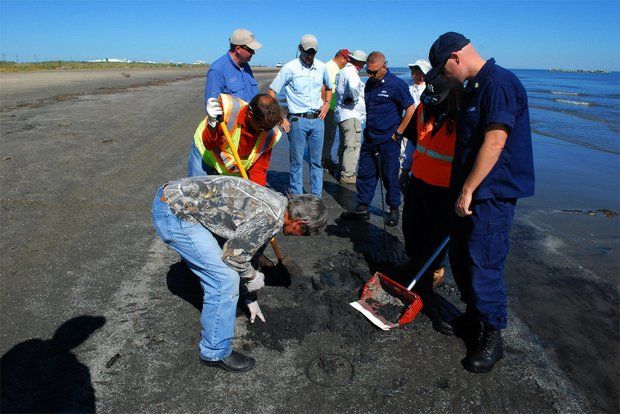
Grand Isle, La. – A Deepwater Horizon Response Shoreline Cleanup and Assessment Team delineates the edges a surface residual ball colony, Oct. 8, 2013. The 12 foot by 3 foot SRB colony was uncovered by the increased tides of Tropical Storm Karen and located during a Deepwater Horizon Post-Storm Rapid Assessment Survey. (Coast Guard/Michael Anderson)

By Katherine Sayre, NOLA.com | The Times-Picayune
Email the author | Follow on Twitter
on October 16, 2013 at 5:52 PM, updated October 16, 2013 at 9:33 PM

The Coast Guard says it has recovered 4,100 pounds of a tar mat discovered under the sand at Fourchon Beach. The oily material was found by crews inspecting Louisiana’s coast after Tropical Storm Karen.

The oily mixture is assumed to be left over from the BP Deepwater Horizon spill three years ago, said Petty Officer 1st Class Michael Anderson, spokesman for the Gulf Coast Incident Management Team. Karen’s storm surge, although weak, was enough to cause some erosion and expose the area.

The tar mat consists of a mixture of 80 percent to 90 percent sand, shell and water and 10 percent to 20 percent oil, Anderson said.

High tides temporarily stopped the cleanup work at the site today, but the effort will continue this week, Anderson said. The exact size of the tar mat hasn’t been determined.
“We’re expecting a significant amount of product,” Anderson said.

He said the Coast Guard does not expect it to be as large as the massive tar mat discovered around Isle Grand Terre in June.

The cleanup effort will include removing the tar mat and sending out snorkeling swimmers to search the waters nearby, he said.

Tar balls have been collected in other areas of Louisiana’s coast after Karen moved through the Gulf of Mexico and dissipated earlier this month.

Special thanks to Richard Charter

Common Dreams: Fossil Fuel Euphoria: Hallelujah, Oil and Gas Forever!

http://www.commondreams.org/view/2013/10/15-3

Published on Tuesday, October 15, 2013 by TomDispatch

by Michael T. Klare

For years, energy analysts had been anticipating an imminent decline in global oil supplies. Suddenly, they’re singing a new song: Fossil fuels growing scarce? Don’t even think about it! The news couldn’t be better: fossil fuels will become ever more abundant. And all that talk about climate change? Don’t worry about it, they chant. Go out and enjoy the benefits of cheap and plentiful energy forever.

Climate justice advocates rally across from the White House, July 27, 2013. (Photo: Stephen Melkisethian/cc/flickr)This movement from gloom about our energy future to what can only be called fossil-fuel euphoria may prove to be the hallmark of our peculiar moment. In a speech this September, for instance, Barry Smitherman, chairman of the Texas Railroad Commission (that state’s energy regulatory agency), claimed that the Earth possesses a “relatively boundless supply” of oil and natural gas. Not only that — and you can practically hear the chorus of cheering in Houston and other oil centers — but many of the most exploitable new deposits are located in the U.S. and Canada. As a result — add a roll of drums and a blaring of trumpets — the expected boost in energy is predicted to provide the United States with a cornucopia of economic and political rewards, including industrial expansion at home and enhanced geopolitical clout abroad. The country, exulted Karen Moreau of the New York State Petroleum Council, another industry cheerleader, is now in a position “to become a global superpower on energy.”

There are good reasons to be deeply skeptical of such claims, but that hardly matters when they are gaining traction in Washington and on Wall Street. What we’re seeing is a sea change in elite thinking on the future availability and attractiveness of fossil fuels. Senior government officials, including President Obama, have already become infected with this euphoria, as have top Wall Street investors — which means it will have a powerful and longlasting, though largely pernicious, effect on the country’s energy policy, industrial development, and foreign relations.

The speed and magnitude of this shift in thinking has been little short of astonishing. Just a few years ago, we were girding for the imminent prospect of “peak oil,” the point at which daily worldwide output would reach its maximum and begin an irreversible decline. This, experts assumed, would result in a global energy crisis, sky-high oil prices, and severe disruptions to the world economy.

Today, peak oil seems a distant will-o’-the-wisp. Experts at the U.S. government’s Energy Information Administration (EIA) confidently project that global oil output will reach 115 million barrels per day by 2040 — a stunning 34% increase above the current level of 86 million barrels. Natural gas production is expected to soar as well, leaping from 113 trillion cubic feet in 2010 to a projected 185 trillion in 2040.

These rosy assessments rest to a surprising extent on a single key assumption: that the United States, until recently a declining energy producer, will experience a sharp increase in output through the exploitation of shale oil and natural gas reserves through hydro-fracking and other technological innovations. “In a matter of a few years, the trends have reversed,” Moreau declared last February. “There is a new energy reality of vast domestic resources of oil and natural gas brought about by advancing technology… For the first time in generations, we are able to see that our energy supply is no longer limited, foreign, and finite; it is American and abundant.”

The boost in domestic oil and gas output, it is further claimed, will fuel an industrial renaissance in the United States — with new plants and factories being built to take advantage of abundant local low-cost energy supplies. “The economic consequences of this supply-and-demand revolution are potentially extraordinary,” asserted Ed Morse, the head of global commodities research at Citigroup in New York. America’s gross domestic product, he claimed, will grow by 2% to 3% over the next seven years as a result of the energy revolution alone, adding as much as $624 billion to the national economy. Even greater gains can be made, Morse and others claim, if the U.S. becomes a significant exporter of fossil fuels, particularly in the form of liquefied natural gas (LNG).

Not only will these developments result in added jobs — as many as three million, claims energy analyst Daniel Yergin — but they will also enhance America’s economic status vis-à-vis its competitors. “U.S. natural gas is abundant and prices are low — a third of their level in Europe and a quarter of that in Japan,” Yergin wrote recently. “This is boosting energy-intensive manufacturing in the U.S., much to the dismay of competitors in both Europe and Asia.”

This fossil fuel euphoria has even surfaced in statements by President Obama. For all his talk of climate change perils and the need to invest in renewables, he has also gloated over the jump in domestic energy production and promised to facilitate further increases. “Last year, American oil production reached its highest level since 2003,” he affirmed in March 2011. “And for the first time in more than a decade, oil we imported accounted for less than half of the liquid fuel we consumed. So that was a good trend. To keep reducing that reliance on imports, my administration is encouraging offshore oil exploration and production.”

Money Pouring into Fossil Fuels

This burst of euphoria about fossil fuels and America’s energy future is guaranteed to have a disastrous impact on the planet. In the long term, it will make Earth a hotter, far more extreme place to live by vastly increasing carbon emissions and diverting investment funds from renewables and green energy to new fossil fuel projects. For all the excitement these endeavors may be generating, it hardly takes a genius to see that they mean ever more carbon dioxide heading into the atmosphere and an ever less hospitable planet.

The preference for fossil fuel investments is easy to spot in the industry’s trade journals, as well as in recent statistical data and anecdotal reports of all sorts. According to the reliable International Energy Agency (IEA), private and public investment in fossil fuel projects over the next quarter century will outpace investment in renewable energy by a ratio of three to one. In other words, for every dollar spent on new wind farms, solar arrays, and tidal power research, three dollars will go into the development of new oil fields, shale gas operations, and coal mines.

From industry sources it’s clear that big-money investors are rushing to take advantage of the current boom in unconventional energy output in the U.S. — the climate be damned. “The dollars needed [to develop such projects] have never been larger,” commented Maynard Holt, co-president of Houston-based investment bank Tudor, Pickering, Holt & Company. “But the money is truly out there. The global energy capital river is flowing our way.”

In the either/or equation that seems to be our energy future, the capital river is rushing into the exploitation of unconventional fossil fuels, while it’s slowing to a trickle in the world of the true unconventionals — the energy sources that don’t add carbon to the atmosphere. This, indeed, was the conclusion reached by the IEA, which in 2012 warned that the seemingly inexorable growth in greenhouse gas emissions of carbon dioxide is likely to eliminate all prospect of averting the worst effects of climate change.

Petro Machismo

The new energy euphoria is also fueling a growing sense that the American superpower, whose influence has recently seemed to be on the wane, may soon acquire fresh geopolitical clout through its mastery of the latest energy technologies. “America’s new energy posture allows us to engage from a position of greater strength,” crowed National Security Adviser Tom Donilon in an April address at Columbia University. Increased domestic energy output, he explained, will help reduce U.S. vulnerability to global supply disruptions and price hikes. “It also affords us a stronger hand in pursuing and implementing our international security goals.”

A new elite consensus is forming around the strategic advantages of expanded oil and gas production. In particular, this outlook holds that the U.S. is benefiting from substantially reduced oil imports from the Middle East by eliminating a dependency that has led to several disastrous interventions in that region and exposed the country to periodic disruptions in oil deliveries, starting with the Arab oil embargo of 1973-74. “The shift in oil sources means the global supply system will become more resilient, our energy supplies will become more secure, and the nation will have more flexibility in dealing with crises,” Yergin wrote in the Wall Street Journal.

This turnaround, he and other experts claim, is what allowed Washington to adopt a tougher stance with Tehran in negotiations over Iran’s nuclear enrichment program. With the U.S. less dependent on Middle Eastern oil, so goes the argument, American leaders need not fear Iranian threats to disrupt the flow of oil through the Persian Gulf to international markets. “The substantial increase in oil production in the United States,” Donilon declared in April, is what allowed Washington to impose tough sanctions on Iranian oil “while minimizing the burdens on the rest of the world.”

A stance of what could be called petro machismo is growing in Washington, underlying such initiatives as the president’s widely ballyhooed policy announcement of a “pivot” from the Middle East to Asia (still largely words backed by only the most modest of actions) and efforts to constrain Russia’s international influence.

Ever since Vladimir Putin assumed the presidency of that country, Moscow has sought to sway the behavior of its former Warsaw Pact allies and the former republics of the Soviet Union by exploiting its dominant energy role in the region. It offered cheap natural gas to governments willing to follow its policy dictates, while threatening to cut off supplies to those that weren’t. Now, some American strategists hope to reduce Russia’s clout by helping friendly nations like Poland and the Baltic states develop their own shale gas reserves and build LNG terminals. These would allow them to import gas from “friendly” states, including the U.S. (once its LNG export capacities are expanded). “If we can export some natural gas to Europe and to Japan and other Asian nations,” Karen Moreau suggested in February, “we strengthen our relationships and influence in those places — and perhaps reduce the influence of other producers such as Russia.”

The crucial issue is this: if American elites continue to believe that increased oil and gas production will provide the U.S. with a strategic advantage, Washington will be tempted to exercise a “stronger hand” when pursuing its “international security goals.” The result will undoubtedly be heightened international friction and discord.

Is the Euphoria Justified?

There is no doubt that the present fossil fuel euphoria will lead in troubling directions, even if the rosy predictions of rising energy output are, in the long run, likely to prove both unreliable and unrealistic. The petro machismo types make several interconnected claims:

* The world’s fossil fuel reserves are vast, especially when “unconventional” sources of fuel — Canadian tar sands, shale gas, and the like — are included.

* The utilization of advanced technologies, especially fracking, will permit the effective exploitation of a significant share of these untapped reserves (assuming that governments don’t restrict fracking and other controversial drilling activities).

* Fossil fuels will continue to supply an enormous share of global energy requirements for the foreseeable future, even given rising world temperatures, growing public opposition, and other challenges.

Each of these assertions is packed with unacknowledged questions and improbabilities that are impossible to explore thoroughly in an article of this length. But here are some major areas of doubt.

To begin with, those virtually “boundless” untapped oil reserves have yet to be systematically explored, meaning that it’s impossible to know if they do, in fact, contain commercially significant reserves of oil and gas. To offer an apt example, the U.S. Geological Survey, in one of the most widely cited estimates of untapped energy reserves, has reported that approximately 13% of the world’s undiscovered oil reserves and 30% percent of its natural gas lie above the Arctic Circle. But this assessment is based on geological analyses of rock samples, not exploratory drilling. Whether the area actually holds such large reserves will not be known until widespread drilling has occurred. So far, initial Arctic drilling operations, like those off Greenland, have generally proved disappointing.

Similarly, the Energy Information Administration has reported that China possesses vast shale formations that could harbor substantial reserves of oil and gas. According to a 2013 EIA survey, that country’s technically recoverable shale gas reserves are estimated at 1,275 trillion cubic feet, more than twice the figure for the United States. Once again, however, the real extent of those reserves won’t be known without extensive drilling, which is only in its beginning stages.

To say, then, that global reserves are “boundless” is to disguise all the hypotheticals lurking within that description. Reality may fall far short of industry claims.

The effectiveness of new technologies in exploiting such problematic reserves is also open to question. True, fracking and other unconventional technologies have already substantially increased the production of hard-to-exploit fuels, including tar sands, shale gas, and deep-sea reserves. Many experts predict that such gains are likely to be repeated in the future. The EIA, for example, suggests that U.S. output of shale oil via fracking will jump by 221% over the next 15 years, and natural gas by 164%. The big question, however, is whether these projected increases will actually come to fruition. While early gains are likely, the odds are that future growth will come at a far slower pace.

As a start, the most lucrative U.S. shale formations in Arkansas, Pennsylvania, North Dakota, and Texas have already experienced substantial exploration and many of the most attractive drilling sites (or “plays”) are now fully developed. More fracking, no doubt, will release additional oil and gas, but the record shows that fossil-fuel output tends to decline once the earliest, most promising reservoirs are exploited. In fact, notes energy analyst Art Berman, “several of the more mature shale gas plays are either in decline or appear to be approaching peak production.”

Doubts are also multiplying over the potential for exploiting shale reserves in other parts of the world. Preliminary drilling suggests that many of the shale formations in Europe and China possess fewer hydrocarbons and will be harder to develop than those now being exploited in this country. In Poland, for example, efforts to extract domestic shale reserves have been stymied by disappointing drilling efforts and the subsequent departure of major foreign firms, including Exxon Mobil and Marathon Oil.

Finally, there is a crucial but difficult to assess factor in the future energy equation: the degree to which energy companies and energy states will run into resistance when exploiting ever more remote (and environmentally sensitive) resource zones. No one yet knows how much energy industry efforts may be constrained by the growing opposition of local residents, scientists, environmentalists, and others who worry about the environmental degradation caused by unconventional energy extraction and the climate consequences of rising fossil fuel combustion. Despite industry claims that fracking, tar sands production, and Arctic drilling can be performed without endangering local residents, harming the environment, or wrecking the planet, ever more people are coming to the opposite conclusion — and beginning to take steps to protect their perceived interests.

In New York State, for example, a fervent anti-fracking oppositional movement has prevented government officials from allowing such activities to begin in the rich Marcellus shale formation, one of the largest in the world. Although Albany may, in time, allow limited fracking operations there, it is unlikely to permit large-scale drilling throughout the state. Similarly, an impressive opposition in British Columbia to the proposed Northern Gateway tar sands pipeline, especially by the native peoples of the region, has put that project on indefinite hold. And growing popular opposition to fracking in Europe is making itself felt across the region. The European Parliament, for example, recently imposed tough environmental constraints on the practice.

As heat waves and extreme storm activity increase, so will concern over climate change and opposition to wholesale fossil fuel extraction. The IEA warned of this possibility in the 2012 edition of its World Energy Outlook. Shale gas and other unconventional forms of natural gas are predicted to provide nearly half the net gain in world gas output over the next 25 years, the report noted. “There are,” it added, “also concerns about the environmental impact of producing unconventional gas that, if not properly addressed, could halt the unconventional gas revolution in its tracks.”

Reaction to that IEA report last November was revealing. Its release prompted a mini-wave of ecstatic commentary in the American media about its prediction that, thanks to the explosion in unconventional energy output, this country would soon overtake Saudi Arabia as the world’s leading oil producer. In fact, the fossil fuel craze can be said to have started with this claim. None of the hundreds of articles and editorials written on the subject, however, bothered to discuss the caveats the report offered or its warnings of planetary catastrophe.

As is so often the case with mass delusions, those caught up in fossil fuel mania have not bothered to think through the grim realities involved. While industry bigwigs may continue to remain on an energy high, the rest of us will not be so lucky. The accelerated production and combustion of fossil fuels can have only one outcome: a severely imperiled planet.
Copyright 2013 Michael T. Klare
Michael T. Klare

Michael T. Klare is the Five College Professor of Peace and World Security Studies at Hampshire College in Amherst, Massachusetts. His newest book, The Race for What’s Left: The Global Scramble for the World’s Last Resources, has just recently been published. His other books include: Rising Powers, Shrinking Planet: The New Geopolitics of Energy and Blood and Oil: The Dangers and Consequences of America’s Growing Dependence on Imported Petroleum. A documentary version of that book is available from the Media Education Foundation.

The Hill: Shutdown delays BP lawsuit over federal contracts freeze & New York Daily News: Former Halliburton manager pleads guilty to destroying evidence of BP’s massive oil spill

http://thehill.com/blogs/e2-wire/e2-wire/328287-shutdown-delays-bp-lawsuit-over-federal-contracts-freeze

The Hill: Shutdown delays BP lawsuit over federal contracts freeze
By Ben Geman – 10/14/13 07:08 AM ET

A federal court has extended the Environmental Protection Agency’s (EPA) looming deadline to respond to BP’s lawsuit challenging the freeze on winning new federal contracts that the agency imposed over the 2010 Gulf of Mexico oil spill. The EPA had faced an Oct. 15 deadline to respond to the lawsuit but asked for a stay last week, citing the lapse in funding for the Justice Department during the government shutdown.

On Friday, Judge Vanessa D. Gilmore of the U.S. District Court for the Southern District of Texas granted the EPA’s motion. She extended all deadlines in the case “commensurate with the duration of the lapse in appropriations” that began Oct. 1. BP, a major fuel supplier to the U.S. military, sued the EPA in August to end its ongoing suspension from winning new federal procurement contracts.

The EPA imposed the suspension in late 2012, shortly after BP’s $4.5 billion plea agreement to resolve criminal and securities claims, citing the oil giant’s “lack of business integrity as demonstrated by the company’s conduct” in the Gulf of Mexico disaster.
______________________

http://www.nydailynews.com/news/national/ex-halliburton-manager-pleads-guilty-destroying-evidence-oil-spill-article-1.1486189

Former Halliburton manager pleads guilty to destroying evidence of BP’s massive oil spill

Anthony Badalamenti, the cementing technology director for Halliburton Energy Services Inc., faces a maximum sentence of 1 year in prison and a $100,000 fine after prosecutors charged he instructed two employees to delete data during a post-spill review of the cement job on BP’s blown-out Macondo well.

THE ASSOCIATED PRESS
TUESDAY, OCTOBER 15, 2013, 12:24 PM

NEW ORLEANS – A former Halliburton manager pleaded guilty Tuesday to destroying evidence in the aftermath of the deadly rig explosion that spawned BP’s massive 2010 oil spill in the Gulf of Mexico.
Anthony Badalamenti, 62, of Katy, Texas, faces a maximum sentence of 1 year in prison and a $100,000 fine after his guilty plea in U.S. District Court to one misdemeanor count of destruction of evidence. His sentencing by U.S. District Judge Jay Zainey is set for Jan. 21.

Badalamenti was the cementing technology director for Halliburton Energy Services Inc., BP’s cement contractor on the Deepwater Horizon drilling rig. Prosecutors said he instructed two Halliburton employees to delete data during a post-spill review of the cement job on BP’s blown-out Macondo well.

Last month, a federal judge accepted a separate plea agreement calling for Halliburton to pay a $200,000 fine for a misdemeanor stemming from Badalamenti’s conduct. Halliburton also agreed to be on probation for three years and to make a $55 million contribution to the National Fish and Wildlife Foundation, but that payment was not a condition of the deal.

The April 20, 2010, rig explosion killed 11 workers and led to the nation’s worst offshore oil spill.

In May 2010, according to prosecutors, Badalamenti directed a senior program manager to run computer simulations on centralizers, which are used to keep the casing centered in the wellbore. The results indicated there was little difference between using six or 21 centralizers. The data could have supported BP’s decision to use the lower number.

Badalamenti is accused of instructing the program manager to delete the results. The program manager “felt uncomfortable” about the instruction but complied, according to prosecutors.

A different Halliburton employee also deleted data from a separate round of simulations at the direction of Badalamenti, who was acting without company authorization, prosecutors said.

Halliburton notified investigators from a Justice Department task force about the deletion of data. Efforts to recover the data weren’t successful.

Badalamenti wasn’t the first individual charged with a crime stemming from the Deepwater Horizon disaster, but he is the first to plead guilty.

BP well site leaders Robert Kaluza and Donald Vidrine await a trial next year on manslaughter charges stemming from the rig workers’ deaths. They botched a key safety test and disregarded abnormally high pressure readings that were glaring signs of trouble before the well blowout, prosecutors say.

Former BP executive David Rainey is charged with concealing information from Congress about the amount of oil that was spewing from the blown-out well in 2010. Former BP engineer Kurt Mix is charged with deleting text messages and voicemails about the company’s response to the spill.

Two floors down from the courtroom where Badalamenti pleaded guilty, U.S. District Judge Carl Barbier is presiding over a trial for spill-related civil litigation. For the trial’s second phase, Barbier is hearing dueling estimates from experts for BP and the federal government about the amount of oil that spewed into the Gulf.

Read more: http://www.nydailynews.com/news/national/ex-halliburton-manager-pleads-guilty-destroying-evidence-oil-spill-article-1.1486189#ixzz2hp0EqVK6

"Be the change you want to see in the world." Mahatma Gandhi