Huffington Post: Gulf Oil Spill Recovery Could Take Decades For Deep-Sea Ecosystem, Study Finds

http://www.huffingtonpost.com/2013/09/25/gulf-oil-spill-recovery-study_n_3984577.html?utm_hp_ref=email_share

Reuters | Posted: 09/24/2013 5:09 pm EDT

WASHINGTON, Sept 24 (Reuters) – The muddy deep-sea ecosystem around the massive 2010 Gulf of Mexico oil spill could take decades to recover from the effects of the disaster, researchers reported on Tuesday.

The oil spill from BP Plc’s Macondo well had its most severe impact on the ecosystem in an area about nine square miles (24 square km) around the wellhead, the report in the online scientific journal PLoS One said.

Moderate effects were seen at 57 square miles (148 square km). The sea bottom’s rich biodiversity was greatly reduced by the oil plume, which was up to 200 yards (183 meters) thick and 1.2 miles (1.9 km) wide, it said.

“Given deep-sea conditions, it is possible that recovery of deep-sea soft-bottom habitat and the associated communities in the vicinity of the DWH blowout will take decades or longer,” the report concluded.

The April 20, 2010 disaster aboard the Deepwater Horizon drilling rig killed 11 workers and ruptured the Macondo well, triggering the worst offshore oil spill in U.S. history.

The research was carried out for the National Oceanic and Atmospheric Administration. Paul Montagna, an ecosystems professor at Texas A&M University, said on NOAA’s website that normally pollution was found within 300 to 600 yards (meters) of an offshore well.

In the Macondo case, it was found nearly two miles (3.2 km) from the well, he said.

Jeff Baguley, an expert on tiny marine and freshwater invertebrates from the University of Nevada, said on the NOAA website that the samples showed that the dominant group in affected areas had become nematode worms.
The research team included members from University of Nevada-Reno, Texas A&M, NOAA’s National Centers for Coastal Ocean Science and representatives from BP.

Special thanks to Richard Charter

Ecowatch.com: Colorado Flooding Triggers More Oil and Gas Spills & Miami Herald: 2 more oil spills caused by flooding in Colorado

http://ecowatch.com/2013/colorado-flooding-triggers-more-oil-and-gas-spills/

September 22, 2013

Cliff Willmeng
The crisis for the Colorado Oil and Gas Association (COGA) that last week’s floods created is now, thanks to community members and their cameras, set firmly onto the world stage. For the last seven days international media attention saw the immensity of the Weld County disaster, and those terrifying images of flood water colliding with oil and gas infrastructure are now the property of history.

colorado1

The industry and state government will now engage in damage control, and attempt to reassure the public and investors that it is in command, and every effort is being made to assess, contain and mitigate the catastrophic damage. COGA spokeswoman, Tisha Schulller, is making daily statements to this effect, and Colorado’s Gov. Hickenlooper spent at least part of his day Saturday tweeting about the cantaloupe he was eating, confident that, “Š the several small spills that we’ve had have been very small, relative to the huge flow of water.”

Anadarko, a multinational petroleum corporation with annual revenue of more than $14 billion and the owner of some of the first major official spills into the South Platte River,
volunteered $300,000 toward flood relief efforts. In the meantime, chemicals from leaking oil and gas wells continue to contaminate the environment of Weld County and beyond. Prior to even minimal environmental assessment, Canadian energy producer Encana Corp said Wednesday that 150 flooded wells due to flooding in Colorado had been returned to service, 245 remain shutdown.

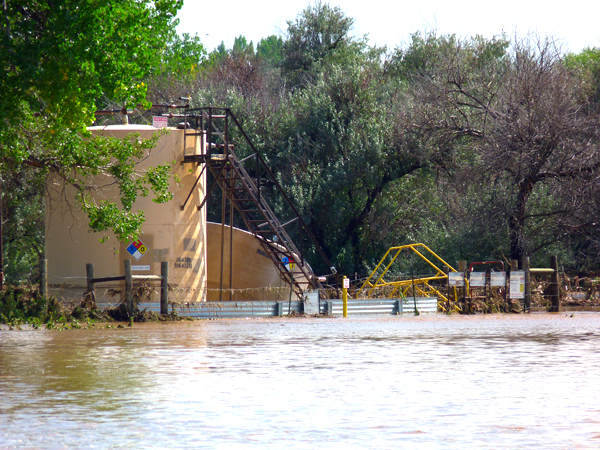
After assessing roughly 30 percent of the impacted area, the Colorado Oil and Gas Conservation Commission (COGCC) said in a statement, that 24 oil and gas storage tanks toppled in the flood bringing the total to more than 22,000 gallons of oil contaminating Colorado’s South Platte River valley.

According to the statement:
COGCC is tracking five notable releases, with volume amounts confirmed for four of those. Those include releases of 323 barrels and 125 barrels from Anadarko locations. Two additional releases of 56 barrels at an Anadarko location and 21 barrels at a Bayswater Exploration and Production location have also been confirmed. Both of the latter two locations are along the South Platte River near Evans.

Those four releases represent about 22,000 gallons of oil. An additional release has been reported by Anadarko, but the volume is unknown at this time.

The COGCC’s aerial survey Thursday revealed as many as two dozen tanks overturned. Releases from these tanks have not been confirmed but are certainly a possibility. In addition we are tracking 11 locations with visible evidence of a release, such as a sheen. No estimates of product losses are available for those sites.

The industry that regularly pollutes our beautiful state will now expect the people of Weld County and Colorado to believe that it is a credible source of information. And while the people of Colorado wait for the industry and government to clean up this mess, five Colorado communities that are attempting to assert some degree of democratic control over oil and gas operations on the ballot this November, will continue to be harassed by industrial public relations groups and corporate law firms.

The COGA and COGCC have refused to drop their lawsuit against the people of Longmont for voting to ban fracking in 2012 and removing the gag order preventing medical professionals and first responders to disclose the composition of fracking fluids in the event of human contamination.

This is the direct result of the colonization of our lands by the oil and gas industry, and a government that acts as its political arm. But as the hydrocarbons drip into the soil, the U.S. Environmental Protection Agency shrugs its collective shoulders, and Colorado’s contaminated floodwaters carry into Nebraska and beyond.

Our communities will continue to fill in where government, and the gas and oil industry, leave human health and safety behind. The tragedy we are all a part of asks us to strengthen our resolve on every level. When it comes to the discussion of mineral rights versus public safety and democratic control, the reality of these floods will not escape the industry, the people of Colorado or Gov. Hickenlooper. Colorado will be changed by these enormous events, and it will be the incredible efforts of the people that will place us all on higher ground.

Photo credit: Cliff Willmeng

___________

http://www.miamiherald.com/2013/09/23/3646463/2-more-oil-spills-caused-by-flooding.html

Miami Herald: 2 more oil spills caused by flooding in Colorado
3-198efV.St.55
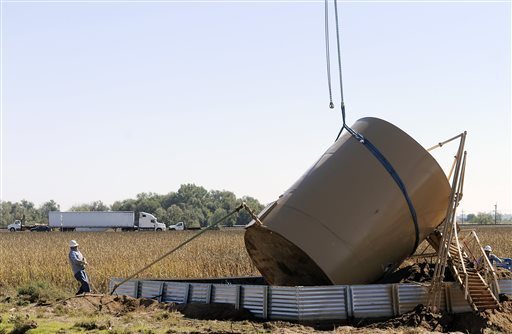
Oil workers try to lift a storage tank for condensate that was knocked over by floodwaters from the Platte River at an oil well site near LaSalle, Colo., on Friday, Sept. 20, 2013. Condensate is the mix of oil and water that is pumped out of the ground. The tank was intact and had not leaked. Numerous oil and gas well sites have been damaged by floodwaters throughout Colorado with several reports of spills. Chris Schneider / AP Photo

BY COLLEEN SLEVIN
ASSOCIATED PRESS
DENVER — A total of 27,000 gallons of oil – the equivalent of about two storage tanks – have been spilled into the South Platte River from flood-damaged tanks as of Monday.
The latest spills are a 36 barrel release at a Noble Energy location between Evans and LaSalle and a 26 barrel spill at an Anadarko Petroleum site near Johnstown, the Colorado Oil and Gas Conservation Commission said.

About 1,300 wells remained shut down because of the flooding, down from 1,900 last week.

In its update, the commission said the spills would have to be cleaned up though it would be difficult to tie the spills to the different companies that had the releases since the spills have been swept away with the flood waters.

It wasn’t clear whether there was any cleanup still going on or what risk the spilled oil posed. The river is a major source of drinking water and agricultural water but the state health department says the millions of gallons of sewage dumped into the river from broken sewer pipes and waste treatment plants pose a bigger problem.

Joseph N. Ryan, a University of Colorado professor researching how to limit the natural gas industry’s impact on the environment and communities for the National Science Foundation, said some of his researchers are taking soil samples along the river looking for evidence of benzene, which is a carcinogen, and benzene compounds, left by the spilled oil. The final data won’t be ready for weeks, but he suspects it won’t reveal significant accumulations because of the amount of water that rushed down the foothills and onto the plains.

“My expectation is that we wouldn’t find anything that’s going to cause a lot of risk,” said Ryan, a professor in CU’s civil, environmental and architectural engineering department.

The spills happened in the booming Wattenberg Field. Soon after the flooding began, activists started posting photos of overturned tanks and flooded gas wells, but inspectors were only able to gain access to the sites Wednesday, five days after the flooding hit the area.

The industry says no hydraulic fracturing was going on when the flood hit, but activists are still concerned about open pits that may have held fracking fluid that could have been washed away. Regulators say it’s rare to use pits for fracking fluid in the Wattenberg Field.

* Read more here: http://www.miamiherald.com/2013/09/23/3646463/2-more-oil-spills-caused-by-flooding.html#storylink=cpy

coloradospills.jpg coloradospills.jpg
393K

StarTribune/World: Russia to file piracy charges against Greenpeace activists for anti-drilling protest in Arctic

http://www.startribune.com/world/224993962.html

Article by: ALEXANDER ROSLYAKOV , Associated Press Updated: September 24, 2013 – 1:05 PM

MURMANSK, Russia – Russia’s top investigative agency said Tuesday it will prosecute Greenpeace activists on piracy charges for trying to climb onto an Arctic offshore drilling platform owned by the state-controlled gas company Gazprom.

The 30 activists from 18 countries were on a Greenpeace ship, the Arctic Sunrise, which was seized last week by the Russian Coast Guard. The ship was towed Tuesday into a small bay near Russia’s Arctic port of Murmansk.

The Investigative Committee, Russia’s main federal investigative agency, said its agents will question all those who took part in the protest and detain the “most active” of them on piracy charges. Piracy carries a potential prison sentence of up to 15 years and a fine of 500,000 rubles (about $15,500).

Two activists tried to climb onto the Prirazlomnaya platform on Thursday and others assisted from small inflatable boats. The Greenpeace protest was aimed at calling attention to the environmental risks of drilling for oil in Arctic waters.

“When a foreign vessel full of electronic technical equipment of unknown purpose and a group of people calling themselves members of an environmental rights organization try nothing less than to take a drilling platform by storm, logical doubts arise about their intentions,” Investigative Committee spokesman Vladimir Markin said in a statement.

He said the activists posed a danger to operations on the oil platform. “Such activities not only infringe on the sovereignty of a state, but might pose a threat to the environmental security of the whole region,” Markin said.

The oil platform, the first offshore rig in the Arctic, was deployed to the vast Prirazlomnoye oil field in the Pechora Sea in 2011 but its launch has been delayed by technological challenges. Gazprom has said it was to start pumping oil this year, but no precise date has been set.

Greenpeace insisted that under international law Russia had no right to board its ship and has no grounds to charge its activists with piracy.

“Peaceful activism is crucial when governments around the world have failed to respond to dire scientific warnings about the consequences of climate change in the Arctic and elsewhere,” Greenpeace International executive director Kumi Naidoo said in a statement.

“We will not be intimidated or silenced by these absurd accusations and demand the immediate release of our activists,” he added.

One Greenpeace activist told The Associated Press that Coast Guard officers hit and kicked some activists when they stormed the Greenpeace vessel.

The Arctic Sunrise was anchored Tuesday in Kulonga Bay near Severomorsk, the home port of Russia’s Northern Fleet, 25 kilometers (15 miles) north of Murmansk.

Greenpeace spokeswoman Maria Favorskaya said activists were ordered Tuesday to prepare to leave the ship. The Interfax news agency reported they were bused later in the day to the Investigative Committee’s headquarters in Murmansk.

Greenpeace said the activists hailed from Argentina, Australia, Brazil, Britain, Canada, Denmark, Finland, France, Italy, the Netherlands, New Zealand, Poland, Russia, Sweden, Switzerland, Turkey, Ukraine and the United States.

Blue Frontier Campaign: Marine conservation groups pledge not to accept money from the fossil fuel industry.

http://www.bluefront.org/wordpress/?p=4620

Recent gatherings themed around ocean conservation included among their sponsors the American Petroleum Institute, BP, Shell, the French oil giant Total and ExxonMobil. It’s as if a medical convention on how to reduce heart and lung disease were sponsored by coal and tobacco companies.

As leaders of groups dedicated to protecting our public seas and ocean planet we will not accept financial sponsorships from the fossil fuel industry. In addressing the critical challenges our blue planet faces from overfishing, pollution, loss of habitat and climate change we recognize the need to engage with all sectors of the marine community.

However we also understand that almost all ocean users including fishing, shipping, ports, recreation and tourism, science, national defense and clean energy have the potential to be part of a unified effort to sustain our coasts and ocean for future generations.

Forty or fifty years ago the same might have been thought of the fossil fuel industry when oil spills from drilling and shipping were seen as the main challenge for marine conservation and common efforts could be sought to balance the risk of pollution against the need for energy.

Today science and observation informs us that the burning of fossil fuels contributes to climate disruption including increased coastal storminess, sea level rise, warming seas, loss of arctic sea ice, coral bleaching and ocean acidification among other dangerous impacts. These changes are already putting millions of people and billions in property at risk along with the marine ecosystems we all depend on.

This is why we will not take any contributions from fossil fuel corporations that will allow them to greenwash (or bluewash) their role in climate change and undermine the marine conservation community’s credibility.

We need to make climate a blue issue by educating the public on why we have to make a rapid transition from fossil fuels to clean non-carbon renewable energy on and offshore as part of our greater effort to protect and restore the wonders and promise of our blue marble planet. Not taking money from big oil is a minimal step we all can commit to.

James N. Barnes
Executive Director
Antarctic & Southern Ocean Coalition

Anna Cummins
Executive Director
5 Gyres Institute

Jim Curland
Advocacy Program Director
Friends of the Sea Otter

Tim Dillingham
Executive Director
American Littoral Society

Vicki Nichols Goldstein
Founder
Colorado Ocean Coalition

Randy Hayes
Executive Director
Foundation Earth

David Helvarg
Executive Director
Blue Frontier

Alex Hobbs
Acting Executive Director
Heal the Bay

Linda Hunter
Executive Director
The Watershed Project

Phillip Johnson
Executive Director
Oregon Shores Conservation Coalition

Laura Kasa
Executive Director
Save Our Shores

Kurt Lieber
Executive Director
Ocean Defenders Alliance

Millard McCleary
Executive Program Director
Reef Relief

David McGuire
Director
Shark Stewards

Bill McKibben
Founder
350.Org

Wallace j. Nichols, PhD
Founder
Blue Mind

Jeff Pantukhoff
President & Founder
The Whaleman Foundation

Louis Psihoyos
Executive Director
Oceanic Preservation Society

Phil Radford
Executive Director
Greenpeace USA

Daniella Dimitrova Russo
Co-Founder and Executive Director
Plastic Pollution Coalition

Carl Safina, PhD
President
Blue Ocean Institute

Cynthia Sarthou
Executive Director
Gulf Restoration Network

Todd Steiner
Executive Director
Turtle Island Restoration Network

Mike Tidwell
Executive Director
Chesapeake Climate Action Network

Marc A. Yaggi
Executive Director
Waterkeeper Alliance

Cindy Zipf
Executive Director
Clean Ocean Action

Special thanks to Blue Frontier as it appeared in Blue Notes

Rigzone: Black Elk Incident Reminder of Dangers from Hazardous Vapors

Black Elk Energy is the lead proponent of the Rigs-to-Reefs program….. Richard Charter

http://www.rigzone.com/news/oil_gas/a/129120/Black_Elk_Incident_Reminder_of_Dangers_from_Hazardous_Vapors

by Karen Boman|
Rigzone Staff|
Wednesday, September 18, 2013

The November 2012 explosion at a Black Elk Energy-operated platform – which resulted from welders welding onto a pipe leading to a wet oil tank – serves as a reminder of the importance of educating workers on the dangers fire or explosions sparked by hazardous vapors, an offshore safety official told Rigzone.

A third party investigation found that the explosion and fire that occurred resulted from contractors failing to follow standard safety practices. Black Elk last month published the results of the investigation into the explosion and fire that killed three workers at the platform at West Delta Block 32 in the U.S. Gulf of Mexico.

The wet oil tank and pipework would have contained hydrocarbon gases that could have easily been ignited by an ignition temperature as the weld heat generated inside the pipe, said Tony Scott, general manager for the OCS Group, in an interview with Rigzone.
“If the workers knew more about the dangers around them the fatalities may well have been avoided,” said Scott.

To address part of this potentially fatal shortfall in training, the OCS Group now offers a Complex Mechanical course for mechanical workers. However, Scott believes that satisfactory Zone awareness training should be offered to all rig personnel throughout the industry.

A hazardous area is considered to be an area where an explosive atmosphere is or may be expected to be present. Thirty-five percent of rigs and drillships offshore will have this area broken down into zones or divisions. Zone Zero, potentially the most hazardous of the three risk areas mentioned, is where an explosive gas/vapor is present continuously for long periods. Zone Zero is not typically found on a rig, but in refineries and chemical plants; a Zone Zero can be found inside a tank where a gap exists at the top and vapor is trapped.

Zone 1 is where an explosive gas/vapor is likely during normal operation; with Zone 1, gas will be present but it is diluted by air. Zone 2, the least potentially hazardous of the three risk areas mentioned – is where an explosive gas/vapor is unlikely to occur in normal operation. If an explosive gas/vapor does occur in Zone 2, it is likely to do so infrequently and existing for short periods. Zone 2 accounts for approximately 28 percent of the total hazardous area of the rig.

Sources of accident ignition include welding, burning and static, which can occur even through nylon clothes. Welding activity could generate an ignition that could be considered an ignition temperature, or when material ignites without an external source of ignition such as a spark. This type of ignition could cause the gas/vapor inside a pipe to explode if someone was welding on the pipe.

“People erroneously assume that a spark is needed to cause ignition but this is not the case,” Scott noted. “When a spark causes ignition, this is called the Flash Point and is different to an ignition temperature. A Flash Point is where the minimum temperature at which a substance gives out sufficient vapor to form an explosive atmosphere is reached. A spark from an aluminum ladder on a rusty beam could generate a Flash Point and cause a gas or vapor to explode.”

The problem with hazardous areas is that offshore workers can be unaware that they are entering a potentially explosive area. Electricians and electronic technicians are likely to have received training to gain a full understanding of the hazardous area zones and their importance where electrical equipment is concerned. However, the rig safety preparatory courses offered to many other groups of rig workers, including welders, mechanics, scaffolders, and riggers, don’t give workers adequate in-depth knowledge of the rig zones and their potential for explosive gases and vapors.

The courses available for offshore workers are good but lightweight on hazardous vapors, an area that Scott feels has been almost neglected in training.
“You almost need separate, half day training session to talk on the dangers of vapors,” Scott commented.

While workers are trained to find muster stations in case of a fire, workers with backgrounds outside of electrical/instrumentation jobs are not given enough training in recognizing the dangers of hazardous vapors, Scott noted. The lack of understanding surrounding hazardous areas presents an issue for both offshore and onshore oil and gas facilities.

For example, a rigger going into a hazardous area on and offshore rig and breaking a junction box while trying to use the box as a foothold. These workers need to be warned on the dangers of a spark.

Scott said it wasn’t clear whether the pipe that blew up on the Black Elk platform was in a zoned area. If it was located in a zoned area, it would likely have had a hot work permit and controls to guard against sparks.

“All it takes is for a spark or hot surface to explode,” said Scott. “People don’t and should understand these hazards.”

Better training and better systems for conveying the dangers of hazardous vapors are definitely needed to fill the knowledge gap. While regulations in the U.S. Gulf of Mexico have tightened since the Macondo incident, in Scott’s opinion, the oil and gas industry is not doing enough to alert workers to the dangers of hazardous vapors, beyond the training and electrical and mechanical inspections. The failure of the Deepwater Horizon rig’s blowout preventer was the root but not the cause of the Macondo incident. Instead, the rig blew because gas that was floating around the rig found a spark or a hot surface.

Besides training, another option could be for rigs to clearly inform workers when they are entering a hazardous area which has zones or divisions that could be explosive, such as the signs used in European Union rigs under the Potentially Explosive Atmospheres Directive (ATEX). The directive, which came out in 2003, established what equipment and work environment is allowed in an explosive atmosphere in order to protect employees from explosion risk.

“I would love to go onto a rig and know that I’m going into a hazardous area,” Scott commented, noting that the times he’s been on offshore rigs, he’s found out about a rig’s hazardous areas by accident.

OCS has done one course for the Bureau of Safety and Environmental Enforcement (BSEE) and will conduct another course for BSEE on ignition sources and hazardous areas.

The company has recommended to the Coast Guard a collection of information needed to demonstrate that certain specific requirements have been undertaken with U.S. Gulf and international requirements. The document proposed would contain electrical equipment in hazardous locations documents contain data on previous inspections and maintenance of electrical equipment. The document also would contain Hazardous Area Equipment Register (HAER), supplied by a third party, including Remedial Actions, an Emergency Shut Down register, also supplied by a third party.
The document in the form proposed by OCS also would include:
* A register of Hazardous Areas qualified staff certified by the American Petroleum Institute, International Association of Drilling Contractors, or CompEx
* Mobile Offshore Drilling Unit or Vessel Hazardous Area classification drawings
* Record of Special X conditions for any equipment marked accordingly with certificates of reference
* Notified incident records within the Hazardous Areas and any potential gas/vapor catastrophes outside of Hazardous Areas
* Details of Fire, First Aid and Rescue Services
* Emergency Shut Down register, supplied by a third party

The dossier would be held on the rig or vessel and be easily accessible by the Coast Guard when they visit. The company that operates the rig or vessel or a third party would maintain the data, which would be introduced into the companies’ quality system. The data could be compiled on certified table so the Coast Guard could check against any of the items on the Hazardous Area Equipment Register.

Under the current Safety and Environmental Management Systems (SEMS) 2 requirements, a third party audit of offshore rigs and vessels. The SEMS II final rule enhances the original SEMS rule, or Workplace Safety Rule, issued in October 2010.

SEMS II was passed to provide greater protection by supplementing operators’ SEMS programs with employee training, empowering field level personnel with safety management decisions and strengthening auditing procedures by requiring third parties to conduct auditing activities. The U.S. Coast Guard’s role with SEMS II is to act as police, following up with visits to rigs and vessels to ensure that third party audits have been conducted.

“As a company that performs Ex inspections, in our experience, we know that sometimes Remedial Action’s aren’t closed out,” OCS said in an Aug. 22 letter to the Coast Guard.

In June of this year, the Coast Guard proposed to amend the electrical engineering regulations for electrical installations in hazardous areas that would expand the list of acceptable national and international explosion protection standards. The IEC System for Certification to Standards relating the equipment for use in Explosive Atmospheres also would be added as an acceptable independent third-party certification system for testing and certifying electrical equipment.

The proposed regulations would apply to foreign and U.S. mobile offshore drilling units, floating facilities and vessels that engaged in activities on the Outer Continental Shelf for the first time after the regulations’ effective date. They would also allow owners and operators of U.S. tank vessels to choose the compliance regime in existing regulations on the proposed regulations.

When the ATEX Directive came out in Europe in 2003, complaints arose that equipment had to be classed as in service to be used. What started to happen was that equipment that would be used in non-risk areas could be certified by the company. The self-certification was good for mechanical people. But the ATEX self-certification process slipped out of Europe into the United States, Scott noted. This led to confusion on the Coast Guard’s behalf that companies would self-certify equipment for Zone 2 work, not only mechanical but electrical equipment as well.

Karen Boman has more than 10 years of experience covering the upstream oil and gas sector. Email Karen at kboman@rigzone.com.

Special thanks to Richard Charter
"Be the change you want to see in the world." Mahatma Gandhi