Palm Beach Daily News.com: Source of sand on reef off Breakers under investigation

http://www.palmbeachdailynews.com/news/content/news/2009/12/26/SUN_reefsand.html
Steve Spring
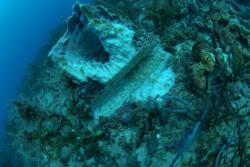
The town has monitored The Breakers rock pile,

seen here on Nov. 17, 2008, for signs of sand burial

from beach fill projects of 2003 and 2006.

Source of sand on reef off Breakers under investigation

By WILLIAM KELLY
Daily News Staff Writer

Saturday, December 26, 2009

Sand from the 2003 and 2006 Midtown beach fills may have drifted onto nearby shallow reef offshore from The Breakers.

If the state finds the town responsible for the sand cover, it could require it to spend millions of dollars to build artificial reef to mitigate for the damage.

In a Dec. 14 letter to the town, the Florida Department of Environmental Protection rejected the “no impact” conclusion reached by a town consultant that monitored the shallow reef, known as The Breakers rock pile, for signs of sand burial resulting from the beach fills.

In the letter, Dr. Vladimir N. Kosmynin, environmental consultant to the DEP’s Bureau of Beaches and Coastal Systems, noted that the town consultant, Coastal Planning & Engineering, identified extensive sand cover of hard bottom areas in a January 2006 report. In the report, CP&E said it was difficult to determine if the sand came from the Midtown nourishment, hurricanes or “unknown sources of rapidly moving sand.”

Kosmynin wrote that, considering the rapid loss of sand from the beach fill area after nourishments, “it is logical to suggest that the ‘source of rapidly moving sand’ is the beach fill.”

State environmental permits for the Midtown projects required the town to monitor for environmental impacts and report annually to the DEP. Coastal Planning & Engineering performed the work for the town in 2006, 2007 and 2008.

Earlier this year, the town hired two other consultants, Tetra Tech and Coastal Eco-Group, to perform the 2009 monitoring. The DEP has requested that those consultants re-evaluate Coastal Planning & Engineering’s findings in a report due Feb. 1.

“We don’t know where it’s going to go,” Public Works Director Paul Brazil said of the DEP investigation. “It’s very premature to say what was the cause of this, and what the impacts are, and therefore the end result.”

The impacts could be mitigated for with mitigation reefs, he said. Artificial reefs are boulder fields that generally cost about $1 million per acre to build.

In 2003, the town placed 1.2 million cubic yards of sand, dredged from an offshore site, along two miles of coast between El Vedado and El Mirasol roads. Following the hurricanes of 2004 and 2005, the area was renourished in 2006 with another 900,000 cubic yards.

Dr. Thomas Goreau: COP-15 CONDEMNS CORAL REEFS, LOW ISLANDS, AND LOW COASTS TO EXTINCTION

Letter by Dr. Thomas Goreau of the Global Coral Reef Alliance dated December 18 2009

United Nations Framework Convention on Climate Change
Conference of Parties 15
Copenhagen, Denmark

COP-15 CONDEMNS CORAL REEFS, LOW ISLANDS, AND LOW COASTS TO EXTINCTION

Any agreement that might be reached in Copenhagen today will condemn coral reefs, low lying island nations, and all low lying coastlines to extinction, because none of the targets being discussed here are adequate to protect them.

All targets proposed are based on models that intrinsically miss more than 90% of the long term climate response to CO2 that are shown in the real climate data. The sensitivity of global sea level and temperature to CO2 shown in the climate record are many times greater than IPCC models suggest. IPCC projections only show the first small initial fraction of the long-term climatic response. The heat is now building up in the deep sea, and only when the deep ocean and ice caps warm up will we feel the full effect of warming. This takes thousands of years.

Coral reefs can take no further warming. We have already lost most of the corals in the world to heat stroke, and it is only a question of when the next record hot year will happen for us to lose most of what is left. Statistically speaking, that will happen in 2010. Therefore proposed targets to let temperature rise by 1.5 or 2 degrees are a death sentence for coral reefs and the marine biodiversity, fisheries, sand supplies, tourism, and shore protection of over 100 countries.

Low lying islands and low lying coastal areas, where billions of people live, can’t take further sea level rise. The long-term equilibrium sea level for TODAY’S atmospheric CO2 concentration is 23 metres (75 feet) above today’s level. The equilibrium sea level for only 280 ppm of CO2 is 7 metres (23 feet) above today’s level. That is the level shown by the flashing red lights on the light poles outside the Bella Center, or around the height of the ceiling of the first floor. At that time Copenhagen was submerged, and crocodiles and hippopotamuses roamed the tropical swamps of London, England. The safe level of CO2 to avert this inevitable ultimate consequence is about 260 ppm. Therefore proposed targets of 350 or 450 ppm amount to a suicide pact for low lying island nations, and billions of people who live near low lying coasts..

Not only are the world’s policy makers failing to grasp the magnitude of the crisis future generations face, and irresponsibly failing to act in time, they are also ignoring known solutions. These are proven and available now, but we are just not using them because policy makers and funding agencies are not using new technologies to adapt to climate change and to reverse CO2 increases and global warming. The United Nations Commission of Sustainable Development Small Island Developing States Partnership In New Sustainable Technologies has issued a 40 chapter multimedia DVD at COP-15 showing cost-effective solutions that could be rapidly implemented to prevent the looming disaster, if there were policies and funding to promote effective action. Many of these new technologies have already been implemented in SIDS on pilot scales, so this is not a technology transfer issue but one of endogenous capacity development.

The world’s leaders have known for more than two years exactly when their final exam was scheduled, but they refused to study for it. Now that they have flunked the exam, they are basically claiming the dog ate the assignment. Our planet’s people need much higher seriousness, less talk, and immediate action.

For more information contact Dr. Thomas Goreau at goreau@bestweb.net

Dr. Goreau is President of the Global Coral Reef Alliance and founder and Coordinator of the UNCSD SIDS Partnership In New Sustainable Technologies.. He was previously Senior Scientific Affairs Officer for global climate change and Biodiversity at the United Nations Centre for Science and Technology for Development. Educated in Jamaican schools, he holds degrees in atmospheric physics, astronomy, chemistry, and microbiology from MIT, Caltech, and Harvard. He developed the HotSpot method to accurately predict the location, timing, and intensity of coral bleaching from satellite data, and made the first measurements of the effects of Amazon deforestation on greenhouse gas emissions. He has dived longer and in more places than any coral scientist.

*************************************
posted on the Coralist by:

Dr. James M. Cervino
Pace University &
Visiting Scientist Woods Hole Oceanographic Inst.
NYC Address: 9-22 119st
College Point NY NY 11356
Cell: 917-620*5287

************************************