Increased Stray Gas Abundance in a Subset of Drinking Water Wells Near Marcellas Shale Gas Extraction

StrayGasStudy

Robert B. Jacksona,b,1, Avner Vengosha, Thomas H. Darraha, Nathaniel R. Warnera, Adrian Downa,b, Robert J. Poredac,
Stephen G. Osbornd, Kaiguang Zhaoa,b, and Jonathan D. Karra,b
aDivision of Earth and Ocean Sciences, Nicholas School of the Environment and
bCenter on Global Change, Duke University, Durham, NC 27708;
cDepartment of Earth and Environmental Sciences, University of Rochester, Rochester, NY 14627; and
dGeological Sciences Department, California State Polytechnic University, Pomona, CA 91768

Edited by Susan E. Trumbore, Max Planck Institute for Biogeochemistry, Jena, Germany, and approved June 3, 2013 (received for review December 17, 2012)

Horizontal drilling and hydraulic fracturing are transforming energy production, but their potential environmental effects remain controversial. We analyzed 141 drinking waterwells across the Appalachian Plateaus physiographic province of northeastern Pennsylvania, examining natural gas concentrations and isotopic signatures with proximity to shale gas wells. Methane was detected in 82% of drinking water samples, with average concentrations six times higher for homes <1 km from natural gas wells (P = 0.0006). Ethane was 23 times higher in homes <1 km from gas wells (P =0.0013); propane was detected in 10 water wells, all within approximately 1 km distance (P = 0.01). Of three factors previously proposed to influence gas concentrations in shallow groundwater (distances to gas wells, valley bottoms, and the Appalachian Structural Front, a proxy for tectonic deformation), distance to gas wells was highly significant for methane concentrations (P = 0.007; multiple regression), whereas distances to valley bottoms and the Appalachian Structural Front were not significant (P = 0.27 and P = 0.11, respectively). Distance to gas wells was also the mostsignificant factor for Pearson and Spearman correlation analyses (P < 0.01). For ethane concentrations, distance to gas wells was the only statistically significant factor (P < 0.005). Isotopic signatures (δ13C-CH4, δ13C-C2H6, and δ2H-CH4), hydrocarbon ratios (methane to ethane and propane), and the ratio of the noble gas 4He to CH4in groundwater were characteristic of a thermally postmature Marcellus-like source in some cases. Overall, our data suggest that some homeowners living <1 km from gas wells have drinking water contaminated with stray gases.

NOAA: National Marine Sanctuaries Program: Florida Keys 2011 Condition Report

http://sanctuaries.noaa.gov/science/condition/fknms/welcome.html

This report is best viewed by going to the link above. Below are a few key reports–I added the bold sections which I find the most disturbing.
DV

Florida Keys National Marine Sanctuary
Condition Summary Table

WATER
1. Are specific or multiple stressors, including changing oceanographic and atmospheric conditions, affecting water quality and how are they changing?

Conditions appear to be declining
Large-scale changes in flushing dynamics over many decades have altered many aspects of water quality; nearshore problems related to runoff and other watershed stressors; localized problems related to infrastructure. Selected conditions may inhibit the development of assemblages and may cause measurable but not severe declines in living resources and habitats. In conjunction with the Environmental Protection Agency and Florida Department of Environmental Protection, the sanctuary will continue implementation of its Water Quality Protection Program and conduct long-term water quality monitoring and research to understand the effects of water transported from near-field and far-field sources, including Florida Bay on water quality in the sanctuary. New regulations prohibit discharge or deposit of sewage from marine sanitation devices (MSD) within the boundaries of the sanctuary and require MSDs be locked to prevent sewage discharge or deposit while inside sanctuary boundaries. The marine area surrounding the Florida Keys has been designated as a Particularly Sensitive Sea Area by the International Maritime Organization. Florida Department of Health Florida Healthy Beaches Program tests for the presence of fecal coliform and enterococci bacteria in beach water on a weekly basis, at 17 locations throughout the Keys. The MEERA Project, which is designed to provide early detection and assessment of biological events occurring in the Florida Keys and surrounding waters, continues to be supported by the sanctuary. A well-established law enforcement program is in place, including NOAA Fisheries Service, Florida Fish and Wildlife Conservation Commission, and U.S. Coast Guard.

2. What is the eutrophic condition of sanctuary waters and how is it changing?
Conditions do not appear to be changing
Long-term increase in inputs from land; large, persistent phytoplankton bloom events, many of which originate outside the sanctuary but enter and injure sanctuary resources. Selected conditions have caused or are likely to cause severe declines in some but not all living resources and habitats.

3. Do sanctuary waters pose risks to human health and how are they changing?
Conditions do not appear to be changing
Rating is a general assessment of “all waters” of the sanctuary, knowing that in very specific locations, the rating could be as low as “poor.” Increased frequency of HABs and periodic swim advisories. Selected conditions have resulted in isolated human impacts, but evidence does not justify widespread or persistent concern.

4. What are the levels of human activities that may influence water quality and how are they changing?
conditions appear to be improving
Historically, destructive activities have been widespread throughout the Florida Keys, but many recent management actions are intended to reduce threats to water quality. Selected activities have caused or are likely to cause severe impacts, and cases to date suggest a pervasive problem.

HABITAT
5. What are the abundance and distribution of major habitat types and how are they changing?
Conditions do not appear to be changing
In general, mangrove and benthic habitats are still present and their distribution is unchanged, with the exception of the mangrove community, which is about half of what it was historically. The addition of causeways has changed the distribution of nearshore benthic habitats in their vicinity. Selected habitat loss or alteration has taken place, precluding full development of living resource assemblages, but it is unlikely to cause substantial or persistent degradation in living resources or water quality. Marine zoning is used in the sanctuary to protect sensitive habitats like shallow coral reefs. Mooring buoys have been installed as a threat-reduction measure. Sanctuary staff and volunteers educate and inform boaters about the unique nature of the coral reef habitat, and organize shoreline clean-up and marine debris removal efforts. Sanctuary staff assess and restore vessel grounding injuries to seagrass and coral habitats, as well as perform coral rescue activities associated with coastal construction. Large vessel avoidance and Racon beacons in lighthouses have resulted in declines in large vessel groundings. An Area To Be Avoided was established to prevent ships larger than 50 meters in overall length from transiting through sensitive areas in the sanctuary. A well established permitting program is in place to issue a variety of permits for activities that are otherwise prohibited by sanctuary regulations. There is also a well-established law enforcement program in place, including NOAA Fisheries Service, the Florida Fish and Wildlife Conservation Commission, and the U.S. Coast Guard. State of Florida’s Mangrove Trimming and Preservation Act of 1996 (§403.9321-403.9333) regulates how mangroves can be trimmed and altered, and by whom.

6. What is the condition of biologically structured habitats and how is it changing?
conditions appear to be declining
Loss of shallow (<10 meters) Acropora and Montastraea corals has dramatically changed shallow habitats; regional declines in coral cover since the 1970s have led to changes in coral-algal abundance patterns in most habitats; destruction of seagrass by propeller scarring; vessel grounding impacts on benthic environment; alteration of hard-bottom habitat by illegal casitas. Selected habitat loss or alteration has caused or is likely to cause severe declines in some but not all living resources or water quality.

7. What are the contaminant concentrations in sanctuary habitats and how are they changing?
?
Few studies, but no synthesis of information.
N/A

8. What are the levels of human activities that may influence habitat quality and how are they changing?
conditions appear to be declining
Coastal development, highway construction, vessel groundings, over-fishing, shoreline hardening, marine debris (including derelict fishing gear), treasure salvaging, increasing number of private boats, and consequences of long-term changes in land cover on nearshore habitats. Selected activities have caused or are likely to cause severe impacts, and causes to date suggest a pervasive problem.

LIVING RESOURCES
9. What is the status of biodiversity and how is it changing?
conditions appear to be declining
Relative abundance across a spectrum of species has been substantially altered, with the most significant being large reef-building corals, large-bodied fish, sea turtles, and many invertebrates, including, the long-spined sea urchin. Recovery is questionable. Selected biodiversity loss has caused or is likely to cause severe declines in some but not all ecosystem components and reduce ecosystem integrity. Marine zoning assists in the protection of the biological diversity of the marine environment in the Keys. Mooring buoys have been installed in these zones to reduce anchor damage to coral reef biota. The sanctuary’s education and outreach team established the “Blue Star” program to help reduce the impact of divers and snorkelers on the coral reef ecosystem. NOAA has also established the Dolphin SMART program encouraging responsible viewing of wild dolphins. Sanctuary staff assesses and restores vessel grounding injuries to seagrass and coral habitats, as well as performs coral rescue activities associated with coastal construction. NOAA Fisheries Service (American Recovery and Reinvestment Act) awarded $3.3 million to support Acropora coral recovery and restoration in Florida (including the Keys) and the U.S. Virgin Islands. Other coral nursery efforts are also underway that contribute to coral restoration. Private efforts examining potential of long-spined sea urchin recovery via nursery propagation and rearing are also underway. A well-established permitting program is in place to issue a variety of permits for activities that are otherwise prohibited by sanctuary regulations, including removal of the invasive lionfish from the small no-take zones. The Florida Keys “Bleach Watch” Program utilizes volunteers to provide reports from the reef on the actual condition of corals throughout the bleaching season. The sanctuary also participates in oil spill drills sponsored by the U.S. Coast Guard and is a partner in the Florida Reef Resilience Program. There is a well-established law enforcement program in place.

10. What is the status of environmentally sustainable fishing and how is it changing?
?
Historical effects of recreational and commercial fishing and collection of both targeted and non-targeted species; it is too early to determine ecosystem effects of new fishery regulations and new ecosystem approaches to fishery management. Extraction has caused or is likely to cause severe declines in some but not all ecosystem components and reduce ecosystem integrity.

11. What is the status of non-indigenous species and how is it changing?
conditions appear to be declining
Several species are known to exist; lionfish have already invaded and will likely cause ecosystem level impacts; impacts of other non-indigenous species have not been studied. Non-indigenous species may inhibit full community development and function, and may cause measurable but not severe degradation of ecosystem integrity.

12. What is the status of key species and how is it changing?
Conditions do not appear to be changing
Reduced abundance of selected key species including corals (many species), queen conch, long-spined sea urchin, groupers and sea turtles. The reduced abundance of selected keystone species has caused or is likely to cause severe declines in ecosystem integrity; or selected key species are at severely reduced levels, and recovery is unlikely.

13. What is the condition or health of key species and how is it changing?
conditions appear to be declining
Hard coral and gorgonian diseases and bleaching frequency and severity have caused substantial declines over the last two decades; long-term changes in seagrass condition; disease in sea turtles; sponge die- offs; low reproduction in queen conch; cyanobacterial blooms; lost fishing gear and other marine debris impacts on marine life. The comparatively poor condition of selected key resources makes prospects for recovery uncertain.

14. What are the levels of human activities that may influence living resource quality and how are they changing?
Conditions do not appear to be changing
Despite the human population decrease and overall reduction in fishing in the Florida Keys since the 1990s, heavy recreational and commercial fishing pressure continues to suppress biodiversity. Vessel groundings occur regularly within the sanctuary. Annual mean number of reported petroleum and chemical spills were around 150 during that time period, with diesel fuel, motor oil, and gasoline representing 49% of these incidents collectively. Over the long term, localized direct impacts may be overwhelmed by the adverse and wide-ranging indirect effects of anthropogenic climate change resulting in sea level rise, abnormal air and water temperatures, and changing ocean chemistry. Selected activities have caused or are likely to cause severe impacts, and cases to date suggest a pervasive problem.

Seaweb via Coral-list: Marine Science Review Contaminants and Pollution – Ocean Acidification

Ahh, the power of the internet and open sources. For anyone studying ocean acidification, this is a nirvana of resources. DV

From: SeaWeb
Date: Wed, Jun 12, 2013 at 9:01 AM

June 11, 2013

OA indicates an open access article or journal.

– *Ocean acidification limits temperature-induced poleward expansion of coral habitats around Japan.
**Biogeosciences* 9(12): 4955-4968, 2012. *OA*

– *Observed acidification trends in North Atlantic water masses. **
Biogeosciences* 9(12): 5217-5230, 2012. *OA*

– *Spatiotemporal variability and long-term trends of ocean acidification in the California Current System.
**Biogeosciences*10(1): 193-216, 2013.*OA*

– *High tolerance of microzooplankton to ocean acidification in an Arctic coastal plankton community.
**Biogeosciences* 10(3): 1471-1481, 2013. *OA*

– *Short- and long-term consequences of larval stage exposure to constantly and ephemerally elevated carbon dioxide for
marine bivalve populations. **Biogeosciences* 10(4): 2241-2253, 2013. *OA*

– *Influence of ocean warming and acidification on trace metal biogeochemistry.
**Marine Ecology Progress Series* 470: 191-205, 2012. *OA*

– *Responses of marine primary producers to interactions between ocean acidification, solar radiation, and warming.
**Marine Ecology Progress Series* 470: 167-189, 2012. *OA*

– *Marine life on acid. **BioScience* 63(5): 322-328, 2013.

– *Red coral extinction risk enhanced by ocean acidification. **Scientific Reports* 3: art. 1457, 2013. *OA*

– *Dolomite-rich coralline algae in reefs resist dissolution in acidified conditions.
**Nature Climate Change* 3(3): 268-272, 2013.

– *Variation in plastic responses of a globally distributed picoplankton species to ocean acidification.
**Nature Climate Change* 3(3): 298-302, 2013.

– *Effects of ocean acidification on the embryos and larvae of red king crab, Paralithodes camtschaticus.
**Marine Pollution Bulletin* 69(1-2): 38-47, 2013.

– *Temperature and CO2 additively regulate physiology, morphology and genomic responses of larval sea urchins,
Strongylocentrotus purpuratus. **Proceedings of the Royal Society of London [B]* 280(1759): art. 20130155, 2013.

– *Addressing ocean acidification as part of sustainable ocean development. **Ocean Yearbook* 27: 29-46, 2013.

– *The marine inorganic carbon system along the Gulf of Mexico and Atlantic coasts of the United States: Insights from a
transregional coastal carbon study. **Limnology and Oceanography* 58(1): 325-342, 2013. *OA*

– *The responses of eight coral reef calcifiers to increasing partial pressure of CO2 do not exhibit a tipping point.
**Limnology and Oceanography* 58(1): 388-398, 2013. *OA*

– *Concentration boundary layers around complex assemblages of macroalgae: Implications for the effects of ocean
acidification on understory coralline algae. **Limnology and Oceanography* 58(1):121-130, 2013.

– *Interactive effects of elevated temperature and CO2 levels on metabolism and oxidative stress in two common marine
bivalves (Crassostrea virginica and Mercenaria mercenaria).
**Comparative Biochemistry and Physiology Part A: Molecular and Integrative Physiology* 164(4):545-553, 2013.

– *CO2-driven seawater acidification differentially affects development and molecular plasticity along life history of fish
(Oryzias latipes). *
*Comparative Biochemistry and Physiology Part A: Molecular and Integrative Physiology* 165(2): 119-130, 2013.

– *Preparing to manage coral reefs for ocean acidification: lessons from coral bleaching.
**Frontiers in Ecology and the Environment* 11(1): 20-27, 2013.

– *Marine fungi may benefit from ocean acidification. **Aquatic Microbial Ecology* 69(1): 59-67, 2013.

– *Effects of ocean acidification on early life-history stages of the intertidal porcelain crab Petrolisthes cinctipes.
**Journal of Experimental Biology* 216(8): 1405-1411, 2013.

– *Impact of ocean acidification on metabolism and energetics during early life stages of the intertidal porcelain crab
Petrolisthes cinctipes. **Journal of Experimental Biology* 216(8): 1412-1422, 2013.

– *Response to ocean acidification in larvae of a large tropical marine fish, Rachycentron canadum. **Global Change Biology*
19(4): 996-1006, 2013.

– *Interacting effects of ocean acidification and warming on growth and DMS-production in the haptophyte coccolithophore
Emiliania huxleyi.
**Global Change Biology* 19(4): 1007-1016, 2013.

– *Food availability outweighs ocean acidification effects in juvenile Mytilus edulis: laboratory and field experiments.
**Global Change Biology*19(4): 1017-1027, 2013.

– *Anthropogenic changes to seawater buffer capacity combined with natural reef metabolism induce extreme future coral reef
CO2 conditions. **Global Change Biology *19(5): 1632-1641, 2013.

– *Impacts of ocean acidification on marine organisms: quantifying sensitivities and interaction with warming.
**Global Change Biology*19(6): 1884-1896, 2013.*OA*

– *Detrimental effects of ocean acidification on the economically important Mediterranean red coral (Corallium rubrum).
**Global Change Biology* 19(6): 1897-1908, 2013.

– *Ocean acidification and warming scenarios increase micro-bioerosion of coral skeletons.
**Global Change Biology* 19(6):1919-1929, 2013.

– *Vulnerability of the calcifying larval stage of the Antarctic sea urchin Sterechinus neumayeri to near-future ocean
acidification and warming. **Global Change Biology *19(7): 2264-2275, 2013.

– *Does elevated pCO2 affect reef octocorals? **Ecology and Evolution*3(3): 465-473, 2013. *OA*

– *One-year experiment on the physiological response of the Mediterranean crustose coralline alga, Lithophyllum cabiochae, to
elevated pCO2 and temperature. **Ecology and Evolution* 3(3): 676-693, 2013. *OA*

– *Meta-analysis reveals complex marine biological responses to the interactive effects of ocean acidification and warming.
**Ecology and Evolution* 3(4): 1016-1030, 2013. *OA*

– *Near-future ocean acidification causes differences in microbial associations within diverse coral reef taxa.
**Environmental Microbiology Reports* 5(2): 243-251, 2013.

– *Consequences of increased temperature and acidification on bacterioplankton community composition during a mesocosm spring
bloom in the Baltic Sea. **Environmental Microbiology Reports* 5(2): 252-262, 2013.

– SeaWeb
– Marine Science Review
– Ocean Update
– Science Matters
– Marine Science Citations
– Contact Us
– Donate

SeaWeb and CFC
Support SeaWeb and Marine Science Review through the Combined Federal Campaign,code
No.*11796*.

SeaWeb in Action–Read about SeaWeb’s work
>>
Marine Photobank
Promoting Science and Conservation Through Imagery

Follow our Ocean in Focus photo essay series
>>
Ocean Voices

Read about scientists and others working for the ocean
>>

SeaWeb connects marine scientists to a global audience. Tell us about your
research at editor@seaweb.org so that we can highlight your work.
Dailymail.co.uk: Why rare species found in coral reefs, tropical forests and alpine meadows could determine how our planet survives global disasters

http://www.dailymail.co.uk/sciencetech/article-2332234/Why-rare-species-coral-reefs-tropical-forests-alpine-meadows-determine-planet-survives-global-disasters.html#ixzz2V4REovtx

Researchers from the University of Montpellier in France analysed the role rare species play within coral reefs, tropical forests and alpine meadows

The findings suggest that rare species play a more important part in maintaining ecosystems than was first thought and this ‘calls into question many current strategies’

By Victoria Woollaston

PUBLISHED: 16:03 EST, 28 May 2013 | UPDATED: 16:03 EST, 28 May 2013

Rare species perform unique roles in the way the world functions, claims new research, contradicting what was previously thought.

A study from a team of researchers at the University of Montpellier in France has discovered that rare species perform tasks that more common species can’t.

Using data from three different ecosystems – coral reefs, tropical forests and alpine meadows – the researchers found that these unique functions are essential for maintaining balance within current ecosystems.
Researchers from the University of Montpellier in France have discovered that rare species, such as the giant moray eel, play a much more vital role in the balance of their ecosystems than was first thought.

Rare species, such as the giant moray eel found in coral reefs in the Red Sea, play a much more vital role in the balance of their ecosystems than was first thought
WHAT MAKES UP CORAL REEFS?

Coral reefs are underwater structures made from calcium carbonate released by corals.

Reefs grow best in warm, shallow, clear, sunny and agitated waters.

Often called ‘rainforests of the sea’, coral reefs form some of the most diverse ecosystems on Earth.

They take up less than 0.1% of the world’s ocean surface, yet are home to 25% of all marine species, including fish, mollusks, worms, crustaceans, echinoderms and sponges.

The annual global economic value of coral reefs was estimated at US$ 375 billion in 2002.

However, coral reefs are fragile ecosystems because they are very sensitive to water temperature.

And if these rare species disappear, our ecosystems could fail – or struggle to rebuild in the event of a global disaster.

Lead researcher Dr David Mouillot said: ‘These unique features are irreplaceable, as they could be important for the functioning of ecosystems if there is major environmental change.’
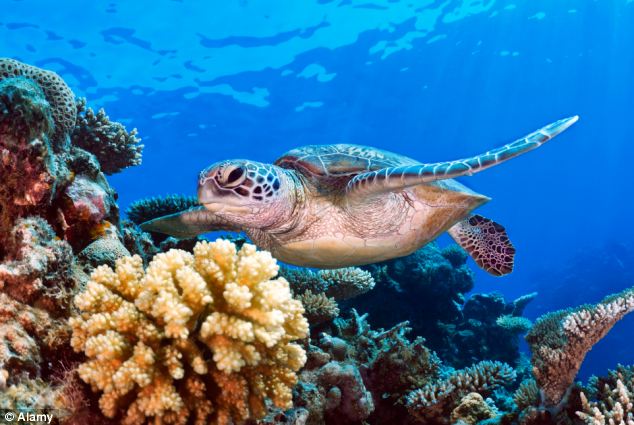
sea turtle

As rare species and the biodiversity of these regions decline, the unique traits and features these animals bring to the areas are vulnerable to extinction because rare species are likely to disappear first.

Biodiverse environments are known by their large number of rare species.

These rare species contribute to the diversity of an area but, up until now, their functional importance within these ecosystems has been largely unknown.

Because there are fewer rare species within a region, they were traditionally thought to have little bearing on how other species interact and how the ecosystem functions, compared with more common species.
If rare species seen in places such as coral reefs and rainforests die out, the carefully balanced ecosystems of those regions could fail and be damaged.

If rare species seen in places such as coral reefs and rainforests die out, the carefully balanced ecosystems of those regions could fail or be damaged. This is because rare species perform unique functions within these areas, say the researchers
The rare pyramidal saxifrage, an alpine plant, is an important resource for pollinators in the mountain regions of Europe

The rare pyramidal saxifrage, an alpine plant, is an important resource for pollinators in the mountain regions of Europe

It was previously assumed that rare species play the same roles within an ecosystem as their common neighbours, yet have less impact because of their low numbers.

This phenomenon is known as ‘functional redundancy’.

The redundancy suggests that rare species merely serve as an ‘insurance’ policy for the ecosystem, in the event of an ecological loss.

To test this, the researchers analysed the extent to which rarer species in the three different ecosystems performed the same ecological functions as the most common ones.

They examined biological and bio-geographical information from 846 reef fish, 2,979 alpine plants and 662 tropical trees and found that most of the unique and vulnerable functions, carried out via a combination of traits, were associated with rare species.

Examples of rare species that were found by the researchers to perform vulnerable functions include the giant moray, a predatory fish that hunts at night in the labyrinths of coral reefs and the pyramidal saxifrage, an alpine plant that is an important resource for pollinators.

Another was the Pouteria maxima, a huge tree in the rainforest of Guyana, which is particularly resilient to fire and drought.

Not only are these species rare, they also have few functional equivalents among the more common species in their respective ecosystems, according to the research published in the journal PLOS Biology.
The Kaieteur National Park in Guyana.

The Kaieteur National Park in Guyana. The rainforest in Guyana is a biodiverse environment because of the large number of species that live in relatively close proximity. Researchers have found that rare species, including the Guyanan tree Pouteria maxima, are fundamental to maintaining balance in biodiverse ecosystems

Dr Mouillot said: ‘Our results suggest that the loss of these species could heavily impact upon the functioning of their ecosystems.

‘This calls into question many current conservation strategies.’

The work emphasises the importance of the conservation of rare species, even in diverse ecosystems.

Dr Mouillot said rare species are more vulnerable and serve irreplaceable functions, the preservation of biodiversity as a whole – not just the most common species, but all those who perform vulnerable functions – appears to be crucial for the resilience of ecosystems.

He added: ‘Rare species are not just an ecological insurance – they perform additional ecological functions that could be important during rapid transitions experienced by ecosystems.

‘The vulnerability of these functions, in particular biodiversity loss caused by climate change, highlights the underestimated role of rare species in the functioning and resilience of ecosystems.

‘Our results call for new experiments to explicitly test the influence of species rarity and the uniqueness of combinations of traits on ecological processes.’

Follow us: @MailOnline on Twitter | DailyMail on Facebook