AP: Gulf states get first $113M from oil spill pleas

http://dfw.cbslocal.com/2013/11/14/gulf-states-get-first-113m-from-oil-spill-pleas/
By Jeff Amy, Associated Press
Updated 1:08 pm, Thursday, November 14, 2013
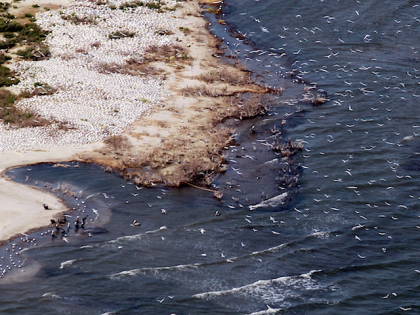
Gulf Oil Spill Begins To Reach Land As BP Struggles To Contain Leak
Birds fly over an island that was threatened by the massive Deepwater Horizon/BP oil spill on May 9, 2010 in Gulf of Mexico. (credit: Joe Raedle/Getty Images)
JACKSON, Miss. (AP) — The five states that border the Gulf of Mexico are getting $113 million to improve the environment.
The grants, announced Thursday by the National Fish and Wildlife Foundation, are the first small chunk of $2.5 billion that BP PLC and Transocean Ltd. were fined as a result of criminal pleas last year following the 2010 Gulf oil spill.

Louisiana is getting $67.9 million, Florida $15.7 million, Alabama $12.6 million, Texas $8.8 million and Mississippi $8.2 million.

Over the next five years, the foundation’s Gulf Environmental Benefit Fund will receive about $1.3 billion for barrier island and river diversion projects in Louisiana, $356 million each for natural resource projects in Alabama, Florida, and Mississippi, and $203 million for similar projects in Texas.

Thursday’s announcement spent only part of the first $158 million that the companies paid earlier this year. Another $353 million will be paid by February, but the largest payments will come in later years, said Thomas Kelsch, who leads the Gulf Environmental Benefit Fund for the foundation.

Louisiana will use its coastal restoration plan as a guide, foundation officials said. “There’s not a requirement that the funds go directly to the habitats that were affected by the spill,” Kelsch said. In Louisiana, the money will go for planning and engineering to restore coastal islands and divert Mississippi River water and sediment into vanishing marshlands, part of the state’s fight to stop its coastline’s erosion.

Environmental advocates applauded the $40.4 million for a diversion from the west bank of Mississippi south of New Orleans to the Barataria estuary. That diversion is supposed to be a pilot project that will guide the design of others in the future.
“The Barataria Basin has one of the highest rates of land loss in the world, and this large-scale wetland restoration project is crucial to reversing that trend,” the Environmental Defense Fund, National Audubon Society, National Wildlife Federation, Coalition to Restore Coastal Louisiana and the Lake Pontchartrain Basin Foundation said in a joint statement.

Money in other states will generally go to improve natural areas and create better habitats for animals. For example, Mississippi will use $3.3 million to uproot invasive land and wetland plant species in its 26 coastal preserves, replanting with native species.

In Florida and Texas, foundation officials said they tried to choose projects closest to the spill zone. That means projects were generally in Florida’s western Panhandle and on the eastern part of Texas’ coast.
Follow Jeff Amy at http://twitter.com/jeffamy

Special thanks to Richard Charter
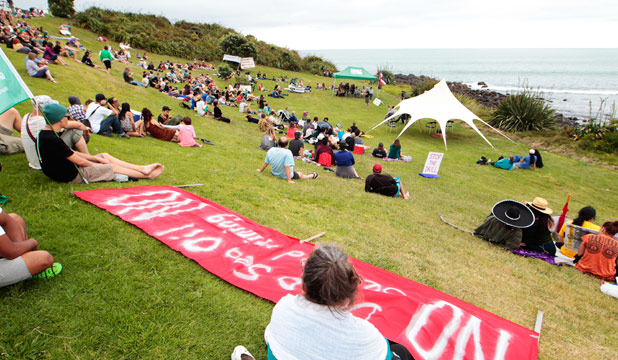
New Zealand: Protesters’ flotilla awaits drillship

http://www.stuff.co.nz/national/9410561/Protesters-flotilla-awaits-drillship

ELTON SMALLMAN

BEN CURRAN/Fairfax NZ

protestors
SPEAKING UP: Raglan residents at the car park in Manu Bay on Saturday, protesting against oil company Anadarko’s offshore drilling programme.

Oil Free Seas Flotilla
A flotilla of protesters is promising to defend the ocean from deep-sea oil exploration as an Anadarko vessel sets a course for their location.

The flotilla of ocean-going yachts, which include the Greenpeace yacht Vega, raced the drillship the Noble Bob Douglas to the site at the Romney Prospect, 110 nautical miles off the Raglan coast, at the weekend.

Greenpeace executive director Bunny McDiarmid, who was on one of the six boats, said they planned a peaceful protest where Anadarko will drill in 1500 metre of water in what will be New Zealand’s deepest well.

“Our objective is to faithfully defend our oceans and our coastline, defend our climate, defend out future generations against very risky and unnecessary deep-sea oil drilling,” she said.

Changes to the Crown Minerals Act, known as the Anadarko Amendment, limits protest activity in New Zealand’s Exclusive Economic Zone and requires all boats to remain 500m clear of drilling operations.

“Seeing as the ship is not here yet there is no restricted zone where we are. We’re just sailing off the coast of New Zealand in very beautiful water.”

The Oil Free Seas flotilla was a loose alliance who wanted to halt exploration and said coastal communities would suffer in a major spill. “The Raglan community and that coastline there would be in the direct path of any major oil spill if it should happen so they have a lot to lose.”

Former Green party leader Jeanette Fitzsimons was also on the flotilla and said Anadarko threatened her grandchildren’s right to a clean environment.

Anadarko’s drilling ship the Noble Bob Douglas was 50 nautical miles off New Plymouth last night and was due to depart overnight.

They will set up in the permitted area and corporate affairs manager Alan Seay expected everything to run smoothly.

“We respect their right to protest and I’d ask that they respect our right to go about our lawful business and respect the safety zone that will be around the Noble Bob Douglas,” he said. “I do understand that they are not allowed to interfere with that location that they must move off when the drillship arrives so we very much hope that that is what happens otherwise they will be interfering.”

Special thanks to Richard Charter

Business Week: Oil Drillers Rush Back to the Gulf of Mexico

http://www.businessweek.com/articles/2013-11-14/2014-outlook-gulf-of-mexico-oil-patch-gushes-again

By Edward Klump November 14, 2013
The Gulf of Mexico has been left for dead more than once over the past half-century. It’s now roaring back to life with at least 10 recent mega-discoveries that have renewed oil explorers’ enthusiasm for the region. Billions of dollars are being poured into new wells in the ultra-deep waters off Texas and Louisiana, fueling a resurrection that could set a production record this decade and complete a recovery from the worst offshore oil spill in U.S. history.

In 2014, output from the deepest parts of the Gulf, where the water is more than 1,300 feet deep, will be equivalent to about 1.5 million barrels of oil a day, 15 percent more than this year, according to estimates by energy consultants Wood Mackenzie. By 2020, the firm says, the deepwater Gulf, which accounts for about half the Gulf’s 252,000 square miles of federal waters, is expected to produce an average of more than 1.9 million barrels a day, a new high. “Investors should not sleep on the Gulf of Mexico,” says Brian Youngberg, an analyst with Edward Jones in St. Louis. “Onshore shale is obviously the main driver in the growth in U.S. production, but going forward, the Gulf of Mexico should start contributing to that.”

U.S. crude production has surged in recent years, largely because companies used hydraulic fracturing and advanced drilling technology to open onshore shale formations. Now producers including Chevron (CVX), Royal Dutch Shell (RDS/A), and Anadarko Petroleum (APC) are preparing to surpass the Gulf’s 2009 peak; production collapsed after BP’s (BP) 2010 spill. That disaster, and the five-month drilling moratorium that followed, led to an exodus of rigs and drilling equipment as regulators bolstered safety requirements. As large oil companies have begun drilling again, so has BP, which remains a major operator in the deep Gulf. It was the biggest producer there in 2012 and has ownership stakes in more than 650 leases.

In the late 1970s energy companies began referring to the Gulf as “the Dead Sea.”

Shallow-water wells drilled decades earlier were tapering off, and the industry lacked the technology to find oil in the deeper waters. New seismic equipment has since let explorers see through once-opaque layers of rock. Engineering innovations enable companies to lower their drills through 10,000 feet of water to the seabed. There the drills penetrate 5 miles into the earth’s crust, where temperatures are hot enough to boil water and high pressures approach the weight of four cars resting on one square inch. That seismic and drilling technology has improved even since the 2010 oil spill, allowing ventures into deeper and deeper waters.

Chevron, with a company-record five rigs drilling, is among the most bullish. The company expects its $7.5 billion Jack/St. Malo platform to begin producing oil and gas in 2014, with a long-range target of 177,000 barrels per day. Other deep-water projects that may begin producing in the Gulf next year include Anadarko’s Lucius, Hess’s (HES) Tubular Bells, and Murphy Oil’s (MUR) Dalmatian. Gulf projects can cost $15 billion for infrastructure, wells, and facilities, and take more than a decade to bring into production.

The U.S. Department of the Interior estimates the Gulf has 48 billion barrels of oil yet to be discovered. “What catches our attention,” says Robert Ryan, vice president for global exploration at Chevron, “is the potential-billions of barrels right in our own backyard.”

Special thanks to Richard Charter

UPI.com: Black Elk Energy opposes rig disaster findings

http://www.upi.com/Business_News/Energy-Resources/2013/11/18/Black-Elk-Energy-opposes-rig-disaster-findings/UPI-53011384781827/?spt=rln&or=1

Nov. 18, 2013 at 8:37 AM

HOUSTON, Nov. 18 (UPI) — Black Elk Energy said it didn’t agree with violations outlined by a federal safety regulator in response to a deadly fire on an offshore platform in 2012.

Three of the 24 rig workers on a platform operated by Black Elk Energy died in a November 2012 accident off the coast of Louisiana.

The U.S. Interior Department’s Bureau of Safety and Environmental Enforcement said Nov. 4 the company lapsed on several safety requirements on the rig and operated “a climate in which workers feared retaliation if they raised safety concerns.”

Black Elk said in a statement Friday it was committed to a safe and compliant offshore working environment.

“Black Elk Energy does not agree with the basis for the [incidents of noncompliance order issued by BSEE] and is evaluating its options for response,” the company said.
In August, Black Elk said a third-party investigation found contractors failed to follow basic safety standards.

Special thanks to Richard Charter

Credo Action: Interior Secretary Jewell doesn’t know about the most dangerous federal fracking loophole?

The petition to Secretary Jewell reads:
“As one of the most important deciders on fracking, it’s vital that you fully understand the dangerous Halliburton Loophole, and other exemptions that the industry has carved out to pave the way for fracking. As long as gaping loopholes like this exist, the only sure way to protect our health and safety from fracking is to ban it outright.”

Automatically add your name:
Sign the petition ► http://act.credoaction.com/sign/jewell_halliburton_loophole/?akid=9475.2084550.NPQz29&rd=1&t=1

Dear DeeVon,

Interior Secretary Sally Jewell is responsible for what may be the Obama administration’s single most important fracking policy decision: Drafting regulations for fracking on public lands.

That’s why it’s so appalling that, recently, when Secretary Jewell was asked if the administration supports a bill to close Dick Cheney’s infamous Halliburton Loophole, which exempts fracking from the Safe Drinking Water Act and parts of other critical environmental laws, she said she wasn’t “intimately familiar” with the loophole.1 2

That’s not acceptable. The Halliburton Loophole is the biggest barrier to keeping us safe from fracking.3 4 This and other federal fracking loopholes are the reason that the burden of regulating fracking has fallen largely to state governments.5 As a result, underfunded regulatory agencies controlled by politicians flush with oily money have largely left Americans at the mercy of the fracking industry.

As Interior writes rules for fracking on federal land, we need to make sure that Secretary Jewell knows all about the Halliburton Loophole, and the other loopholes in federal environmental law that protect the fracking industry from accountability.

Tell Secretary Jewell: The “Halliburton Loophole” fracking exemption is a major threat to our health and safety. Click here to sign automatically.

An area of federal land larger than the entire state of Florida is currently under lease for oil and gas extraction and more than 15 million Americans live within a mile of a fracked oil or gas well, so Interior’s pending fracking rule will have a sweeping impact on America’s energy policy.6 7

But, unfortunately, every indication is that Interior is caving to the fracking industry. The most recent draft fracking rules are even weaker than the previous draft — likely as a result of a fracking industry lobbying blitz at the White House.8

More than a million Americans submitted public comments on the rule opposing fracking, including more than 600,000 calling for an outright ban on fracking on federal lands. But apparently our message hasn’t gotten through yet — and Secretary Jewell’s recent comments may give us some clue why.

Tell Secretary Jewell: The “Halliburton Loophole” fracking exemption is a major threat to our health and safety. Click here to sign automatically.

Zack Malitz, Campaign Manager
CREDO Action from Working Assets

Automatically add your name:
Sign the petition ►

Learn more about this campaign

1. David Baker, “Interior Sec. Jewell: U.S. can pump oil and fight climate change,” San Francisco Chronicle, November 8, 2013
2. “U.S. Secretary of the Interior Sally Jewell,” Climate One, November 7, 2013
3. “The Halliburton Loophole,” Earthworks
4. Lauren Pagel and Lisa Sumi, “Loopholes for Polluters,” Earthworks, May 16, 2011
5. Steve Horn, “Regulatory Non-Enforcement by Design: Earthworks Shows How the Game is Played,” DeSmogBlog, September 27, 2013
6. Amy Mall, “More than six percent of U.S. already leased for oil and gas: new NRDC analysis,” NRDC Switchboard, February 26, 2013
7. Katie Valentine, “More Than 15 Million Americans Now Live Within One Mile Of A Fracking Well,” ThinkProgress, October 26, 2013
8. Mike Soraghan, “White House huddled with industry before changes to BLM fracking rule,” EnergyWire, April 12, 2013

"Be the change you want to see in the world." Mahatma Gandhi