Common Dreams: via TomDispatch.com: Can Obama Ever Stand Up to the Oil Industry?

http://www.commondreams.org/view/2013/10/28-0

Published on Monday, October 28, 2013 by TomDispatch.com

X-ray of a flagging presidency: Will Obama block the Keystone XL pipeline or just keep bending?
by Bill McKibben
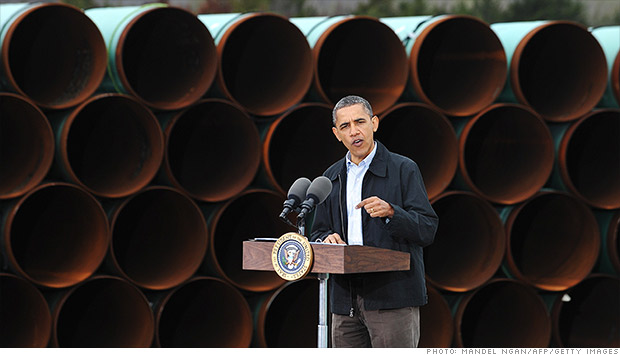
obama-keystone

President Barack Obama speaks at the southern site of the Keystone XL pipeline on March 22, 2012 in Cushing, Oklahoma. In June of this year, President Obama said that the building of the full pipeline — on which he alone has the ultimate thumbs up or thumbs down — would be approved only if “it doesn’t significantly exacerbate the problem of carbon pollution.” By that standard, it’s as close to a no-brainer as you can get. (Photo: Getty images)As the battle over the Keystone XL pipeline has worn on — and it’s now well over two years old — it’s illuminated the Obama presidency like no other issue. It offers the president not just a choice of policies, but a choice of friends, worldviews, styles. It’s become an X-ray for a flagging presidency. The stakes are sky-high, and not just for Obama. I’m writing these words from Pittsburgh, amid 7,000 enthusiastic and committed young people gathering to fight global warming, and my guess is that his choice will do much to determine how they see politics in this country.

Let us stipulate at the start that whether or not to build the pipeline is a decision with profound physical consequences. If he approves its construction, far more of the dirtiest oil on Earth will flow out of the tar sands of Alberta, Canada, and reach the U.S. Gulf Coast. Not just right away or for a brief period, but far into the future, since the Keystone XL guarantees a steady flow of profits to oil barons who have their hearts set on tripling production in the far north.

The history of oil spills and accidents offers a virtual guarantee that some of that oil will surely make its way into the fields and aquifers of the Great Plains as those tar sands flow south. The greater and more daunting assurance is this, however: everything that reaches the refineries on the Gulf Coast will, sooner or later, spill into the atmosphere in the form of carbon, driving climate change to new heights.

In June, President Obama said that the building of the full pipeline — on which he alone has the ultimate thumbs up or thumbs down — would be approved only if “it doesn’t significantly exacerbate the problem of carbon pollution.” By that standard, it’s as close to a no-brainer as you can get.

These days, however, as no one will be surprised to hear, brainless things happen in Washington more often than not, and there’s the usual parade of the usual suspects demanding that Keystone get built. In mid-October, a coalition that included Exxon, Chevron, ConocoPhillips, and Royal Dutch Shell, not to mention the U.S. Chamber of Commerce, the National Association of Manufacturers, and the Business Roundtable, sent Obama a letter demanding that he approve Keystone in order to “maintain investor confidence,” a phrase almost guaranteed to accompany bad ideas. A report last week showed that the Koch brothers stood to earn as much as $100 billion in profits if the pipeline gets built (which would come in handy in helping fund their endless assault on unions, poor people, and democracy).

But don’t think it’s just Republican bigwigs and oil execs rushing to lend the pipeline a hand. Transcanada, the pipeline’s prospective builder, is at work as well, and Obama’s former communications director Anita Dunn is now on the Transcanada dime, producing TV ads in support of the pipeline. It’s a classic example of the kind of influence peddling that knows no partisan bounds. As the activists at Credo put it: “It’s a betrayal of the commitments that so many of us worked so hard for, and that Dunn herself played a huge role in shaping as top strategist on the 2008 campaign and communications director in the White House.”

Credo’s Elijah Zarlin, who worked with Dunn back in 2008, wrote that attack on her. He was the guy who wrote all those emails that got so many of us coughing up money and volunteering time during Obama’s first run for the presidency, and he perfectly exemplifies those of us on the other side of this divide — the ones who actually believed Dunn in 2008, the ones who thought Obama was going to try to be a different kind of president.

Yes, the Environmental Protection Agency has put in place some new power plant regulations, and cars are getting better mileage. But the president has also boasted again and again about his “all of the above” energy policy for “increasing domestic oil production and reducing our dependence on foreign oil.”

On energy there’s been precious little sign of that. Yes, the Environmental Protection Agency has put in place some new power plant regulations, and cars are getting better mileage. But the president has also boasted again and again about his “all of the above” energy policy for “increasing domestic oil production and reducing our dependence on foreign oil.” It has, in fact, worked so well that the United States will overtake Russia this year as the biggest combined oil and natural gas producer on the planet and is expected to pass Saudi Arabia as the number one oil producer by 2017.

His administration has okayed oil drilling in the dangerous waters of the Arctic and has emerged as the biggest backer of fracking. Even though he boasts about marginal U.S. cuts in carbon emissions, his green light to fracking means that he’s probably given more of a boost to releases of methane — another dangerous greenhouse gas — than any man in history. And it’s not just the environment. At this point, given what we know about everything from drone warfare to NSA surveillance, the dream of a progressive Obama has, like so many dreams, faded away.

The president has a handy excuse, of course: a truly terrible Congress. And too often — with the noble exception of those who have been fighting for gay rights and immigration reform — he’s had little challenge from progressives. But in the case of Keystone, neither of those caveats apply: he gets to make the decision all by himself with no need to ask John Boehner for a thing, and people across the country have made a sustained din about it. Americans have sent record numbers of emails to senators and a record number of comments to the State Department officials who oversee a “review” of the pipeline’s environmental feasibility; more have gone to jail over this issue than any in decades. Yet month after month, there’s no presidential decision.

There are days, in fact, when it’s hard to muster much fire for the fight (though whenever I find my enthusiasm flagging, I think of the indigenous communities that have to live amid the Mordor that is now northern Alberta). The president, after all, has already allowed the construction of the southern half of the Keystone pipeline, letting Transcanada take land across Texas and Oklahoma for its project, and setting up the beleaguered communities of Port Arthur, Texas, for yet more fumes from refineries.

Stopping the northern half of that pipeline from being built certainly won’t halt global warming by itself. It will, however, slow the expansion of the extraction of tar sands, though the Koch brothers et al. are busy trying to find other pipeline routes and rail lines that would get the dirtiest of dirty energy out of Canada and into the U.S. via destinations from Michigan to Maine. These pipelines and rail corridors will need to be fought as well — indeed the fights are underway, though sometimes obscured by the focus on Keystone. And there are equally crucial battles over coal and gas from the Appalachians to the Pacific coast. You can argue that the president’s people have successfully diverted attention from their other environmental sins by keeping this argument alive long past the moment at which it should have been settled and a decision should have been made.

At this point, given what we know about everything from drone warfare to NSA surveillance, the dream of a progressive Obama has, like so many dreams, faded away.

At this point, in fact, only the thought of those 900,000 extra barrels a day of especially nasty oil coming out of the ground and, via that pipeline, into refineries still makes the fight worthwhile. Oh, and the possibility that, in deciding to block Keystone, the president would finally signal a shift in policy that matters, finally acknowledge that we have to keep most of the carbon that’s still in the ground in that ground if we want our children and grandchildren to live on a planet worth inhabiting.

If the president were to become the first world leader to block a big energy project on the grounds of its effects on climate, it might help dramatically reset the international negotiations that he allowed to go aground at Copenhagen in 2009 — the biggest foreign policy failure of his first term.

But that cascade of “ifs” depends on Obama showing that he can actually stand up to the oil industry. To an increasingly disillusioned environmental movement, Keystone looks like a last chance.
Justice News Flash.com: BP Oil Spill Cleanup Workers Still Searching for Answers & UGA researchers help continue Gulf oil spill research, community

http://www.justicenewsflash.com/
BP Oil Spill Cleanup Workers Still Searching for Answers
2013-10-17 19:11:08 (GMT) (JusticeNewsFlash.com – Health & Law, Press Release)
10/14/2013 // BP Oil Spill Claim Website (Press Release) // Greg Vigna // (press release)

Court hearings continue over the financial responsibility of oil giant BP for damages caused by the oil spill in the Gulf of Mexico in 2010. In a recent news report it was stated that the attorneys for the company and the federal government remain at odds over methods used to estimate how big the massive spill was. Estimates from both sides show that over three million barrels were leaked into the Gulf during the nearly three months it took to stop it.

The outcome of the recent court matter could lead to BP having to shell out hundreds of millions of dollars in fines under the Clean Water Act. This is in addition to other sums set aside for the compensation of those who were injured or sustained property damage as a result of the spill.

Those who worked as response workers for cleanup efforts following the oil spill are also now being considered in the group of those with potential damage claims against BP. Although many injured cleanup workers are still waiting for answers regarding their eligibility to pursue damages, a proposed settlement is being discussed by attorneys and others to compensate injured response workers for medical expenses. A number have experienced respiratory, skin, and other health conditions due to crude oil contaminant exposure and toxic chemical exposure to dispersants sprayed during cleanup efforts.

Injured BP oil spill response workers can contact the BP Gulf Oil Spill Help Desk for information regarding the status of the proposed settlement, and what their available medical and legal options may be. The help desk is now open for those who would like to request a free case review.

http://www.redandblack.com/

UGA researchers help continue Gulf oil spill research, community
By Jeanette Kazmierczak @sciencekaz | Posted: Thursday, October 17, 2013 1:00 pm

When millions of barrels of oil spilled out of the Deepwater Horizon oil rig and into the Gulf of Mexico in April 2010, researchers and coastal communities braced themselves for a long haul recovery. University of Georgia researchers at the Skidaway Institute of Oceanography in Savannah are conducting continuing research on the potential effects of oil on the life cycles of economically important blue crabs and shrimp.

Richard Lee, a professor emeritus at Skidaway, and his team studied the effects of emulsified oil, and initial results show exposure reduces the production of eggs and embryos in female shrimp and alters immune-related blood cells in blue crabs.
“Emulsified oil is produced when oil is vigorously mixed with seawater to produce a water-in-oil emulsion which is much more viscous than the original crude oil,” Lee wrote in an email to The Red & Black. “The catalysts are metal compounds in the crude oil that produce the emulsion. We have found that emulsified oil remains on the sediment when washed ashore and thus because of its persistence is more toxic to marsh animals, such as crabs.”

Observations made on blue crabs were done in conjunction with Anna Walker, a professor of pathology at Mercer University in Macon. “We looked at tissues from control blue crabs and then blue crabs that had been fed emulsified oil over a period of various numbers of days,” Walker said. “And it did appear that those animals that had consumed the emulsion for seven days, they had some kind of material in their hemocytes.” Hemocytes are the invertebrate equivalent of human white blood cells. “The suggestion that we had – because this is all very preliminary – is that the hemocytes were not functioning properly. And if they can’t function properly, they can’t remove any type of infectious organism from the hemolymph therefore the blue crab would be at a greater risk for the development of an infection.”

Walker stressed these are extremely preliminary results, based on one set of observations. She also said she and Lee are trying to avoid coming across as “Chicken Little.” While the immediate consequences of the spill were dire for many animals, the long-term consequences are proving to be less horrible than was expected. She said the key point to take away was that studying both types of consequences is important for understanding the repercussions of not only this, but future oil spills.

Researchers working with Lee have also been looking at the effects of dispersed oil, which is different from emulsified oil in that dispersed oil is treated by a chemical to break it up into droplets to prevent slicks. Lee said to imagine using oil-cutting soap to clean dishes – the oil isn’t destroyed, just broken up. He wrote in his email that the idea was that in this form the oil would be more quickly degraded by marine bacteria.

“This point is still in some disagreement by scientists, particularly in the case of a large oil spill,” Lee wrote. “We have determined that these dispersed oil droplets can be taken up by plankton, the small organisms that make up much of the biomass of the ocean. This is work we did with Marion Koshland at the University of Griefswald in Germany and Gustav Paffenhoeffer at [Skidaway]. Fish and other larger organisms can consume plankton containing dispersed oil and thus this oil enters the marine food web.”

Lee wrote the overall effect of the oil spill on population numbers of crabs and shrimp is hard to determine because population will vary from year to year anyway.

Lee and his team have also collaborated with researchers at the University of Southern Mississippi to provide outreach for affected communities. Jessica Kastler, the coordinator of program development at USM’s marine education center, said much of their work was with the Vietnamese-American fishing community in Ocean Springs, Miss.

“Our goal in this project was to talk to people about the role of science because science is going to be coming up with answers about the oil spill for at least another decade,” Kastler said. “And it would be nice if people were listening for those answers when they come up and then we can keep that information available for making decisions about future things. But working within the community – there’s a real, strong interest within the Vietnamese-American community to work with scientists and to be part of the data collection and interpretation effort.”

Kastler said discussion wasn’t always easy, both because of the language barrier and the emotions tied up in the ramifications of the oil spill, but she said the Vietnamese-American community was more interested even than some of the charter boat captains because their livelihoods are so intricately tied to the water.
“They got to learn how science works, they got to practice some of the things Dr. Lee was doing in his lab,” she said. “Then they got to share some of the messages from the project – this is the role of science, this is not, this is what science can tell us and we’re going to be waiting a long time for all of the answers.”
Untitled 5102 2

Special thanks to Richard Charter

AP: BP oil spill settlement probe target lashes out at special investigator

The Associated Press By The Associated Press
October 17, 2013 at 6:33 PM, updated October 17, 2013 at 6:34 PM

One of the lawyers singled out in an investigation of alleged misconduct in the settlement program for victims of BP’s 2010 Gulf oil spill is questioning the chief investigator’s impartiality.

Before a judge appointed him to lead the investigation, former FBI Director Louis Freeh disclosed that he is a partner at a law firm that is working on an unrelated case with lawyers for Kirkland & Ellis, a firm that represents the London-based oil giant.
In a court filing Wednesday, lawyers for New Orleans-based attorney Jon Andry argue they need more information about the relationship to determine whether to seek Freeh’s disqualification as “special master.”

In a report last month, Freeh said he found “ample evidence” that Andry and other attorneys tried to corrupt the settlement process by using a lawyer on the staff of claims administrator Patrick Juneau to expedite a $7.9 million settlement claim by The Andry Law Firm.

Andry’s lawyers claim Freeh has withheld evidence that could clear Andry of wrongdoing and “abandoned all pretense of the neutrality required of a Special Master.” “It requires no imagination to understand the value to BP and by extension its law firm, Kirkland & Ellis, of the criticisms made by Freeh,” they wrote. Freeh is a partner and chairman of the executive committee of Pepper Hamilton LLP, a law firm that also owns his consulting company, Freeh Group International Solutions. Andry’s lawyers said Pepper Hamilton is working with Kirkland & Ellis on class-action litigation over the diabetes drug Avandia. “Jon Andry has a right to a Special Master free of conflicts and free of the appearance of conflicts,” his lawyers wrote. “Mr. Jon Andry’s lawyers’ belated and rambling motion to recuse the Special Master is without merit in law and fact,” Freeh said in a statement emailed by Freeh Group International Solutions LLC president and CEO Jim Bucknam.

Freeh said he fully disclosed the “claimed conflicts” before he was appointed. “Additionally, all of the Special Master’s fees in this case are approved by the Court, not by BP and its lawyers,” he wrote. Separately, Andry’s attorneys, led by Lewis Unglesby, asked U.S. District Judge Carl Barbier for an order requiring Freeh to turn over all of the material that he gathered during his investigation.

“Freeh has made mistakes. They are substantial. They have caused great damage, but these errors are fixable once all the facts come out,” they wrote. In the report he issued on Sept. 7, Freeh cleared Juneau of engaging in any “conflict of interest, or unethical or improper conduct.” But he concluded that top members of Juneau’s staff engaged in conduct that was improper, unethical and possibly criminal. Freeh said Andry and another private attorney, Glen Lerner, used Lionel Sutton, a lawyer on Juneau’s staff, to expedite their firm’s claim. In return, Sutton received more than $40,000 in fees from payments on claims he had referred to their law firm before joining Juneau’s staff, Freeh’s report says. Freeh recommended that his report be forwarded to the Justice Department so it could determine whether Andry and others broke any laws. He also urged Barbier to consider disallowing payment on the $7.9 million claim.
By Michael Kunzelman, Associated Press

Special thanks to Richard Charter

Waking Times: Setting the Record Straight About BP’s Failed Gulf of Mexico Cleanup

http://www.wakingtimes.com/2013/10/23/setting-record-straight-bps-failed-gulf-mexico-cleanup/

October 23, 2013 | By WakingTimes |

Julie Dermansky, DeSmogBlog
Waking Times

The second phase of hearings in the legal battle over the BP oil disaster in the Gulf of Mexico ended on October 17th. Following two weeks of testimony by the U.S. Department of Justice and BP, U.S. District Court Judge Carl Barbier will determine what quantity of oil was spilled into the Gulf. He will also decide whether BP was simply negligent or grossly negligent.

The Justice Department claims 176 million gallons of oil were spilled; BP argues that it only spilled 103 million gallons. Under the Clean Water Act and the Oil Pollution Control Act, Judge Barbier can fine BP and its partners $1,100 per barrel should he find they were negligent in their actions leading up to the spill and in the cleanup afterwards. The fine would rise to $4,300 per barrel if he finds the companies were grossly negligent or acted with willful misconduct, as the State Department alleges.Using the State Department’s numbers, the fine could be $18 billion; if BP’s numbers are accepted, the fine could be $10.5 billion.

The outcome of the case will play a role in all subsequent litigation around the BP disaster, including the case of Dean Blanchard, owner of Dean Blanchard Seafood, the largest shrimp buyer and wholesaler in the Gulf region. Blanchard’s company in Grand Isle, Louisiana is all but shut down now. Blanchard keeps a small fraction of his staff employed – more of them than he needs to keep his dwindling operation going. He doesn’t have the heart to make further cuts.

Blanchard estimates his company’s loss at over $100 million. He estimates that his business is now 15 percent of what it was before the spill. He keeps his doors open only because he can’t bring himself to close down. He recently moved part of his business to a different area where some shrimpers are still able to harvest product, but he faces an uphill battle against BP, and an uncertain future, along with many other Gulf fishermen.
Dean Blanchard talks about the use of the chemical dispersant Corexit during the BP oil spill:

This fall, BP launched a new PR campaign depicting itself as a victim of fraud. The BP ads accuse people of filing fraudulent claims, and asks upstanding citizens to turn them in. Blanchard doesn’t doubt there are fraudulent claims, but holds BP responsible for allowing that to happen.

He and others in the fishing industry offered to help BP figure out who the real fishermen were since they know their community well, but BP turned them down. Blanchard suggests that BP may have wanted to create chaos, initially giving a token payment to anyone who wore a pair of white boots into the claims offices so they could play victim later, just as they are doing now. On Facebook, activists encourage those affected by the spill to call the BP fraud hotline set up for this campaign and choke the company’s line with calls accusing BP of fraud.

BP’s other commercials claim that all fishing areas have reopened, although the waters near Grand Isle are not. Blanchard wonders why the government continues to allow the company to lie in its advertising.

BP’s “Make it Right” campaign, which asserts that things are back to normal, is a source of rage for many along the Gulf Coast. And Dean Blanchard doesn’t pull punches about it:

Some of the shrimpers who sell to Blanchard periodically monitor the areas they used to work in. They have caught deformed shrimp with no eyes and oil in their gills, and other fish with lesions.

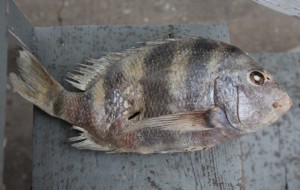
Recently, a fisherman gave him a fish with a hole in the middle of its body that Blanchard has kept on ice to show people as an example of the abnormalities in the seafood he has seen since the spill.

fish with hole
Image Source
Fish with mysterious hole in its side caught by a fisherman and given to Blanchard.

Despite the government and company assurances that the seafood is safe, Blanchard’s insurance company dropped his product liability insurance. Blanchard wont be covered if the product he is selling turns out to be unsafe.

Besides the fiscal strain, Blanchard worries about the health of his family. He says everyone he knows on the island now has sinus and breathing problems.

Many have moved, including longtime resident Betty Doud, her daughter and grandchildren. She and Blanchard both tell me they can breathe better when they travel away from Grand Isle. Doud and her daughter are renting homes near New Orleans.

Over lunch, they rule out places to resettle that are sites for potential environmental disasters, crossing off all the states that have fracking activity, for instance. Doud recently sold off her Grand Isle home and won’t ever move back. Like Blanchard, she’d rather sue BP than accept the meager settlement it offered for her loss.

BP has been forced to take some responsibility for the health issues faced by residents and cleanup workers. In May 2012, as part of the Deepwater Horizon oil spill settlement, $36 million in grant money was earmarked for behavioral and mental healthcare needs, making it possible for residents and cleanup workers to file claims in a class action suit against BP for their health issues.

Meanwhile, more tar mats containing BP oil were discovered by the Coast Guard after the recent tropical storm Karen.

The amount of oil recovered in the cleanup process in Louisiana has grown this year. Garret Graves, chairman of the Coastal Protection and Restoration Authority, suggested in an interview with Reuters that the initial cleanup had clearly been insufficient since the amount of recovered oil increased this year.

Oil turning up on these beaches is no surprise to residents like Betty Doud, who witnessed activities in 2010 that suggested to her that cleanup workers were burying the oil rather than taking it away.

Dean Blanchard isn’t surprised either. He has no doubt that the reason there are no shrimp left in the area rests on the fact that Corexit was used to chemically disperse the oil, letting it sink to the sea floor where the shrimp reproduce.

The use of dispersant by BP irks Blanchard the most. He believes that if the government hadn’t allowed BP to disperse the oil, it could have been cleaned up.

“I never knew you could buy a branch of the government, but BP bought the Coast Guard,” he says. “They were complicit in letting BP do what they wanted.”

Blanchard is irked by the fact that BP was making tons of money and still cutting corners – putting the health of Gulf Coast residents and the economy at risk. And the fact that BP was allowed to do so by the government also riles him.

“Someone at the top needs to go to jail,” Blanchard says.

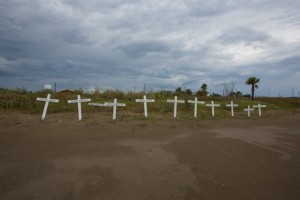
graveyard BP
Graveyard erected to those who died in the BP blowout.

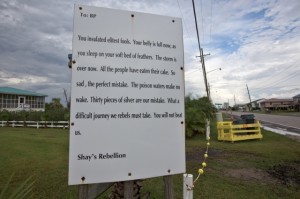
message to BP on Main St
Message to BP on Main Street
Special thanks to Richard Charter

RigZone: API: 67% of US Voters Support Offshore Drilling

http://www.rigzone.com/news/oil_gas/a/129711/API_67_of_US_Voters_Support_Offshore_Drilling

Even though this poll was done by a reputable pollster, knowing the American Petroleum Institute commissioned it leads me to question these figures… DV

by American Petroleum Institute
Press Release
Monday, October 21, 2013

Sixty-seven percent of voters nationwide support offshore drilling for domestic oil and natural gas resources, according to a new poll conducted by Harris Interactive for the American Petroleum Institute’s ( API’s) “What America is Thinking on Energy Issues” series. This support bridged party lines, with clear majorities of Republicans (79 percent), Democrats (57 percent) and Independents (67 percent) all supporting offshore drilling.

“Americans get it: domestic oil and natural gas development is a key driver for new jobs, economic growth and energy security,” said Erik Milito, director of upstream and industry operations for API. “Our country is now firmly positioned as an energy superpower, and most Americans want our nation to seize opportunities to build upon that status.”

Four state-specific polls showed similar levels of support for offshore oil and natural gas development in Virginia (67 percent), North Carolina (65 percent), South Carolina (77 percent) and Florida (64 percent). Nationwide, 90 percent of voters say producing more oil and natural gas here at home is important. Increasing domestic oil and natural gas production is also important to 88 percent of Virginians, 89 percent of North Carolinians, 91 percent of South Carolinians, and 87 percent of Floridians.

“Americans are eager to put more of our offshore energy resources to work,” said Milito. “If exploration and development is allowed to safely expand to new areas, domestic oil and natural gas could provide more energy, jobs and government revenue than ever before.”

The Obama administration will soon begin work on its next five-year offshore leasing plan, in which areas of the Atlantic and Pacific Outer Continental Shelf (OCS) and the Eastern Gulf of Mexico could be included for oil and natural gas leasing. Early next year, the administration is also expected to decide whether to permit seismic surveys in the Atlantic from Delaware to northern Florida for the first time in 30 years.

Seismic surveys, which have been used safely around the world for decades, are the most accurate method available to prospect for oil and natural gas reserves offshore apart from drilling. More accurate survey data makes offshore energy production safer and more efficient by reducing its environmental footprint. Technological advances and data collection improvements since seismic surveys were last conducted in the U.S. Atlantic OCS have rendered old resource estimates obsolete.

– See more at: http://www.rigzone.com/news/oil_gas/a/129711/API_67_of_US_Voters_Support_Offshore_Drilling#sthash.i2s8X5Iy.dpuf

Special thanks to Richard Charter

"Be the change you want to see in the world." Mahatma Gandhi