New York Times: Facing Fire Over Challenge to Louisiana’s Oil Industry

Oh yeah, the good ol’ boys are angry now….so what do you think “secured” that gentlemen’s agreement? DV

August 31, 2013

By CAMPBELL ROBERTSON

BATON ROUGE, La. – State Senator Gerald Long of Louisiana calls it “kind of a gentlemen’s agreement.” For the generations since Mr. Long’s third cousin Huey P. Long was the governor, this state has relied on the oil and gas industry for a considerable part of its revenues and for tens of thousands of jobs. In return, the industry has largely found the state an obliging partner and staunch political ally as it has fought off curbs on its business.

Now, however, a panel of state appointees, created after Hurricane Katrina to be largely insulated from politics, showed just how insulated it was by upending the agreement.

In July, the panel, the Southeast Louisiana Flood Protection Authority-East, composed primarily of engineers and scientists charged with managing flood control for most of New Orleans and its suburbs, filed a lawsuit against nearly 100 oil and gas companies. The suit argues that these companies unlawfully neglected to fix decades’ worth of damage they caused to the state’s wetlands, thus making flooding from hurricanes more dangerous and flood protection vastly more expensive.

The reaction was swift. Gov. Bobby Jindal, a Republican, immediately called the suit “nothing but a windfall for a handful of trial lawyers,” prompting local activists to highlight the $1 million he has received in donations from oil and gas interests. But at public meetings here and down on the bayou, the board has faced the displeasure of public officials largely alone.
At the meetings, the governor’s senior coastal adviser, Garret Graves, has strongly criticized the board as jeopardizing the broad coalition assembled to address coastal issues and needlessly complicating the state’s own efforts to find money for remediation. Other officials at public meetings have taken turns disparaging the board for seeking to penalize companies for activities decades old and, perhaps more than anything, acting without broad collaboration or political consent.

“You are not a state unto yourself,” State Senator Robert Adley said at a crowded legislative hearing, a rare occurrence in August. John M. Barry, a historian and writer who is the vice president of the flood panel, chalked the reaction up to politics, referring to an old saying that the flag of Texaco should fly atop the Louisiana Capitol.

It is true, at least, that the oil and gas industry’s connection with Louisiana runs deep. Industry executives – like Mr. Adley, who has run two different oil- and gas-related companies – sit in the Legislature, and former politicians lobby on the industry’s behalf. Several years ago, eight of the 16 judges on the United States Court of Appeals for the Fifth Circuit, based in New Orleans, recused themselves because of perceived conflicts in a case involving the energy industry. But the connection goes beyond politics, into the state’s identity and culture. In 2010, many residents of south Louisiana were as outraged at the federal government for its moratorium on offshore drilling as they were at BP for its Gulf of Mexico oil spill.

The industry – which has shifted away from conventional drilling to refining, fracking and petrochemical manufacturing – paid Louisiana $1.5 billion last year in royalties and taxes. Industry analyses say it accounts for, directly and indirectly, around 16 percent of the state’s work force.

While the energy industry has its complications, says Senator Long, a Republican, the arrangement on the whole has been a net positive for the state.

Other officials put it more strongly. “We’ve had a $10 million surplus every year I’ve been president of Plaquemines Parish because of oil and gas,” Billy Nungesser, who himself ran a $20 million business providing services to offshore rigs and platforms, said at one public meeting. “We can’t keep picking their pockets.”

But studies of the state’s catastrophic land loss in the past century – the disappearance of nearly 2,000 square miles of marsh serving as a crucial buffer against hurricanes – show that decades of oil and gas activity has come at a steep price. Dams and federally built levees holding back the replenishing sediment of the Mississippi River are main culprits in the land loss, but there is widespread agreement that the 10,000 miles of pipelines and canals cut into the marsh by oil companies are to blame as well. One widely cited study concludes that oil and gas activity accounts for 36 percent of the total loss.

No one anticipated a clash over these issues when civic activists and Chamber of Commerce groups urged an overhaul of New Orleans’s patronage-riddled levee boards in the months after Hurricane Katrina. These efforts, over staunch opposition, led to laws and amendments creating a regional flood protection authority with east and west branches. More critically, the laws established a less political appointment process, putting a premium on technical expertise. “It became a symbol of Louisiana willing to change its ways,” said Robert Scott, the president of the Public Affairs Research Council of Louisiana, a good-government group.

Six years later, the experts in the east branch did something no one would have foreseen here. They voted unanimously to file the lawsuit against oil and gas companies. Citing regulations and permits requiring companies to restore what they had disrupted, the suit argues that the wetlands crisis is at least related to unlawful neglect.

Mr. Graves does not dispute that damage was caused by industry, but does deny that opposition to the suit is about politics. He said the state had worked for years to build a broad coalition, including environmentalists and representatives from oil companies, to finance and implement a $50 billion coastal master plan.

“There’s a bigger strategy that they’ve come in and really screwed up,” he said. Mr. Graves said the state was focused on three areas: attaining penalties and legal remedies from the BP spill, pushing legislation that would bring Louisiana a substantial share of offshore drilling royalties currently going into the federal treasury and battling with the Army Corps of Engineers over its management of the Mississippi River.

“You have to strategize, prioritize and sequence,” he said in an e-mail. Asked if the state’s strategy could conceivably involve litigation against energy companies for historical wetlands damage, Mr. Graves said that was “not our plan A, B, C, D or X.”
Mr. Barry said he fully supported holding the federal government accountable. But the cost of coastal protection is enormous and growing, he said, and he cannot see any way this lawsuit would interfere with these other efforts.

“All we’re trying to do is have a court decide whether we’re right or not, that they broke the law,” he said. “And if they broke the law, they need to fix the part of the problem that they created. It is so simple.”
For now, the suit’s chief obstacles may be political rather than legal.

The terms of four of the nine authority members are either expired or in limbo. And lawmakers are already planning to pass legislation next year to block the suit, possibly by taking away some of the authority’s powers.

“We’ll definitely do some legislation to try to decapitate this thing,” said State Senator Norby Chabert, a Republican.
State Representative Sam Jones, a Democrat, was on the same page.

“This House will probably not be punitive to the oil companies because, look, they’ve brought us thousands of jobs,” he said.
But the scope of opposition is unclear, as many politicians have remained conspicuously quiet. And in recent years, efforts by oil and gas interests to fight in the Legislature a wave of lawsuits by private landowners have met with significant resistance. Among residents along the coast, the crisis of the wetlands has complicated what were once straightforward arrangements.

“We need the gas and oil, but it’s clearly evident that there’s lasting damage in the marshes from the canals that they dug,” said Dave Cvitanovich, a lifelong oysterman. He spoke of the jobs the industry brought, but also of the broad stretches of water where there was land not that long ago.

On the lawsuit, he was still undecided. “It was a gutsy move, to say the least,” he said.

Special thanks to Richard Charter
Centre Daily Times: In Pa., shale waste tripping alarms in landfills

http://www.centredaily.com/2013/08/31/3759270/in-pa-shale-waste-tripping-alarms.html

Published: August 31, 2013 Updated 2 hours ago

By ANYA LITVAK – Pittsburgh Post-Gazette
PITTSBURGH – Last year, nearly 1,000 trucks hauling 15,769 tons of Marcellus Shale waste were stopped at Pennsylvania landfill gates after tripping radioactivity alarms.

The trucks were pulled to the side, wanded with hand-held detectors and some of the material was sent to laboratories for further evaluation. In the end, 622 tons were shipped to three out-of-state landfills specifically designed to dispose of hazardous and radioactive materials.

But most of the flagged waste was eventually allowed past the gates. It was safe enough to be buried along with other waste as long as it stays below the annual limit, the Department of Environmental Protection and landfill operators deemed.

The increase in radiation alarms going off at landfills has mirrored the growth in Marcellus Shale activity, and the DEP has launched a yearlong study of radioactive Marcellus waste to determine any risks involved in its transportation or disposal.

The agency’s bureau of waste management also has formed a working group and charged it with developing protocol for tracking rejected loads, for telling gas operators how to characterize the waste, for developing waste acceptance criteria for landfills, and for clarifying how well sites and waste treatment plants should handle residual waste.

So far, neither the DEP nor the landfill owners are alarmed.

To put it into perspective, the alarms flagged only 1 percent of all landfill-bound Marcellus waste last year, according to state figures. Shale gas operators reported sending just under 1 million tons of waste to Pennsylvania landfills in 2012. The majority of that was drill cuttings – chunks of earth pulled out of the well during the drilling process – but there was also flow-back water, frack sand and other fluids that were turned into sludge for disposal.
It’s these sludges that experts say are most likely contributing to elevated radiation counts.

The radioactive material in Marcellus waste is naturally occurring. It’s mostly radium, a product of uranium decay, and it has been underground for millions of years in the Marcellus formation. Dredging earth and gas out of the ground brings up the radioactive elements.

Since 2002, all Pennsylvania landfills have been outfitted with radiation detectors following concerns about medical waste ending up in the municipal waste stream. All trucks arriving at the facilities pass through a gate topped with a sensor that takes a reading inches away from the top of the truck.

According to the DEP, Marcellus sludge is three times more likely to trip alarms than solid shale waste. Last year, 224 loads of drill cuttings elicited alarms at landfills, while 773 loads of sludge did the same. So far this year, 211 loads of sludge and 124 loads of drill cuttings tripped alarms, the DEP said.

But the number of times an alarm is tripped doesn’t tell the whole story.

Landfill sensors are particularly sensitive and able to detect even small levels of radioactivity, said Erika Deyarmin, a spokeswoman for Waste Management Corp., which operates 17 commercial landfills in Pennsylvania.

Usually, if a load is really radioactive, it never makes it to a landfill because the oil and gas company or wastewater treatment plant that first scans that waste at their site knows it will be rejected, she said. In such cases, the company must come up with another disposal option.

The increase in radioactivity at landfills may be a product of how Marcellus waste treatment has changed over the last few years.

In 2011, radioactivity concerns centered around water. Back then, oil and gas companies were still taking their waste to municipal wastewater treatment plants and to commercial plants that were discharging into the state’s waters.

In the summer of 2011, the DEP collected and analyzed sediment from the PA Brine wastewater treatment plant in Indiana County and found levels of radium 226 in the discharge pipe that was 44 times the drinking water standard. Twenty meters downstream of the discharge point, levels were still 66 percent above the standard.

Similar results were found at several other facilities, as revealed in a settlement between the Environmental Protection Agency and the company earlier this year.

In April 2011, the PA Brine plant and all such plants in the state had been told not to accept Marcellus wastewater, but the radioactive elements found in PA Brine’s soil were remnants of prior discharges.

Kelvin Gregory, an assistant professor at Carnegie Mellon University who works on Marcellus water issues, said the peak of radioactivity in wastewater comes after the initial gush of flow-back water comes to the surface after fracking. Radium concentrations are highest in produced water, a term that describes the brine that continues to flow out of the well for long periods of time after that well starts producing gas.

In a survey of flow-back and produced water at 46 Marcellus sites, Mr. Gregory found radioactivity increases for two months on average, then he saw plateaus.

Whether the level stays at that high concentration forever or tapers off at some point isn’t yet clear, Mr. Gregory said. The wells haven’t been producing long enough to tell.

Examples of highly radioactive waste from the Marcellus are rare so far.

“The cases where we get a very hot load are very few and far between,” said John Poister, a spokesman for the DEP’s southwestern district.

But every once in awhile, it happens.

In April, a truckload from Rice Energy arrived at Max Environmental’s Yukon Landfill in Westmoreland County and set off the alarm. The waste was deemed too radioactive.
The company shopped it around to a few landfills, but no one would take it, Mr. Poister said. Eventually, the truck went back to the source while arrangements were made to transport the waste to a specialized disposal site in Idaho.

Why was Rice’s load so much hotter than others?

“That’s a question for the (DEP) study,” Mr. Poister said.

“We’ve taken quite a bit of drill cuttings at our Yukon facility this year, and only one truck triggered the radiation alarm,” said Carl Spadaro, environmental general manager of the Yukon landfill. “Other landfills have had alarms triggered quite a bit.”

Yukon accepts about 90,000 tons of waste annually and just last month amended its permit to be able to accept waste that trips radiation alarms.

“We didn’t do this to bring in a lot of (radioactive) waste,” Mr. Spadaro said. “We did this to level the playing field.”

Yukon competes with two other landfills within a 5-mile radius.

“The biggest concern is exposure of a landfill worker during unloading and somebody who’s handling material,” Mr. Spadaro said.

The exposure level allowed at Pennsylvania landfills is a quarter of the EPA’s public radiation dose limit of 100 millirem per year.

“This is equivalent to about two chest X-rays,” said Kevin Sunday, a former spokesman for the DEP.

Online:
http://bit.ly/12rlZlx
Information from: Pittsburgh Post-Gazette, http://www.post-gazette.com

Read more here: http://www.centredaily.com/2013/08/31/3759270/in-pa-shale-waste-tripping-alarms.html#storylink=cpy

Special thanks to Richard Charter

Cleveland Plain Dealer: Youngstown man admits dumping toxic fracking waste into Mahoning River

http://www.cleveland.com/metro/index.ssf/2013/08/youngstown_man_admits_dumping.html#incart_river_default

Cleveland.com
By James F. McCarty, The Plain Dealer
on August 29, 2013 at 12:30 PM, updated August 29, 2013 at 2:28 PM

fracking tanks
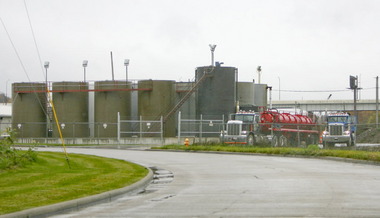
Hardrock Excavating is one of several oil and gas drilling-related companies Ben Lupo owns in the Youngstown area. It houses 58 20,000-gallon storage tanks.
Associated Press file photo

CLEVELAND, Ohio — An employee of a Youngstown company that stored, treated and disposed of oil and gas drilling liquids admitted this morning to dumping tens of thousands of gallons of fracking waste on at least 24 occasions into a tributary of the Mahoning River.

Michael Guesman appeared in U.S. District Court where he pleaded guilty to a charge of unpermitted discharge of pollutants under the Clean Water Act. He faces a sentence of about a year in federal prison, although his time could be reduced by the amount of assistance he provides to prosecutors, and his acceptance of responsibility for his crime.

Guesman 34, of Cortland, said he acted on the orders of his boss at Hardrock Excavating, owner Benedict Lupo, when ran a hose from the 20,000-gallon storage tanks to a nearby storm water drain and opened the release valve. A gusher of waste liquid left over from hydraulic fracturing operations — commonly known as “fracking” — poured into the drain, sending saltwater brine and a slurry of toxic oil-based drilling mud, containing benzene, toluene and other hazardous pollutants, flowing into the Mahoning, prosecutors said.

Assistant U.S. Attorney Brad Beeson said Guesman is cooperating with investigators, and if necessary will testify for the government at the trial of Lupo, which has not yet been scheduled.

Guesman has told investigators that, between Nov. 1 and Jan. 31, Lupo instructed him to dump the fracking waste into the storm sewer at least 24 times, always after dark and after all of the other employees had left the facility, Beeson said.

The black fracking waste left a smelly, oily sheen on the Mahoning, which was located less than a mile away from the Hardrock facility and its 58 storage tanks, investigators said.
U.S. District Judge Donald Nugent scheduled sentencing for Nov. 15.

Lupo, 62, of Poland, Ohio, has pleaded not guilty to charges of violating the federal Clean Water Act.

An anonymous tipster alerted authorities from the Ohio Department of Natural Resources that the improper dumping of fracking waste was occurring, and state agents observed the crime as it was being committed, according to court documents.

Guesman told the agents that Lupo ordered him to lie if questioned about the dumping, and to tell law enforcement officers he had emptied the waste tanks only six times, when in fact he had done it at least four times that number, documents state.

The fracking process involves injecting millions of gallons of chemical-laced water to crack open rock formations holding gas deposits deep under the Earth’s surface. Ohio allows for disposing of fracking waste in state-permitted injection wells.

Special thanks to Richard Charter

Greenpeace: Greenpeace activists invade Shell refinery

Christian Wenande
August 28, 2013 – 09:38
The action is a protest against Shell spearheading the search for oil in the vulnerable Arctic region
Around 40 Greenpeace activists, some dressed as polar bears, forced entrance to the Shell oil refinery in Fredericia this morning (Photo: Greenpeace)

Shell’s oil refinery in the Jutland city of Fredericia was invaded by about 40 Greenpeace activists dressed up like polar bears early this morning.

The activists forced entry to the Dutch oil giant’s refinery just after 6am and a group of them immediately began climbing up one of the refinery’s large silos , where they hung a banner featuring an image of the well-known yellow and red Shell logo juxtaposed with a polar bear’s face.

“We are here to reveal Shell’s true face. The company is leading the hunt for oil in the Arctic, despite having shown us that they are completely unable to protect the vulnerable environment and unique nature in Greenland and the rest of the region,” Helene Hansen, a 28-year-old activist, told Ekstra Bladet tabloid.

Part of a global campaign
The activist group in Fredericia includes Danes as well as individuals from Sweden, Norway, Finland, Italy, Germany and Latvia.

The police showed up at around 6:30am but as of two hours later no arrests had made.
The Fredericia action is the latest Greenpeace stunt aimed at taking on Shell’s hunt for arctic oil. In July, six activists climbed western Europe’s tallest building near Shell’s headquarters in London to display a ‘Save the Arctic’ banner, and last Sunday a 20-metre banner was unveiled during the Formula 1 Grand Prix in Belgium.

The Arctic: another Nigeria?
Shell is currently preparing a number of seismic examinations in protected sea areas in Baffin Bay, the body of water between Greenland and Canada. Whale experts have warned that the noisy seismic tests could threaten the population of whales in the area. In June, Denmark’s Arctic oil spill preparedness was found woefully inadequate by experts.

“Shell has already a displayed horrendous breach of security in Alaska, they’ve polluted the entire Niger Delta and now they’re getting ready for Russia and Greenland. The plans should be stopped so Greenland doesn’t become the next Nigeria,” Niels Fuglsang, a spokesperson for the Danish Arctic campaign in Greenpeace, told Ekstra Bladet.
Greenpeace is hoping that politicians in Greenland and Denmark step up and prohibit Shell’s tests before they commence over the next few months.

Special thanks to Richard Charter

Sierra Club: FAIL: How Keystone XL’s tar sands flunk the climate test

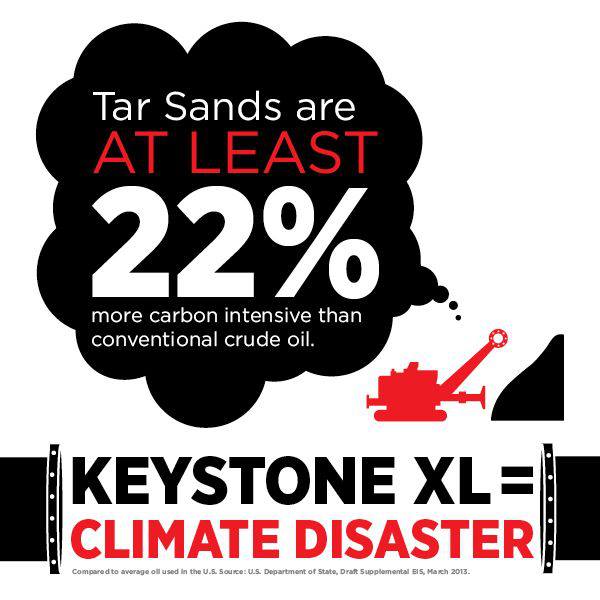
tar sands

The Sierra Club

Sierra Club and Oil Change International just released an extensive report, titled “FAIL: How Keystone XL’s tar sands flunk the climate test,” to directly answer President Obama’s pledge to reject KXL if it significantly exacerbates #climate pollution.

Read more about the report: http://sc.org/kxl-fail-climate-test
— with Thomas Edward Pearce.

August 29, 2013
Why Keystone Flunks the Climate Test

In June President Obama set a climate test for his decision on the Keystone XL tar sands pipeline. He said he will not approve the pipeline if it would significantly exacerbate the problem of carbon pollution. Today the Sierra Club, Oil Change International, and 13 partner groups have released a report that settles the issue unequivocally: Keystone XL would be a climate disaster.

Our report, “FAIL: How the Keystone XL Tar Sands Pipeline Flunks the Climate Test,” spells out the full consequences of building the pipeline.

Start with the one fact that the State Department, the U.S. EPA, climate scientists, and even Wall Street and industry analysts all agree on: The Keystone XL tar sands pipeline will create massive amounts of carbon pollution. Tar sands, after all, are the world’s dirtiest and most carbon-intensive source of oil. Oil Change International estimates that the pipeline would carry and emit more than 181-million metric tons of carbon pollution each year. That’s the pollution equivalent of adding 37.7 million cars to U.S. roads, or 51 new coal-fired power plants.

The State Department, though, tried to ignore this 181-million metric ton elephant. It argued in its environmental review of Keystone XL that tar sands development was inevitable, regardless of whether the pipeline is built. That’s not true for several reasons.

Tar sands can be processed only at specialized refineries. The accessible U.S. and Canadian refineries capable of handling it are already at or near capacity. In order to expand production, tar sands producers must reach the U.S. Gulf Coast, where the heavy crude can be refined or, more likely, exported.

Although other pipeline projects have been proposed to export tar sands east, west, and south from western Canada, all of them face legal, technical, economic, and political obstacles that make them unlikely. Using rail is too expensive because tar sands transport requires special heated rail cars and loading terminals. Industry experts and financial firms like Goldman Sachs have already said this will be cost-prohibitive.

Keystone XL is critical for the Canadian oil industry to meet its goal of massive expansion in the tar sands. You don’t need to take our word for it, though. Just this week, Canada’s independent Pembina Institute uncovered documents from the industry itself that make that case. Briefing notes prepared for Canadian natural resources minister (and pipeline proponent) Joe Oliver state: “in order for crude oil production to grow, the North American pipeline network must be expanded through initiatives, such as the Keystone XL Pipeline project.”

The U.S. Interior Department has already joined the Environmental Protection Agency in criticizing the State Department’s environmental review for disregarding how the Keystone XL pipeline would affect wildlife and waterways. Given that we now know the State Department’s review was conducted by a consultant with strong ties to Keystone XL’s backer, TransCanada, and to the tar sands industry, perhaps we shouldn’t be surprised.

In fact, earlier this month, the State Department’s own office of inspector general confirmed that it has opened an into inquiry how its Keystone XL review was conducted. Perhaps the most serious charge is that State Department officials tried to cover up evidence of conflicts of interest.

For an administration that’s actually done many good things on climate, the State Department’s environmental review of Keystone XL is both a failure and an embarrassment. It’s time to kick the oil industry lobbyists out of the room, listen to the scientists, weigh the facts, and reject this pipeline once and for all.

Add your voice to the growing chorus: By President Obama’s own standard, Keystone XL should not be approved.

"Be the change you want to see in the world." Mahatma Gandhi