E&E: Council unanimously OKs restoration plan

Annie Snider, E&E reporter
Published: Thursday, August 29, 2013

The federal-state panel tasked with overseeing the spending of potentially billions of dollars in fines related to the 2010 Deepwater Horizon oil spill yesterday unanimously approved its initial plan for restoring the Gulf ecosystem and economy.

The plan sets overarching restoration goals for the region, broadly lays out how the council will evaluate and fund projects and describes how it will consider states’ plans for spending their share of the money. Under the RESTORE Act, passed by Congress last year, 80 percent of Clean Water Act civil fines from the spill will be sent to the Gulf through the Gulf Coast Restoration Trust Fund. The council, made up of federal and state officials, oversees 60 percent of the dollars in the fund.

Commerce Secretary Penny Pritzker, who serves as chairwoman of the Restore Council, said the panel plans to begin selecting and funding projects within the next 12 months. Environmental groups, however, have pointed out that the plan approved yesterday does not lay out details on how those projects would be selected (Greenwire, Aug. 27). The panel has been considering options for improving public participation as the process moves forward, potentially by creating a structure like a citizens advisory council.

In her first public appearance with the council, Pritzker, who took the helm of Commerce in late June, was careful to note that “restoring the natural ecosystem and restoring the economy are interconnected goals,” in prepared remarks.

“If we continue to work in a collaborative spirit, I’m confident that we can implement the RESTORE Act in a way that reinvigorates economies, creates jobs and rebuilds our environment for generations to come,” she said. “In short, we can help ensure the long-term health, prosperity and resilience of the entire Gulf region.”

She also said overdue regulations from the Treasury Department that will spell out how money sent through the Restore Council can be spent are expected to be released in draft form “very soon.” The council has said it has not been able to move forward with a required list of projects approved for funding and a 10-year spending plan in part because of the lack of those regulations.

Louisiana Gov. Bobby Jindal (R) hosted the meeting, which took place in New Orleans. He noted that his state has committed to spending the entirety of the fine money that it receives on ecosystem restoration projects.

“We must see a swift flow of RESTORE Act funds without red tape so we can continue responding to the compounding damages caused by the BP oil spill here in Louisiana and across the entire Gulf Coast,” he said.

Jindal noted that the spill made marshes more vulnerable to erosion, turning around progress that Louisiana had been making in combating land loss.

Special thanks to Richard Charter

Grist: Drill next door: Here’s what it looks like when fracking moves in by Erik Hoffner

http://grist.org/article/the-fracking-rig-next-door-photos/

By Erik Hoffner

Grist guest contributor

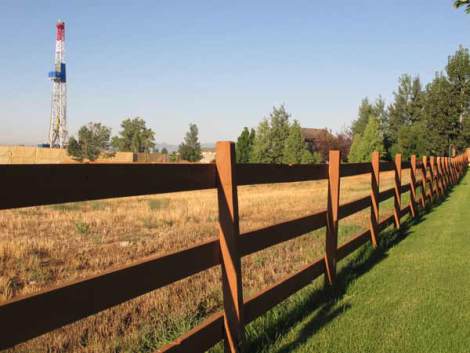
When my wife and I pulled into a relative’s subdivision in Frederick, Colo., after a wedding on a recent weekend, it was a surprise to suddenly find a 142-foot-tall drill rig in the backyard, parked in the narrow strip of land between there and the next subdivision to the east. It had appeared in the two days we’d been gone.

1
The 142 foot derrick looms over homes in Eagle Valley.Erik Hoffner

This couple hundred grassy acres, thick with meadowlarks and bisected by a creek crowded with cattail, bulrush, willow, and raccoon tracks, sits atop the DJ Basin shale deposit. Our folks hadn’t known that when they bought the property last year, nor did they recall any useful notice that this new industrial neighbor was moving in.

We witnessed the increasing phenomenon of rigs popping up in suburban neighborhoods like mushrooms overnight. The craze of the gas rush means that companies won’t hesitate to drill wherever shale deposits lie — even if they’re under a school or a subdivision. The message to homeowners in towns big and small alike seems to be: You are on notice. The ills of fracking that were once viewed as a rural concern — contamination of air and water, noise pollution, reduced safety on roads jammed with heavy trucks — are coming to your backyard, too.

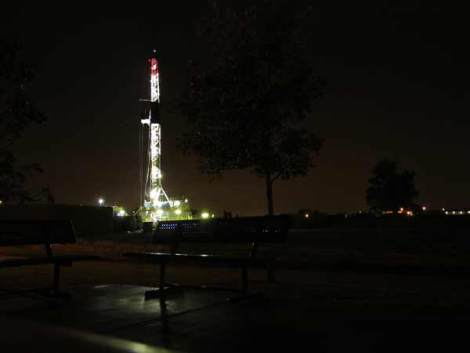
Their neighborhood was now lit 24/7 by floodlights and featured the incessant low grind of the drill’s nearly 900 HP Caterpillar engine, the clanking of roughnecks beating on pipe at 2 a.m., and regular snorts from the rig’s massive 525 HP diesel generator … loud enough that we kept the windows closed to hear the television at night.

2
View from the picnic pavilion: nights are flooded with light since the drilling began.

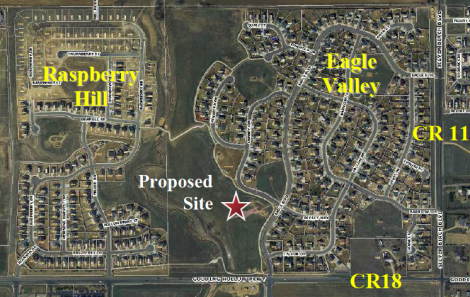
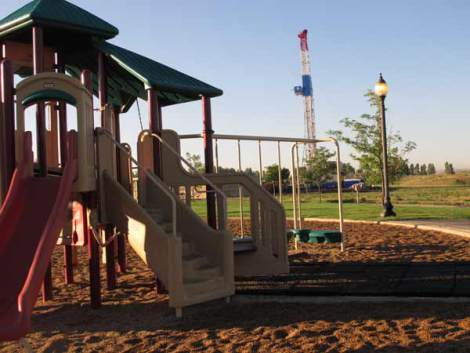
We stared at this potentially toxic tower surrounded on three sides by many homes of the Eagle Valley and Raspberry Hill developments, and on the other side across a county road, by Legacy Elementary School. It seemed that the rig was only about 300 feet from the nearest homes, and about the same to a playground. Definitely too close.

But as a member of Fracking Colorado (which fights such projects in the Denver suburb of Aurora) told me by email, “The setback for wells from homes in urban areas was 350 feet. The new setback rules have increased that distance to 500 feet, but that probably was not in effect when this permit was granted. The new rules are effective as of Aug. 1, 2013. Also, when they re-enter an existing abandoned well, that was there before the homes were built, they can be closer than 350 feet to homes.”
Approximate current location of the rig.
3
An aerial map did seem to reveal the presence of a previous wellhead, but the difference between 300, 350, or even 500 feet seemed trivial, given the industry’s uninspiring track record on air and water pollution, plus the occasional explosion.

But then there are energy companies that think they don’t need any meaningful setback at all: Take a current frack-job just to the north. The derrick looms so near roads and powerlines that it’s potentially in direct contact with people in case of an accident, in direct violation of setback rules. Unfortunately for the managers of that project, U.S. Rep. Jared Polis owns a home across the street. His threat of a legal injunction prompted an apology from the company and a $26,000 fine from the state last week, although the drilling continues.

Back in Frederick, concerns of abutters went unheeded. After news of the project eventually became known (rules about notice vary, with some towns only requiring signs be posted on fields in the project area), numerous residents spoke up about safety, congestion, air quality, proximity to the school, and noise.

Interestingly, it’s town-owned land that’s being debated, so I suppose they will be collecting the check, as outlined in the town’s board of trustees meeting minutes on June 11: “Upon approval of the (Surface Use Agreement) and drilling permit application, the Town would be paid … a total of $20,000. In addition, the Town would receive a nominal amount of residual compensation for its share of the minerals …”

Hardly sounds like enough remuneration (a new pickup truck for the highway department?) given the steadily souring opinion of residents, one of which stated in a letter to the trustees on June 11: “Many homeowners have said they didn’t think it would do any good to come to meetings and give their input because it didn’t do any good in past years. Please fight for us, the citizens you represent, and don’t allow (them) to drill in Eagle Valley.”

But the drilling has begun, and a shrieking frack rig is now a regular feature of the hammock time, dog walks, and backyard barbecues of hundreds of people.

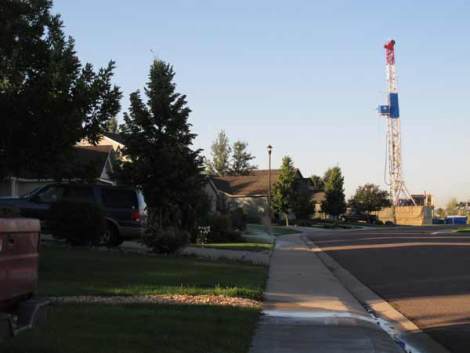
Here’s what that looks like:

4
Playground view, about 300 or so feet from the rig.Erik HoffnerPlayground view.

5
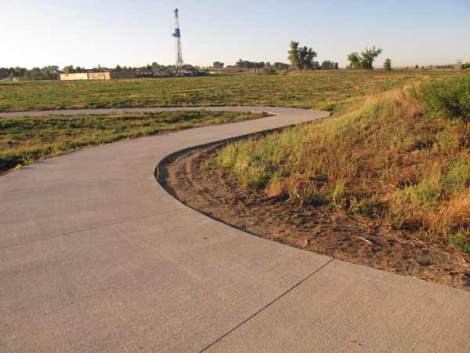
View from the bike path.Erik HoffnerView from the bike path.

6
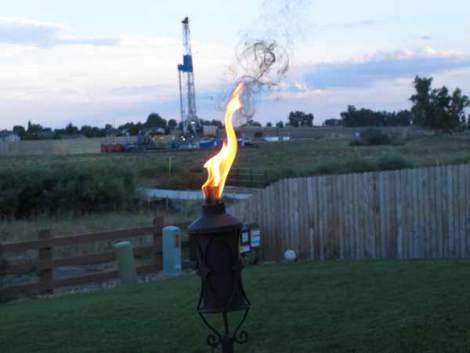
Ironic flame of a tiki torch at a backyard BBQ foreshadowing events to come.Erik HoffnerIronic flame of a tiki torch at a backyard BBQ foreshadowing possible events to come.

7
Sunset, trampoline, fracking rig.Erik HoffnerSunset, trampoline, rig.

8
Many homeowners wish fences made better neighbors.Erik HoffnerMany homeowners wish fences made better neighbors.

Update: We’ve dropped references to “fracking rigs” as the fracking comes after the drilling.

Special thanks to Erik Hoffner, Outreach Coordinator at Orion Magazine

Houston Business Journal: Black Elk plans to resume drilling at Gulf of Mexico explosion site soon

http://www.bizjournals.com/houston/blog/drilling-down/2013/08/black-elk-plans-to-resume-gulf-of.html

Aug 28, 2013, 11:46am CDT

Deon Daugherty, Reporter-

Black Elk Energy Offshore Operations LLC hopes to bring its West Delta 32 oil platform back into production as early as next week, company executives said Wednesday during a conference call with investors.

The platform was the site of an explosion in November that resulted in the death of three contract workers in the Gulf of Mexico, 17 miles off the coast of Louisiana.

Art Garza, chief technical officer at Houston-based Black Elk, said he expects a final walk-through with federal regulators this week and that the Bureau of Safety Environmental Enforcement officials will permit the platform to return to service. Garza said that by next week, production could be up to 300 barrels of oil per day. In the following weeks, the company anticipates getting production closer to the 650 barrel per day mark.

Last week, a report commissioned by Black Elk said it was actions taken by poorly trained subcontract workers hired by a contractor, in violation of a construction contract, that led to the deadly explosion.

The platform’s return to work comes at a crucial time for the company. Black Elk reported first quarter revenue was down $22 million compared to the first quarter of 2012, and revenue for the first six months of 2013 was down $55 million compared to the same period a year earlier.

Bruce Koch, Black Elk’s CFO, said production was down from last year’s 15,000 barrels of oil equivalent per day to about 10,000 barrels in the second quarter 2013. The company is moving toward producing closer to 13,000 per day or more by the end of the third quarter.

Garza said bringing West Delta back online will help to mitigate the declines. The company also expects to benefit from a $50 million capital program signed in March with Platinum Partners Value Arbitrage Fund LP, as well as its $50 million sale of four noncore Gulf of Mexico properties to Renaissance Offshore LLC in Houston.

What’s more, the company is reducing its general and administrative staff by 25 jobs in August – a savings of about $4.5 million, Koch said. That leaves about 120 people left at the company.

Deon Daugherty covers energy and law for the Houston Business Journal..

Special thanks to Richard Charter

West Virginia Public Broadcasting: WV, ND face similar environmental concerns with drilling industries

http://www.wvpubcast.org/newsarticle.aspx?id=31440

Drilling
Ashton Marra
An advertisement advocating for flaring in the Bismarck, ND, Airport. State officials say they’re beginning to look at regulations to curb the practice in the Bakken shale region.

By Ashton Marra

August 28, 2013 · West Virginia and North Dakota have one thing in common – an economy that relies on extractive industry that each state taxes. Last week legislators from West Virginia met in North Dakota learn more about that state’s Legacy Fun, but as the meeting progressed, the focus changed from talk about the savings account to the industry.

The environmental concerns of the two states with very different topographies are similar when it comes to the oil and natural gas industries.

Shale is one common element when it comes to oil and gas extraction in the two states. West Virginia’s natural gas production is based on the hydraulic fracturing of Marcellus shale. In North Dakota, oil comes from the Bakken shale formation, and the portion of the Bakken situated in the state is about the same size as West Virginia.

As with any extraction industry, environmental concerns are always a high priority for the governments regulating them. North Dakota’s industry is regulated by the state Department of Mineral Resources.

“Right now, the environmental concern is flaring,” said Lynn Helms, the director of the department.

Flaring is the process through which natural gas and other byproducts are burned as waste at the well site before the crude oil reaches the surface.

David Manthos is with the Shepherdstown-based group SkyTruth which studies the effects of activities like mining, drilling and logging using satellite digital mapping technology. Manthos said Skytruth has seen the impact oil drilling has had in the Bakken region.

“Thirty percent of the natural gas produced in the Bakken is being flared and the annual emissions are equivalent to the annual emissions of one million automobiles,” he said Tuesday. “So, even if it’s working optimally, it’s producing enough carbon dioxide to offset some of the benefits we would hope to obtain by extracting natural gas.”

Manthos said the practice does not happen as often at wells in the Marcellus region because natural gas is the sought after resource, but one industry representative said it still occurs.

“We do some flaring, but we do it to burn off impurities,” said Corky DeMarco, Executive Director of the West Virginia Oil and Natural Gas Association. “They’re doing it because natural gas is a nuisance to them.”

DeMarco said those impurities are methane, butane, or associated gases that flow up from the ground with the frack water before the natural gas starts to surface, and if they’re not disposed of properly they can pose an explosive safety risk for works at well sites.

North Dakota’s Helms said DeMarco is right, natural gas can be seen as a nuisance for drillers who are after oil. Some forms of natural gas produced in the Bakken are more expensive to capture than they’re worth on the market so they burn them off, but the state is now starting to reassess the regulations surrounding the practice.

“I met with my Commissioners (of oil and gas) and told them that we’re at a stage in the Bakken and Three Forks where they need to reevaluate flaring policy and make some changes to reduce the amount of natural gas that’s being flared,” Helms said.

Both states deal with water issues as well. In fracking, chemical laced water is injected into the shale to release the gas or oil.

“The water issue is the most universal one across the board with hydraulic fracturing whether it’s here or at other locations,” Manthos said. “It’s the surface and groundwater contamination that could occur.”

In West Virginia, drilling companies run into the topographical challenge of finding flat land. They either have to build well sites in valleys close to streams or high on ridge tops. In both cases, the possibility of run off contamination has to be considered.

Run off is less of a concern on the flat plains of North Dakota, but both states share the issue of transportation, getting the water to and from the well sites.

Bakken shale is 20 percent salt, so tap water is used to dissolve it to get to the oil, but, much like West Virginia, the water is brought back up to the surface and trucked from the site.

Helms said it takes 2,000 truckloads of water to get just one well site on production in western North Dakota, prompting the state to look at other options.

“We’re trying to work with industry and get pipeline systems in place for moving the water to and from the wells. If we can do that number of truckloads goes from 2,000 down to 850,” he said. “So, we eliminate way over half of the truck trips and that will have an enormously positive impact on, not the truck industry, but obviously on dust, traffic and road infrastructure. Environmentally, it’s just absolutely the right thing to do.”

North Dakota plans to use public private partnerships to build many of the pipelines, but Manthos isn’t sure that is the solution for West Virginia.

“They’re at least a bigger engineering challenge to build pipelines. I do know there are locations where pipelines are being used and if that does reduce the amount of truck traffic than that by itself is progress,” he said, “but the fragmentation of constructing well pads, especially up and down some steep hillsides. So, there’s just as much of a concern that a hillside could slip in the process of building a pipeline.”

Still, Helms said all of the issues, environmental, economic and social, have to be balanced in order for the industry to be a success in any state.

“If you overemphasize environmental or social you can make it uneconomic. If you overemphasize the economics, you can make it something that is environmentally bad or socially bad for the people and all three of those have to be looked after.”

Special thanks to Richard Charter
Scientific American: Groundwater Contamination May End the Gas-Fracking Boom

http://www.scientificamerican.com/article.cfm?id=groundwater-contamination-may-end-the-gas-fracking-boom

Well water in Pennsylvania homes within a mile of fracking sites is found to be high in methane
By Mark Fischetti

September 12, 2013 issue

In Pennsylvania, the closer you live to a well used to hydraulically fracture underground shale for natural gas, the more likely it is that your drinking water is contaminated with methane. This conclusion, in a study published in the Proceedings of the National Academy of Sciences USA in July, is a first step in determining whether fracking in the Marcellus Shale underlying much of Pennsylvania is responsible for tainted drinking water in that region.

Robert Jackson, a chemical engineer at Duke University, found methane in 115 of 141 shallow, residential drinking-water wells. The methane concentration in homes less than one mile from a fracking well was six times higher than the concentration in homes farther away. Isotopes and traces of ethane in the methane indicated that the gas was not created by microorganisms living in groundwater but by heat and pressure thousands of feet down in the Marcellus Shale, which is where companies fracture rock to release gas that rises up a well shaft.

Most groundwater supplies are only a few hundred feet deep, but if the protective metal casing and concrete around a fracking well are leaky, methane can escape into them. The study does not prove that fracking has contaminated specific drinking-water wells, however. “I have no agenda to stop fracking,” Jackson says. He notes that drilling companies often construct wells properly. But by denying even the possibility that some wells may leak, the drilling companies have undermined their own credibility.

The next step in proving whether or not fracking has contaminated specific drinking-water wells would be to figure out whether methane in those wells came from the Marcellus Shale or other deposits. Energy companies claim that the gas can rise naturally from deep formations through rock fissures and that determining a source is therefore problematic. Yet some scientists maintain that chemical analysis of the gas can reveal whether it slowly bubbled up through thousands of feet of rock or zipped up a leaky well. Jackson is now analyzing methane samples in that way.

Another way to link a leaky fracking well to a tainted water well is to show that the earth between them provides pathways for the gas to flow. Leaky wells have to be identified first, however. Anthony Ingraffea, a fracking expert at Cornell University, is combing through the inspection reports for most of the 41,311 gas wells drilled in Pennsylvania since January 2000. Thus far, he says, it appears that “a higher percentage” of Marcellus Shale fracking wells are leaking than conventional oil and gas wells drilled into other formations. Stay tuned.

This article was originally published with the title Fracking and Tainted Drinking Water.

Special thanks to Richard Charter
"Be the change you want to see in the world." Mahatma Gandhi